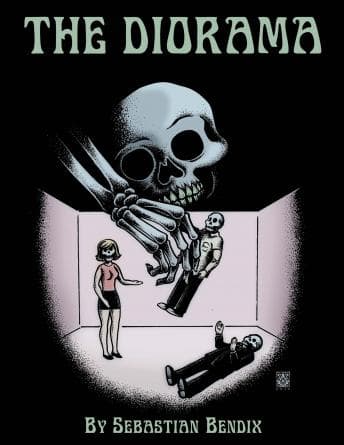

I was shelving returns in the back of the library — the part of the building where the fluorescent light flickers just enough to feel wrong — when I finished this one. Earbuds in, cart full of donated paperbacks nobody wants, and Sebastian Bendix's voice in my ear telling me about a pet store clerk whose miniature world starts biting back. The timing was almost too perfect. Small, overlooked spaces. Things on shelves that shouldn't move. Yeah.
So here's the thing about Diorama: it's 77 minutes. That's barely a long lunch break. And I want to talk about what Bendix does with that constraint, because it matters.
A Pet Store, a Playset, and the Quiet Rage of Invisible Men
Martin Taper is the kind of protagonist horror doesn't spend enough time with — the guy whose life is so crushingly small that his fantasy world isn't escapism, it's survival. He works at a pet store. His manager bullies him. He's got a crush on a coworker who doesn't notice him. And every night he goes home to this elaborate diorama full of heroes and villains and monsters, and he plays out the life he can't have. That setup alone is doing something interesting, because Bendix is writing about powerlessness before he ever introduces anything supernatural. The diorama isn't creepy at first. It's sad. And that sadness is what makes everything that follows actually land.
When a strange boy enters Martin's orbit and things start shifting — the diorama developing its own agenda, Martin's real life suddenly bending toward his fantasies — the story earns its horror because you already understand what Martin has been feeding into that little world. Frustration. Resentment. Longing. The diorama didn't just wake up on its own. Martin gave it fuel.
This understands that horror isn't about gore — it's about dread. The dread here is specifically about what happens when a person who's been invisible suddenly gets exactly what they want, and realizes the wanting was the only thing keeping them human.
The Author-Narrator Gamble
Bendix wrote this, and Bendix reads it. That's always a coin flip. Writers know their words better than anyone, but knowing your words and performing them are two very different skills. With Diorama, the gamble mostly pays off. Bendix has a musician's ear for rhythm — you can feel it in how he paces Martin's internal monologue, letting certain lines hang just a beat longer than expected. There's a flatness to his delivery of Martin's daily life that I think is intentional — it mirrors the monotony Martin's drowning in — and then when the diorama sequences kick in, there's a shift. Not dramatic. Not theatrical. But present.
Where it gets tricky is the supporting characters. Martin's bully manager and the coworker he's fixated on don't get wildly different vocal signatures, which at 77 minutes isn't a dealbreaker, but it does mean you're sometimes relying on context clues to track who's speaking. The strange boy fares better — there's something slightly off-register in how Bendix voices him, a deliberate wrongness that works.
The narrator commits. That's rare. Not every moment lands perfectly, but the commitment is there, and for a story this intimate, that matters more than polish.
77 Minutes and the Art of Not Overstaying
I keep coming back to the runtime because it's actually one of the best things about this audiobook. Diorama is a novella, maybe even a long short story, and it doesn't pretend to be anything else. There's no padding. No subplot about Martin's tragic backstory that runs for three chapters. No love triangle. It's lean, and Bendix — as both writer and narrator — trusts that the central image is strong enough to carry the story without decoration.
And it is. A lonely man. A miniature world. The line between controlling your fantasies and being controlled by them. That's enough.
My one hesitation is that the ending feels slightly rushed even by novella standards. The escalation in the final fifteen minutes moves fast, and I would've liked another scene or two to sit in the aftermath. But honestly? For horror, leaving the listener slightly unsteady is better than over-explaining. Shirley Jackson understood that. Bendix seems to understand it too.
Who Needs This (and Who Should Walk Past the Shelf)
If you're into psychological horror that works on a small scale — think early Clive Barker short fiction, or maybe Thomas Ligotti's obsession with inanimate objects developing terrible purpose — this is your speed. If you need a body count or a monster with teeth, this isn't that. The monster here is loneliness, and the teeth are metaphorical. Mostly. (Though if you want teeth that are decidedly not metaphorical, I reviewed Killing Game a while back — a very different beast, but it scratched a completely different kind of dread.).
I listened in the dark. Mistake? Maybe. Worth it? Absolutely. Not because Diorama made me jump — it didn't — but because it made me look at the shelf of knickknacks across my living room and feel genuinely uneasy. Shirley (my cat) was unimpressed. I was unsettled in a way that lasted past the runtime, which is more than most full-length novels manage.
For 77 minutes and likely a couple bucks, this is worth the experiment. It's a debut-feeling work from a writer who clearly loves the genre and isn't just strip-mining it for tropes. My podcast listeners are going to love this — it's exactly the kind of small, weird, ambitious horror that deserves more attention than it gets.
File Under: Miniatures That Bite Back
Finally, horror that respects the genre. Not perfect. Not polished to a gleam. But genuinely unsettling in a way that suggests Bendix knows exactly what kind of stories he wants to tell. I'll be watching what he does next.