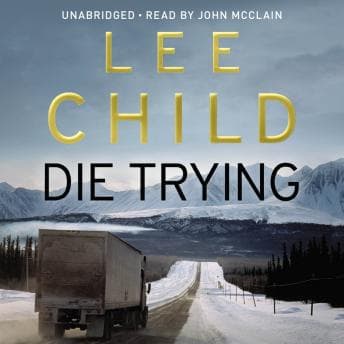

Lee Child doesn't write horror. I know this. And yet there's something about the way Die Trying handles captivity — the chains, the dark van, the slow realization that nobody knows where you are — that scratches the same itch as a good kidnapping thriller in the horror-adjacent space. This understands that dread isn't about monsters. Sometimes it's about being chained to a stranger in a moving vehicle with zero leverage and a lot of questions.
I was shelving returns at the library on a quiet Tuesday afternoon, earbuds in, when the kidnapping scene kicked off. Broad daylight. Fluorescent lights humming overhead. Patrons browsing cookbooks ten feet away from me. And my heart rate still spiked. That's the mark of effective tension — it doesn't need your cooperation. It just takes it.
Reacher as a Contained Threat
Here's what makes this work as a second installment: Child figured out that Reacher is scarier when he's restrained. Book one lets him roam. Die Trying puts him in chains and lets the reader — or listener — sit with the knowledge that when those chains come off, it's going to be catastrophic. The militia compound setting in the back half gives the whole thing a domestic terrorism edge that feels uncomfortably prescient. That same flavor of institutional dread running underneath a thriller's surface showed up in Devil Colony, though Rollins leans harder into the conspiracy scaffolding where Child keeps things brutally personal. Reacher paired with Holly Johnson, the FBI agent on crutches who refuses to be a damsel, creates a dynamic where neither character is waiting to be rescued. They're both calculating. Both dangerous. Holly's the kind of female character who'd hold her own in a Shirley Jackson novel — not because she's supernatural, but because she's thinking three moves ahead while everyone underestimates her.
Child's prose is famously spare, almost skeletal. Short declarative sentences. Minimal interiority. It works beautifully in audio because there's nothing to trip over — the narration can just move. At 14 hours and 20 minutes, this is a commitment, but the pacing earns it. The first few chapters are a slow burn setup — Chicago street, crutches, gun, van — and then it's a cross-country pressure cooker.
McClain's Gravel vs. His Falsetto
Johnathan McClain narrates this like a man who's read the assignment and mostly aced it. His Reacher voice has this low, gruff authority that fits the character's physicality — you buy that this voice belongs to someone who could snap a man's neck without raising his pulse. The action sequences land hard. McClain doesn't rush them. He lets the violence have weight, which is exactly what Child's writing demands.
But — and this is where I have to be honest — his female character voices are a problem. Holly Johnson deserves better than what she gets here. There's this thing some male narrators do where they pitch up for women and add a breathiness that reads less "distinct female character" and more "man doing an impression of what he thinks women sound like." McClain falls into that trap. It's not constant, and it's less jarring than some narrators I've endured, but in a book where Holly is arguably the most competent person in the room at any given moment, having her voice come across as slightly cartoonish undercuts her authority. It's a frustrating miss in an otherwise strong performance.
The "he said / she said" repetition is a Child writing tic, not a McClain problem, but it does become noticeable in audio in a way it might not on the page. By hour eight I'd stopped hearing it. By hour twelve I was hearing it again.
I'll give McClain this: he's a marked improvement over what I've heard from the first book's narration. The cadence is more confident, the pacing more controlled. He commits. That's rare. He just needs to trust that female characters can sound like real people instead of voice exercises.
Who Gets Kidnapped by This Book (Willingly)
If you're already in the Reacher pipeline, this is where the series starts flexing. If you scare easily — wrong genre, wrong reviewer, but the militia compound sequences have genuine menace that might catch thriller readers off guard. If you're an audiobook purist who can't tolerate imperfect character voices, McClain's female work might pull you out. If you can ride past that? The action delivery alone is worth it.
My podcast listeners who cross over into thriller territory are going to appreciate the contained-threat structure here. It's essentially a horror setup — isolated location, armed extremists, limited resources — played out as an action thriller. I respect that.
Shirley (my cat) slept through the entire final act. I did not.
Lock the Van Door Behind You
This is solid mid-series thriller audio with a narrator who's growing into the role. McClain's Reacher voice carries the book. His Holly voice doesn't sink it, but it does bruise it. At 14-plus hours, it's a genuine time investment, and the early chapters require patience — but once that van door slams shut, you're locked in. Worth the credit if you're building a Reacher library. Just maybe don't start here if you've never met the guy.