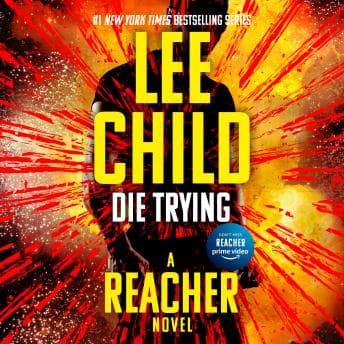

Okay, so here's the thing about Jack Reacher books: they're basically behavioral psychology case studies wrapped in testosterone and gunpowder. And I mean that as a compliment.
I finished Die Trying during a particularly brutal week of grading papers, and honestly? Reacher solving problems by being bigger and smarter than everyone else was exactly the escapism I needed. There's something deeply satisfying about a protagonist who exhibits classic hypercompetent loner syndrome but actually earns it. Most thriller writers give us heroes who are supposedly brilliant but make rookie mistakes every chapter. Lee Child? He did his homework. Reacher thinks like someone who's actually spent years in military intelligence. Child digs even deeper into Reacher's military psychology in Affair: A Jack Reacher Novel, which I rated even higher for exactly that reason. The way he calculates odds, reads people, plans three steps ahead—psychologically, this tracks.
The setup is deliciously simple. Woman gets kidnapped. Reacher happens to be standing next to her. Now he's kidnapped too. Chained together in a van heading who-knows-where. What makes Reacher compelling is that he doesn't panic. Doesn't posture. He just... observes. Catalogues. Waits. It's a fascinating case study in controlled aggression versus reactive violence. My therapist would have thoughts about this character, but she'd probably also admit he's weirdly well-adjusted for a guy who solves most problems with his fists.
McClain's Voice: Gravel Wrapped in Leather
Now, Johnathan McClain's narration. Look, I found myself asking: why does this work so well when it probably shouldn't? His voice is gruff in exactly the right way—like gravel wrapped in leather, if that makes sense. (It probably doesn't. I'm on my second glass of wine.) He nails the action scenes. Absolutely nails them. When things go sideways—and they go sideways a lot—McClain's pacing ramps up without becoming breathless. You feel the tension in your chest.
But here's where I have to be honest. Some of the character voices? A bit much. The militia guys in particular—he's going for menacing and sometimes lands on... cartoonish? I didn't hate it, but I noticed it. And once you notice, you keep noticing. The research actually shows that listeners are way more forgiving of voice acting inconsistencies when they're already invested in the story, which—lucky for McClain—I was. By chapter ten, I'd stopped caring about the occasional accent wobble.
Holly Johnson: A Strong Woman Who's Actually Human
The woman Reacher gets kidnapped with—Holly Johnson—is interesting. She's FBI, she's tough, she's got secrets. Child writes her as competent without making her a cardboard Strong Female Character™. She's scared sometimes. She makes judgment calls that don't always pan out. She's human. I appreciated that. Too many thriller writers think "strong woman" means "woman who never shows vulnerability." That's not strength. That's bad psychology.
The villains, though. Ugh. This is where I got a little frustrated. The militia group holding them is painted with pretty broad strokes. I get it—they're meant to be terrifying in their conviction, their willingness to die for a cause. And that part works. But I wanted more interiority. Why does someone join a group like this? What's the psychological pathway from regular citizen to extremist? Child gestures at it but doesn't really dig in. (Yes, I know this is an action thriller and not a character study. But I'm a behavioral psychologist. I can't help myself.)
The Pacing Question
The middle section drags a tiny bit. There's a lot of waiting around in the militia compound, a lot of Reacher observing and planning. I didn't mind because I find that stuff interesting, but if you're looking for wall-to-wall action, you might zone out around hour eight. The payoff is worth it, though. The last few hours? Chef's kiss. McClain absolutely brings it home. Midnight Line has that same payoff quality, though the pacing throughout is tighter.
I listened mostly during my morning jogs through Cambridge, which meant I occasionally had to stop running because I was too invested in what was happening. (My Fitbit was confused. I was confused. We all had feelings.)
Who's This For (And Who Should Skip)
Fans of action thrillers who want a protagonist who actually thinks. People who like competence porn—and I mean that technically, not... you know. Commuters who need something that'll make the drive disappear. Skip it if you need deep psychological exploration of your villains, or if theatrical voice acting pulls you out of a story. But honestly? McClain's strengths outweigh the occasional over-the-top moment.
The production quality is clean. No weird audio glitches, no background noise. Just fourteen hours of Reacher being Reacher.
Back to the Grading Pile
Lee Child understands human nature—specifically, he understands that most people are predictable and a few people are dangerous precisely because they're not. Reacher lives in that second category. It's what makes him compelling. It's what makes these books work.
Now if you'll excuse me, I have papers to grade. They won't grade themselves. (They really, really won't.)