
"I was not the Homecoming King type. I was more like the kid who sat in the back of the gym hoping nobody would throw dodgeballs at his head."
That's not a direct quote, but it might as well be. Greg Heffley's energy is so specific, so painfully middle school, that I found myself laughing out loud during a faculty meeting - which, for the record, I was absolutely paying attention to. (I wasn't. Principal Martinez was discussing hallway traffic flow patterns. Greg Heffley was discussing the Cheese Touch. Greg won.)
The Kid Who Thinks He's the Hero but Is Actually the Cautionary Tale
Here's what Jeff Kinney does that I wish more writers understood: he creates a protagonist who is genuinely, consistently wrong about himself. Greg Heffley is not a lovable underdog. He's a scheming, self-absorbed middle schooler who treats his best friend Rowley like a stepping stone and genuinely believes he's destined for fame and fortune. And it's hilarious. Not because the book winks at you and says "isn't he terrible?" but because Kinney trusts the diary format enough to let Greg condemn himself with his own words.
This is unreliable narration for kids, and I mean that as the highest compliment. I teach juniors who struggle with the concept when we hit The Great Gatsby, but hand them this book at twelve and they'd get it instinctively. Greg tells you he's the victim. The story shows you he's the problem. That gap between self-perception and reality is where all the comedy lives. That same tension between what a character believes about themselves and what the reader can plainly see is something I kept thinking about in Cutting Season: A Novel - though the stakes there are considerably darker than the Cheese Touch.
At two hours and twenty minutes, it's barely a commitment - I finished it across two grading sessions - but Kinney packs a surprising amount of social observation into that runtime. The hierarchy of the cafeteria. The politics of who gets to sit where. The way Greg manipulates the school safety patrol situation to sabotage Rowley when Rowley starts getting more popular than him. It's petty and recognizable and - if you've spent twenty years watching teenagers navigate exactly these dynamics - uncomfortably accurate.
Dan Russell and the Art of Playing It Straight
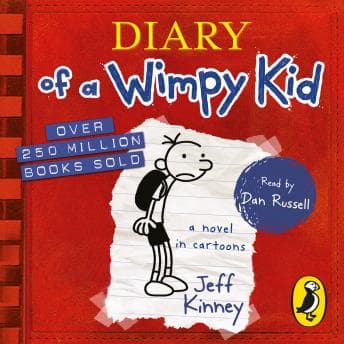
Dan Russell makes a smart choice here: he doesn't oversell it. His Greg isn't a cartoon voice or a broad comedy performance. It's more like a kid actually reading his diary aloud, with subtle tone shifts when Greg is rationalizing his worst behavior versus when he's genuinely confused by the social world around him. The comedic timing works precisely because Russell trusts the material. He doesn't punch the jokes. He lets Greg's obliviousness do the heavy lifting.
Now, I'll be honest - the research didn't turn up much about distinct character voices, and listening confirms that. Russell doesn't do wildly different voices for Rowley or Greg's parents or Fregley. It's more of a slight tonal adjustment. For a diary-format book where everything is filtered through one kid's perspective, that actually works. You're inside Greg's head, and everyone else sounds the way Greg perceives them. But if you're coming from a full-cast production expecting vocal fireworks, recalibrate.
The big limitation of this audiobook - and it's inherent to the format, not Russell's fault - is that you lose Kinney's illustrations. The book is half cartoon drawings. That visual humor is simply gone in audio, and while Russell carries the text well enough, there are moments where you can feel something missing. A joke lands a little flat, and you suspect the drawing was doing thirty percent of the work.
Why I'm Recommending This to Parents, Not Just Kids
Let's talk about what Kinney is really saying. This book gets shelved as light comedy for reluctant readers, and sure, it serves that purpose beautifully. But there's a genuinely sharp satire of how kids learn social manipulation happening underneath the laughs. Greg's treatment of Rowley - using him, discarding him, panicking when Rowley finds other friends - is a case study in toxic friendship that middle schoolers live through every day. The book doesn't moralize about it. It just shows it. And that restraint is what makes it effective.
My students would probably roast me for analyzing a Wimpy Kid book like it's literature. But twenty years of teaching has taught me that the books kids actually read are worth taking seriously, even - especially - when they're funny.
The Annotation in the Margin
If you've got a kid who "doesn't like reading," this audiobook is a solid gateway. At 2 hours 20 minutes, it's low-commitment and high-reward. If you're an adult looking for a deep listen, this isn't your stop. But if you want to understand what your students or your own children find funny - and why Greg Heffley's brand of self-delusion is basically a middle school survival manual read backwards - it's worth the short listen. I'd grab it through a streaming service or library rather than spending a credit on it, though. The runtime is just too slim for full price, and the missing illustrations mean you're getting maybe seventy percent of the intended experience.
Denise caught me chuckling at it on our lakefront walk and asked what I was listening to. When I told her, she gave me the same look my students give me when I compare things to Fitzgerald. Fair enough.