
A Case Study I Wasn't Prepared For
I started this one on a Saturday morning jog through Cambridge, thinking a two-hour listen would be perfect for my route plus cooldown. Mistake. By mile three, I'd stopped running entirely and was just standing on the bridge near MIT, earbuds in, staring at the Charles River while a man who died in 1913 explained exactly why he was going to end his life.
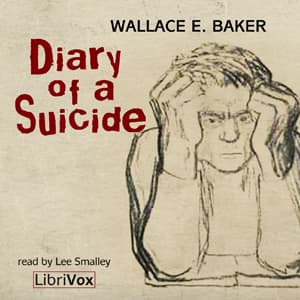
Look, I study this stuff. I've read suicide notes for research papers. I've analyzed fictional characters wrestling with ideation. But Diary of a Suicide is something else entirely. It's not fiction, it's not clinical, it's not filtered through a hundred years of editorial distance. It's Wallace E. Baker, a real person, writing in real-time as he moves toward a decision he's already made. And Lee Smalley reads it like he understands that weight.
The Voice That Carries the Weight
Here's the thing about narrating a diary—especially this diary. You can't perform it. You can't add drama where there isn't any, because the drama is in the flatness. In the matter-of-fact way Baker describes his reasoning. Smalley gets this. His delivery is clear, almost conversational, like someone reading aloud from a journal they found in an attic. No theatrical pauses. No vocal manipulation to signal "this is the sad part." He trusts the text.
And the text is devastating precisely because it's so... pragmatic? Baker writes about his decision the way I'd write about planning a trip. There's logistics. There's consideration of how it will affect others. There's a weird kind of courtesy in his letters to the people who will find out. Smalley's straightforward read lets all of that land without pushing you toward any particular emotional response. You just sit with it.
I found myself asking: why does this feel so different from clinical case studies? And I think it's because Baker isn't explaining himself to doctors or posterity. He's just... writing. For himself. The narrator honors that privacy even as we're eavesdropping on it.
What Makes This Psychologically Fascinating (And Difficult)
The protagonist—and yes, I'm using that word deliberately—exhibits classic patterns of what we'd now recognize as depression and possibly some obsessive thought loops. But here's what's interesting from a historical psychology perspective: Baker's framework for understanding his own mind is completely different from ours. He doesn't have our vocabulary. He doesn't have CBT or SSRIs or even a cultural script that says "this is treatable." He's working with the tools of 1913, which is to say, almost none.
It's a stark contrast to something like Untethered Soul, which gives readers a whole toolkit for observing their own mental patterns—Baker had no such distance available to him.
Some listeners have noted that his fixation on certain topics (sex comes up repeatedly) gets repetitive. I'd push back on that framing. What they're noticing is rumination—the mind returning again and again to the same grooves. That's not a flaw in the writing. That's the condition itself, documented in real-time. My therapist would have thoughts about this character, except he's not a character, and that's the whole point.
The research actually shows that people in crisis often circle the same themes obsessively. Baker's diary is almost a textbook example, except it predates the textbook by decades. For anyone studying suicidal ideation—students, clinicians, pastoral care workers—this is primary source material. Uncomfortable, yes. But valuable.
Fair Warning
I need to be direct here. This is not a book that offers hope in any conventional sense. Baker does not have a last-minute revelation. There is no intervention. You know from the forward how this ends, and then you spend two hours listening to someone walk toward that ending. If you're in a vulnerable place yourself, this could be genuinely harmful. Please take that seriously.
That said, I've seen listener responses that describe this as oddly comforting—not because it romanticizes anything, but because it articulates something they've felt and couldn't name. One quote that stuck with me: "It felt like someone else had successfully articulated my struggles with absolute accuracy." There's a strange comfort in being seen, even by someone who died a century ago. I don't know what to do with that, ethically. But I'm noting it.
The Verdict
This is a fascinating case study in how we documented mental illness before we had the language for it. It's also a difficult, sometimes disturbing listen that I wouldn't recommend casually. Lee Smalley's narration is exactly what it needs to be—clear, present, unobtrusive. The production is clean. At just over two hours, it doesn't overstay.
Who Should Listen (And Who Should Skip)
This one's for a narrow audience: researchers, students in psychology or medical humanities, people who want to understand the internal logic of suicidal thinking without the filter of fiction or clinical remove. If that's you, this is essential. If you're looking for something to get through your commute, or if you're in a vulnerable headspace right now? Keep scrolling.
I finished it sitting on a bench near Harvard Square, and I didn't start another audiobook for three days. Some things need space.