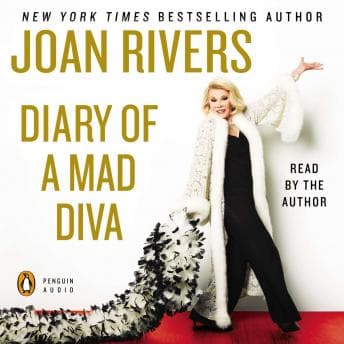

Look, I need to start with a confession that might get my English teacher card revoked: I spent an entire faculty professional development day listening to Joan Rivers talk about Kirstie Alley's weight instead of learning about differentiated instruction. And I don't regret a single minute of it.
I was supposed to be taking notes on new assessment rubrics. Instead, I had one earbud in, phone face-down on the table, trying not to visibly laugh while Joan Rivers ripped through celebrity culture like a chainsaw through a birthday cake. Principal Martinez, if you're reading this - I was definitely engaged with the workshop content. (I wasn't. I was learning what Joan thought about Paula Deen's butter obsession.)
A Stand-Up Set Disguised as a Diary
Here's what I didn't expect: this isn't really a diary. Not in the Pepys or Anaïs Nin sense. Joan Rivers takes the diary format - which her daughter Melissa apparently gifted her for Christmas, prompting Joan's immediate horror at the comparison to Bridget Jones - and uses it as scaffolding for what amounts to a year-long stand-up routine organized by date. Each entry is less "dear diary" and more "dear everyone I'm about to destroy."
And that's both the book's greatest strength and its most obvious limitation. When Joan is firing on all cylinders, the entries crackle. Her bit connecting Anne Frank to modern real estate complaints is the kind of joke that makes you gasp-laugh, the kind where you immediately feel guilty and then laugh again. Her observations about aging, about plastic surgery (her own, obviously), about the absurdity of celebrity culture - these land because she's not punching from the outside. She IS the culture she's skewering. She knows it. She weaponizes it.
But here's the thing my students understand about repetition that Joan maybe didn't: once you've established the pattern, you have to break it to keep attention. By hour four, I could predict the structure of each entry - date, cultural observation, celebrity insult, self-deprecating punchline about being old or plastic. The shtick calcifies. What felt electric in the first two hours starts feeling like a comedian who's been on stage twenty minutes too long and keeps circling back to the same three bits.
Joan Rivers Reading Joan Rivers Is the Whole Point
Now - the narration. This is where the audiobook justifies its existence entirely, and it's why this thing won a Grammy for Best Spoken Word Album. You cannot separate Joan Rivers the writer from Joan Rivers the performer. The text on a page would lose maybe sixty percent of its impact. Her timing - that half-beat pause before she drops the cruelest word in a sentence, the way her voice rises with mock indignation before she delivers the kill shot - that's not something another narrator could replicate.
This reminds me of what Hemingway said about prose being architecture, not interior decoration. Joan's written jokes are the architecture. Her voice is the interior decoration, the furniture, the lighting, and the view from every window. She reads "Can we talk?" and you hear fifty years of comedy clubs, Carson appearances, red carpet takedowns. At 6 hours and 50 minutes, it's a lean listen - no fat on it, which is ironic given how much time Joan spends commenting on everyone else's.
I listened at 1.0x because the author chose those words AND those pauses. Joan's comedic timing doesn't survive acceleration. Speed this up and you'll flatten the rhythm that makes the jokes work.
The Uncomfortable Part Nobody Wants to Talk About
I teach high school. I think about audience and context constantly. Some of Joan's material - the racial jokes, the Holocaust humor, the body-shaming that goes from self-directed to aimed-at-others without much warning - hits different now than it did in 2014. I'm not going to pretend that didn't affect my listening experience. It did.
But I also think dismissing Joan as just "an old lady seeking shock factor" misses something real underneath the acid. There are moments - scattered, not frequent, but genuine - where she talks about depression, about the terror of irrelevance, about what it means to still need the stage at eighty. Those passages have an emotional honesty that caught me off guard. They're the diary entries that actually feel like a diary. That same unexpected emotional gut-punch in the middle of something that seemed purely entertaining is what I kept thinking about when I reviewed Carry On, Warrior - humor as armor for something much more fragile underneath. And then she pivots right back to eviscerating someone's outfit, because vulnerability in Joan's world always comes with an escape hatch.
My students would hate this. I mostly loved it. Those are not contradictory statements.
Who Gets the Most Out of This
If you already love Joan Rivers, this is her voice - literally and figuratively - preserved in amber. It's her last major work before her death, and knowing that gives the whole thing an unintentional weight she probably would've made a joke about. If you're new to Joan or sensitive to humor that doesn't observe modern guardrails, this is not your entry point. Try her earlier work or her talk show clips first.
If you're a comedy nerd interested in how timing works in audio, this is a masterclass whether you laugh or not.
Worth Pausing the Faculty Meeting For
Joan Rivers reading her own diary is the literary equivalent of a comedian doing crowd work at her own funeral - inappropriate, self-aware, occasionally brilliant, and impossible to look away from. It's uneven. Some entries are throwaways. But when she's locked in, there's nobody funnier, and the audio format is the only way to experience it properly. I just wish she'd trusted the material enough to let some jokes breathe instead of machine-gunning every entry with the same rhythm.
The prose deserves to be savored. Even when - especially when - it's making you wince.