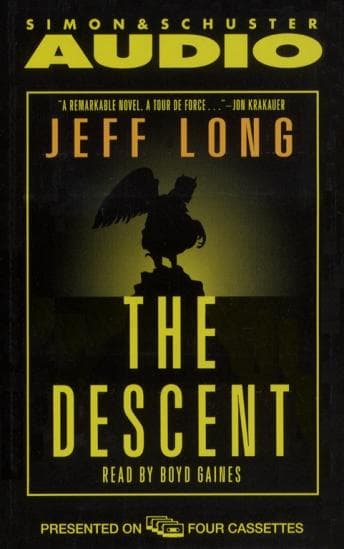

What happens when you take Milton's Paradise Lost, smash it together with a Michael Crichton expedition thriller, and then push the whole thing through a geological fever dream? You get Jeff Long's Descent, and I'm still not entirely sure how I feel about that.
I picked this one up on a recommendation from a former student — now a geology PhD candidate, which tells you something — and started it during one of those lakefront walks with Denise where the February wind off Lake Michigan makes you question every life choice. The cold helped, honestly. Boyd Gaines's narration has this basement-deep quality that pairs disturbingly well with wind chill and grey water. By the time Ike Crockett dropped into that Tibetan cave system, I was hunched into my coat like I was descending with him.
The Audacity of Building Hell as Real Estate
Let's talk about what Jeff Long is really saying here, because the premise is genuinely wild. The underworld — capital-H Hell — turns out to be a real, physical network of tunnels riddling the planet. Inhabited by proto-human creatures that look like the gargoyles and demons of religious art. And humanity's response? Not prayer. Not terror. Colonization. Resource extraction. Corporate land grabs.
This is where the book surprised me. I expected monster horror. What I got was a meditation on how quickly the sacred becomes the commercial. Nations racing to claim subterranean territory like it's the scramble for Africa all over again. This reminds me of what Conrad was doing in Heart of Darkness — the horror isn't the creatures in the dark, it's what supposedly civilized people do when they smell profit. Long was a journalist and election supervisor in Bosnia, and you can feel that experience bleeding through. The mass grave scene with Major Branch and the pale cannibals — that's not just horror set dressing. That's someone who's seen what humans do to each other in daylight and decided the underground version might actually be more honest about it.
Boyd Gaines Turns the Lights Off
Gaines narrates this at six hours — which, let me be honest, feels compressed. The novel is dense with ideas, and six hours means you're moving through Long's world-building at a clip that occasionally leaves you wanting more room to breathe. But what Gaines does with that limited real estate is remarkable. His voice sits in this low register that doesn't need to shout to unsettle you. The narrator understands that pause is punctuation — and Gaines uses silence the way a horror director uses darkness. When the expedition pushes deeper and the prose gets more claustrophobic, his delivery tightens. Layer by layer, the intensity ratchets up without ever feeling performative.
I don't have specifics on how he differentiates individual characters — the research came up dry there — and at six hours with multiple storylines (Ike's expedition, Ali the nun's archaeological work, the surface scholars hunting for literal Satan), that's a potential issue. But Gaines's strength is tonal. He captures the shift between scientific curiosity and primal dread so naturally that you barely notice you've crossed from one to the other. Bone-chilling is the word that keeps coming up, and it's earned.
Where the Darkness Thins
Now. The book isn't perfect, and I'd be lying if I pretended otherwise. Long is juggling at least three major plotlines and a theological mystery, and not all of them get equal weight. The surface scholars searching for evidence of Satan's literal existence — that's a fascinating thread that sometimes feels like it belongs in a different, longer book. Ali von Schade's journey from leper colony nun to expedition member is compelling but moves so fast you wish Long had let her sit with her own transformation longer. At six hours of audio, some of these transitions feel like jump cuts.
And the Satan question — is he underground, is he walking among us — it's the kind of ambiguity that either thrills you or frustrates you depending on what you came for. My students would hate this. I love it. But I'll admit the ending left me wanting a longer conversation with the text than the text was willing to have with me.
If you loved The Passage by Justin Cronin or even Cormac McCarthy's more apocalyptic moments, this is their spiritual predecessor — Long published this in 1999, before either. The prose deserves to be savored, even when the pacing doesn't always cooperate.
Worth Pausing the Faculty Meeting For?
Absolutely — with a caveat. Descent is the kind of book that rewards you for paying attention, which means this isn't your background-listening-while-grading audiobook. (I tried. I had to rewind twice during a stack of sophomore essays on The Great Gatsby.) The ideas here — about what lies beneath civilization, literally and figuratively — are worth sitting with. Gaines makes the darkness feel inhabited. The six-hour runtime makes it accessible but leaves you slightly hungry.
Who should listen: Anyone who wants their horror served with theological ambition and geopolitical satire. Fans of Crichton's structure but with a much darker philosophical engine. The thriller instincts here actually reminded me of Enemy (Jack Reacher 8) — not thematically, but in the way both books use procedural momentum to drag you somewhere you maybe shouldn't want to go. If you've ever stared at a cave entrance and felt that pull — that ancient, stupid curiosity — this one's for you.
Who should skip: If you need tight character arcs resolved cleanly, or if religious horror themes (Satan as a potentially real, physical being) aren't your thing, this will test your patience.
Me, I'm queuing up the sequel. Denise says I can't listen on our walks anymore because apparently I "get weird and quiet." Fair.