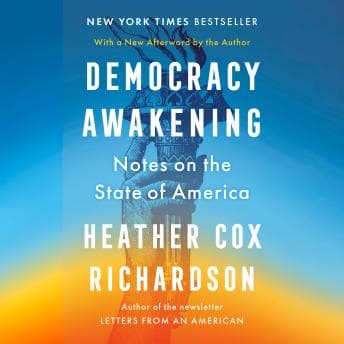

How many Americans could actually explain why the Founders were terrified of oligarchy? Not the bumper-sticker version - the real, historically grounded fear that concentrated wealth would strangle self-governance before it ever got off the ground?
I was up at 0430 with Ranger, both of us too restless to sleep, and I started this one in the dark of my home office with black coffee and a dog who couldn't care less about political history. Eight and a half hours later, I had a much sharper understanding of how we got here - wherever "here" is.
The Briefing You Should've Gotten in School
Let me cut to the chase: Richardson structures this book in three parts - the historical erosion of democratic ideals, the modern machinery of authoritarianism, and the argument for civic renewal. What makes it work is her ability to draw a straight line from Reconstruction-era voter suppression through the Southern Strategy through the January 6 insurrection without it feeling like a conspiracy theory. It's cause-and-effect history, not hand-wringing.
The section on "movement conservatism" - how a specific strain of anti-New Deal ideology got laundered through think tanks and talk radio starting in the 1950s - was the strongest material. Richardson traces how figures like William F. Buckley Jr. deliberately reframed economic oligarchy as "freedom" and government programs as "socialism," and how that language infrastructure made someone like Trump not just possible but almost inevitable. I've seen this scenario play out in real life - the way language gets weaponized to reshape reality. Did it in information operations overseas. Watching Richardson document the domestic version was... uncomfortable in a familiar way. That particular discomfort - watching courage and sacrifice get tangled up in systems that don't always deserve them - hit me again when I read Flyboys: A True Story of Courage, which does something similar with World War II aviators: honors the men while refusing to sanitize the machinery that sent them.
She's particularly sharp on the death of the liberal consensus - that brief postwar period when both parties basically agreed the government had a role in building the middle class. The way she walks through how that consensus was deliberately dismantled, issue by issue, decade by decade, made me rethink some of my own assumptions. And I say that as someone who spent 25 years serving a government I wasn't always sure deserved the sacrifice.
The Professor Behind the Microphone
Richardson narrates her own book, and this matters. She's a Boston College historian with a newsletter that pulls over two million subscribers, and you can hear why - her delivery is clear, measured, professorial in the best sense. No dramatics, no vocal tricks. She sounds like someone explaining something important to smart adults who just need the facts organized properly.
That said, it's very much a lecture. At 1.25x (my standard speed), the pacing worked fine, but this isn't a book that grabs you by the collar. It persuades through accumulation - fact stacked on fact, pattern revealed after pattern. If you're looking for narrative storytelling with characters and drama, this isn't it. It's analytical history, and it demands your full attention. I tried listening during a client meeting prep and had to restart two chapters because I'd missed critical threads.
One thing I appreciated: she doesn't hide her perspective. Richardson clearly believes American democracy is under genuine threat from a specific political movement, and she says so plainly. You can disagree with her conclusions - some listeners will - but she doesn't pretend to be neutral while clearly taking a side. In the military, we called that intellectual honesty. I respect it even when I'm not sure I agree with every point.
Where the Intel Gets Thin
The book's weakness is the final section on civic renewal. After spending six-plus hours building an incredibly detailed case for how democracy got undermined, the prescription feels rushed. She invokes the spirit of civic participation and historical resilience, but it's abstract compared to the surgical precision of her diagnosis. It's like getting a brilliant threat assessment followed by a PowerPoint slide that just says "Stay Vigilant." I wanted operational specifics.
Also - and this is a personal gripe - the book covers 150 years of American history in under nine hours, which means some periods get compressed almost to the point of caricature. The Gilded Age gets excellent treatment. The Cold War era less so. If you already know this history well, some sections will feel like review. If you don't, they'll feel like drinking from a fire hose.
Who Needs This Brief
If you want to understand the structural forces behind American political polarization - not the Twitter version, the actual historical machinery - this is worth your time. Veterans and anyone in public service will find the sections on how democratic norms erode particularly relevant. Folks who already read Richardson's newsletter will recognize the voice and the framework but get a much more comprehensive argument.
If you're looking for a balanced both-sides treatment, look elsewhere. Richardson has a thesis and she prosecutes it. That's not a flaw - it's a feature - but know what you're getting.
Mission Debrief
Ranger slept through most of this one, which is fair - no explosions. But I kept pausing to think, which is rare for me. The author clearly did her homework, and then some. Democracy Awakening isn't comfortable listening, but the best intelligence briefs never are. Worth the credit, especially if you're willing to sit with it and do some hard thinking about what you actually believe about this country.







![Steve Jobs [unabridged audiobook] audiobook cover](/_next/image?url=https%3A%2F%2Fcovers.audiobooks.com%2Fimages%2Fcovers%2Ffull%2F9788499923406.jpg&w=1920&q=75)