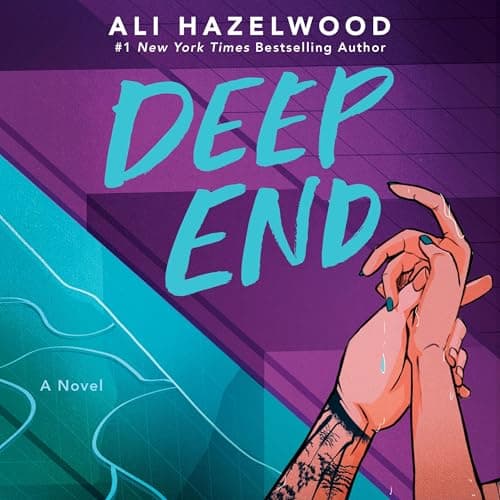

I have a bone to pick with Ali Hazelwood. After building an entire brand on STEM romances where the heroines are neuroscientists and physicists and game theorists, she drops a sports romance about competitive divers and swimmers and somehow expects me not to feel personally betrayed by the genre pivot. Worse? It actually works. Not perfectly — but it works, and I'm annoyed about it.
Let me get the main gripe out of the way: the first three hours of Deep End nearly lost me. I was folding laundry, half-listening, and realized I'd mentally checked out during what felt like an extended orientation tour of Stanford's aquatics facilities. Scarlett's internal monologue in the early chapters circles the same anxious loops — I'm focused on med school, I don't have time for distractions, I'm recovering from this injury — and while that repetition is clearly intentional character work, it tests your patience before the story earns your investment. If you bail before the arrangement between Scarlett and Lukas clicks into place, I wouldn't blame you. But you'd also be missing the payoff.
Because once these two collide, the audiobook transforms. And the reason to choose audio over print is sitting right there in the dual narration booth. Ben Holtzmuller voices Lukas with this low, unhurried cadence that turns every line of dialogue into something you lean toward. His Swedish accent for Lukas drew debate — some listeners called it wildly convincing, others side-eyed its authenticity — but here's what matters: it gives the character a specific texture that a flat American reading wouldn't. When Holtzmuller drops into Lukas's more vulnerable moments, that slight accent becomes an anchor, not a gimmick. He also juggles the male supporting cast with enough variation that you never lose track of who's talking, which is harder than it sounds in a dialogue-heavy romance.
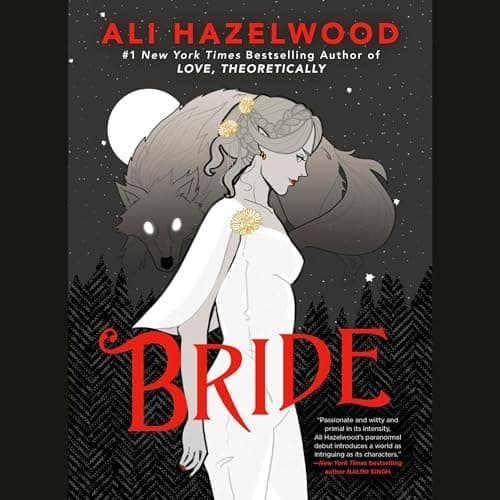
Thérèse Plummer takes on Scarlett with a voice that initially struck me as too weathered for a 21-year-old. In those opening chapters, I kept thinking she sounded like someone narrating a memoir, not living through college. But here's where the book pulled a reversal on me: as Scarlett's backstory surfaces — dead parent, controlling and abusive family dynamics, genuine PTSD layered under the diving injury recovery — that vocal maturity stops feeling like a mismatch and starts feeling like a choice. Plummer captures the specific anxiety of someone who's been parenting herself for years, and the way she modulates Scarlett's voice from guarded and tight to open and playful as the relationship develops is the kind of performance detail you'd miss entirely on the page. Plummer brought that same layered emotional range to Bride, which is worth a listen if you want to hear what she does with a heroine carrying even heavier baggage. Her comedic timing on Hazelwood's one-liners lands cleanly without undercutting the heavier material surrounding them.
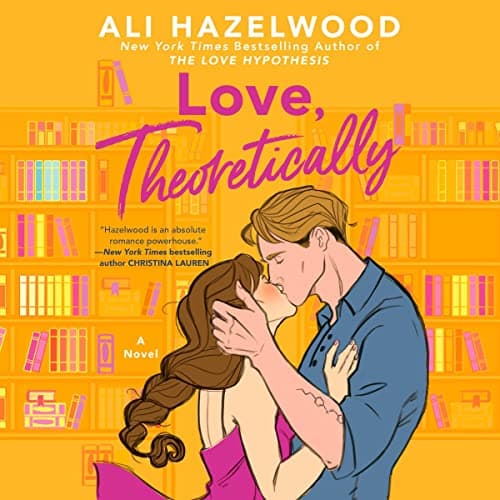
The duet format gives this production its edge. These two narrators are clearly recording separately, but the handoffs between Scarlett's and Lukas's chapters create a rhythm that mirrors the push-pull of their relationship. When the steamy scenes arrive — and they arrive frequently, with significantly more heat and kink-forward content than The Love Hypothesis or Love, Theoretically — the dual perspective means you're getting both sides of the tension. Hazelwood goes explicitly into BDSM territory here, and the narrators commit to it without flinching. It's a sharper tonal shift than anything in Love, Theoretically, which Plummer also narrates and sits much closer to Hazelwood's earlier, safer register. If that content isn't something you want in your earbuds during a morning commute, that's a firm skip signal, not a soft one.
Where this falls short of Hazelwood's best is everywhere outside the central couple. The supporting characters serve their plot functions and vanish from memory. The Olympic pressure subplot, which should be cranking up external stakes, mostly hums in the background like ambient noise. And Lukas spends too long being impossibly perfect before the story lets him be complicated — a problem The Deal by Elle Kennedy handled better by giving its male lead rough edges from page one. Compared to Collide from the similar books shelf, Deep End trades some of that raw athletic intensity for Hazelwood's trademark banter, which is a lateral move rather than an upgrade.
The content warnings deserve a direct mention because they're not decorative: parental death, an abusive parent, estrangement, PTSD, and sports injury trauma run through the story's bones. Hazelwood handles them with enough care that they don't feel exploitative, but they're persistent, not confined to a single flashback chapter.
At 1.5x speed, the slow opening tightens up and the emotional beats still breathe. I found it worked well during my commute and weekend errands, though the character-driven stretches where Scarlett processes her anxiety reward you for actually paying attention rather than treating this as background noise.
Who Should Listen (And Who Should Skip)
If you're a Hazelwood fan curious whether she can pull off a sports romance, or you want a dual-narrated listen with real heat and emotional weight — this one's for you. Skip it if you need a fast-starting plot, if BDSM content isn't your thing, or if you're looking for the lighter, lab-coat energy of her earlier books.
The narration elevates a good-not-great Hazelwood novel into an audiobook that justifies the format. Plummer and Holtzmuller don't just read this story — they perform a relationship arc that builds from cautious to consuming. It's not her strongest book, but it might be one of her strongest listens.