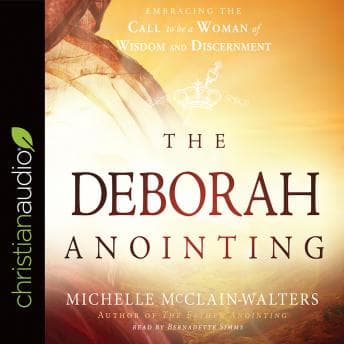

I was halfway through a dal makhani that had no business taking three hours when Bernadette Simms started laying out the résumé of a woman who lived roughly three thousand years ago: judge, prophetess, military strategist, intercessor, mother of Israel. I turned the heat down on both the stove and my skepticism. Because here's the thing - the readers who love this book talk about it like it confirmed something they already felt stirring inside them. And I found myself asking: why does that confirmation matter so much? What's actually happening, psychologically, when someone maps an ancient archetype onto their own life?
That question kept me far more engaged than I expected.
When Scripture Becomes a Mirror
Michelle McClain-Walters is doing something that my narrative psychology brain finds genuinely interesting, even if the framework is theological rather than empirical. She's essentially offering Deborah as an identity template - a way for women, particularly women in faith communities, to see ambition and authority as not just permitted but divinely ordained. The research actually shows that narrative identification with heroic figures can shift self-concept, especially in populations that have internalized restrictive roles. I kept thinking of Being You, Changing The World, which activates a similar self-concept mechanism but without the narrative anchor that makes a specific archetype like Deborah so psychologically sticky. McClain-Walters doesn't cite Bruner or McAdams (why would she), but the mechanism she's activating is real.
The book walks through Deborah's various roles - the prophetic voice, the judicial authority, the military command under Barak - and then pivots each one into a modern application. Some of these pivots land better than others. The discussion of cultural and gender prejudice within church structures feels pointed and specific enough to be useful. The sections on prophetic gifting lean more devotional, more abstract, and - I'll be honest - that's where my engagement dipped. Not because it's wrong for its audience, but because the psychological specificity gives way to exhortation. "God desires for you to break through" is a fine sentiment. It's just not an actionable framework.
At under five hours, it's a compact listen. Which is both a strength and a limitation. You get the concept clearly. You don't get much depth on any single facet of the Deborah archetype.
Bernadette Simms and the Steady Hand
The narration is clean. I mean that literally - no static, no audio artifacts, no weird compression. Simms reads with a steady, authoritative tone that suits inspirational content. She doesn't do dramatic vocal shifts or character voices, which makes sense because this isn't that kind of book. It's a single voice delivering teaching material, and she delivers it clearly.
But here's where I have to be straightforward: there's nothing about the performance that elevates the material beyond what reading the print edition would give you. No moments where Simms's delivery made me stop stirring the dal and really sit with a passage. For spiritual audiobooks, I think that elevation matters - the voice should feel like it carries conviction, not just competence. Simms is competent. That's not nothing. But it's also not the reason to choose the audio format.
The Protagonist Exhibits Classic Archetype Activation
(My therapist would have thoughts about me analyzing a biblical figure like a case study, but here we are.)
What makes Deborah compelling as a psychological vehicle - and this is what McClain-Walters gets right even if she'd frame it differently - is the tension between cultural expectation and internal calling. Deborah didn't rebel against her society's norms for rebellion's sake. She operated within a structure while simultaneously exceeding its boundaries. That's a psychologically sophisticated model for women navigating institutions that weren't built for their leadership. It's not "burn it down." It's "I belong here, and here is going to expand."
The book is strongest when it stays close to that tension. It's weakest when it generalizes into broad spiritual encouragement that could apply to anyone regardless of gender, which undercuts the specificity of the Deborah framework.
Who This Is Actually For (And Who Should Keep Walking)
If you're a woman of faith - particularly in charismatic or Pentecostal traditions - who has felt the friction between your sense of calling and the institutional limits placed on women's leadership, this book was written for you. Specifically. The listener quotes I've seen basically say: "This confirmed what I already knew." And that confirmation, psychologically, is valuable. It's external validation of an internal narrative that's been fighting for space. Rising Strong maps almost exactly onto that same territory - the psychological relief of having your own story handed back to you with permission attached.
If you're coming at this from outside that tradition, or if you want rigorous biblical scholarship or psychological research, this isn't that book. It's devotional teaching with a focused thesis. Know what you're getting.
And if you're deciding between print and audio? The print might actually serve you better here - the kind of book you underline, write in the margins, return to specific sections. The audio is fine. Just not the superior format for material you'd want to study rather than simply absorb.
I finished the dal. It was excellent. The book was - useful. For the right person, in the right season, with the right questions. That's not a small thing.