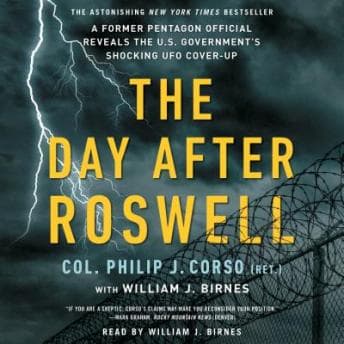

So everyone told me this was the definitive Roswell book - the one that blows the lid off government cover-ups, the one written by a guy who was actually there. I went in expecting something between a whistleblower memoir and a military thriller. What I got was... more complicated than that. And I'm still not sure how I feel about it, which is honestly the most interesting part.
I was making dal makhani at 10 PM on a Tuesday - the kind of elaborate, unnecessary cooking I do when my brain needs something to chew on besides research - when Birnes's narration kicked in and I immediately thought: this man sounds like he's about to tell me who got whacked in North Jersey. I grew up in New Jersey. I know this cadence. It's the voice of a guy who's absolutely certain he's right and dares you to disagree. Which is either perfect or terrible for a book about alien technology being reverse-engineered by the U.S. Army, depending on your tolerance for conviction without peer review.
Colonel Corso and the Psychology of the True Believer
Here's what fascinated me as someone who studies why people construct the narratives they do: Colonel Philip Corso presents himself as a reliable narrator in every sense. Military credentials, National Security Council, the Foreign Technology Desk. The framework is designed to make you trust him before he asks you to believe the extraordinary. The protagonist exhibits classic credibility-stacking - layering verifiable facts (his real career, real military positions) against claims that are, to put it mildly, unverifiable. Fiber optics from alien wreckage? Circuit chips reverse-engineered from a crashed spacecraft? The research actually shows that this is exactly how effective persuasion works: anchor to the believable, then extend to the incredible.
And Corso commits fully. There's no hedging, no "I think this might have been" equivocation. He describes handling alien artifacts the way another retired officer might describe requisitioning boots. Matter-of-fact. Almost boring in its delivery. Which is either the mark of a man telling the truth about something extraordinary, or a man who has told this story so many times it's become his truth. My therapist would have thoughts about the distinction between those two things.
I found myself asking: why does a decorated Army colonel wait until retirement to publish this? The book frames it as duty finally outweighing secrecy, but psychologically, there's something else going on - the construction of a legacy narrative. Corso isn't just reporting events; he's positioning himself as the quiet hero of a shadow history. It's a fascinating case study in how memoir becomes mythology. The self-help genre does the same thing constantly, actually — I kept thinking about this while reading You Can Heal Your Life, where the author's personal authority is doing enormous narrative work before a single claim is verified.
Birnes Behind the Mic - Tony Soprano Reads Your Government Files
William J. Birnes narrates, and he's also the co-author, which creates an interesting dynamic. He's not performing the book so much as advocating for it. The delivery has this prosecutorial energy - every sentence lands like he's presenting evidence to a jury that's already skeptical. The New Jersey accent (thick, unapologetic, very "I'm-walkin'-here" energy) actually works for the military wise-guy tone of Corso's voice. When the text calls for Corso's no-nonsense Army bluntness, Birnes channels it well enough.
But here's the problem: he doesn't have a second gear. At 12 and a half hours, that same dramatic intensity becomes exhausting. By hour six or seven, every revelation - whether it's about alien biology or Pentagon bureaucracy - gets the same breathless treatment. There's no dynamic range. A quiet aside about Corso's personal doubts gets the same volume and urgency as a claim about night-vision technology being extraterrestrial. Psychologically, this actually undermines the credibility the text is trying to build. When everything is equally dramatic, nothing is.
I'd honestly recommend bumping this to 1.25x speed. It tightens the pacing and makes the dramatic delivery feel less like a late-night infomercial and more like an excited colleague who's had too much coffee.
Who This Is Really For (And Who Should Run)
If you're a UFO enthusiast or someone interested in Cold War military culture, this is essential listening - not because it's necessarily true, but because it's one of the most influential texts in the genre and understanding it helps you understand the entire discourse around Roswell. If you're looking for rigorous evidence-based analysis, you're going to be frustrated. Corso makes enormous claims and the evidence is essentially "trust me, I was there." If you're a psychology nerd like me, though? The narrative construction alone is worth the listen.
My Case File Note
I kept coming back to one question while stirring that dal: does it matter if Corso believed what he was saying? Because the book works differently depending on the answer. If he's sincere, it's a haunting document of one man's impossible burden. If he's not, it's one of the most sophisticated pieces of narrative manipulation I've encountered outside of fiction. Either way, the human psychology here is more interesting than the aliens. Which, knowing me, was probably always going to be the case.