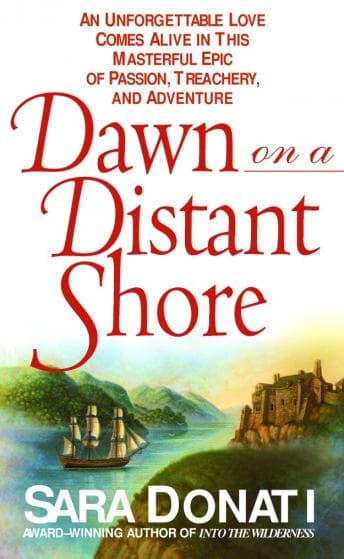

"I will have my husband back, and I will do it without your help if I must."
Somewhere around hour six, Elizabeth Bonner delivers this line with such quiet fury that I actually stopped grading sophomore essays on The Scarlet Letter and just... sat there. Kate Reading's voice dropped to something cold and certain, and I thought: this is what Hester Prynne would have sounded like if Hawthorne had given her a rifle and a reason to use it.
I finished this one over three nights - the first while Denise was already asleep and I was pretending to review quiz answers, the second during an interminable walk along the lakefront in that gray Chicago drizzle that makes you question your life choices, and the third while actively ignoring my phone during what was allegedly a "quick" department meeting about standardized testing. Principal Martinez, I promise I was taking mental notes. (I wasn't. I was somewhere in the Scottish Highlands.)
When the Frontier Meets the Drawing Room
What Sara Donati does here - and what made me recommend this to my AP Lit students who complain that "old books are boring" - is stage a collision between two worlds. The Bonners start in the New York wilderness of 1794, all survival and snow and practical violence. Then circumstances drag them across the Atlantic to Scotland, where an Earl with claims on Nathaniel's father forces them into a world of inheritance law, aristocratic maneuvering, and the particular cruelty of polite society.
This reminds me of what Hemingway said about writing: "The dignity of movement of an iceberg is due to only one-eighth of it being above water." Donati keeps most of her historical research submerged. You feel the weight of 1790s class dynamics without getting a lecture. Elizabeth's education becomes a weapon in Scottish parlors the way Nathaniel's woodcraft was a weapon in the forest. Different battlefields, same marriage.
The prose deserves to be savored. At 20 hours, this isn't a quick listen - it's a commitment. But Donati earns every hour. She trusts her readers to track multiple storylines, to remember secondary characters who reappear chapters later, to understand that sometimes the most important conversations happen in what's not said.
Kate Reading Understands That Pause Is Punctuation
I've listened to Kate Reading before, but this performance reminded me why she's become one of my go-to narrators. Her Elizabeth carries this particular blend of Enlightenment-era education and frontier pragmatism - there's a crispness to her diction that softens when she's speaking to her children but sharpens into something almost dangerous during confrontations.
The Scottish characters are where she really shows her range. The Earl's household required her to differentiate between various servants, aristocrats, and hangers-on, each with their own relationship to power. Her Scots accents vary by class - the groundskeeper doesn't sound like the butler doesn't sound like the Earl himself. It's subtle work, the kind of thing you don't notice until you realize you've never once confused who's speaking.
Nathaniel's voice gave me pause initially - there's something slightly formal in how she renders him that took adjustment. But by hour ten, I understood the choice. He's a man caught between worlds, raised with both Mohawk and European influences, never fully comfortable in either. That slight stiffness in his speech isn't a flaw; it's characterization.
The Sequel Problem (And How Donati Solves It)
Full disclosure: this is book two in a series, and I came in cold. My students would call this "chaotic energy." They're not wrong. But Donati handles backstory with enough grace that I never felt lost - just occasionally aware that there were relationships and events I was meeting mid-stream. If you loved Into the Wilderness, this is its spiritual successor. If you haven't read it, you'll survive, but you might want to go back afterward.
What struck me most was how Donati handles the central marriage. Elizabeth and Nathaniel aren't falling in love here - they already have. This is a book about staying in love across separation, across an ocean, across the discovery that your husband's family history is considerably more complicated than you thought. It's a mature romance in the truest sense. Not because it's explicit (though there are moments), but because it's honest about how much work love actually requires.
Who's Going to Love This (And Who Should Run)
If you want fast-paced action, this will test your patience. There are stretches - particularly in the Scottish sections - where the plot moves at the pace of 18th-century correspondence. But if you loved the historical depth of Outlander and wished it took itself a bit more seriously, or if you've ever wanted a frontier romance that treats its female protagonist as genuinely intelligent rather than just "feisty," this delivers. The same kind of intelligent protagonist shows up in Lost Girl, though in a completely different setting. Skip it if you need constant momentum or if 20 hours feels like a prison sentence rather than a gift.
My students would hate this. I love it.
Mr. Williams's Final Grade
The 20-hour runtime is a feature, not a bug. Bring it on your next road trip, or parcel it out over a few weeks of commutes. Just don't start it the night before you have papers to grade. Trust me on this one.