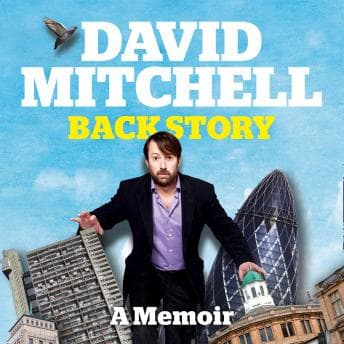

Everyone told me this was hilarious. Every review I skimmed before hitting play used the word "funny" like it was contractually obligated. And look - it IS funny. But here's what nobody prepared me for: David Mitchell's memoir is secretly one of the most honest pieces of writing about anxiety, social inadequacy, and the specific British terror of being perceived that I've encountered outside of actual literature.
I need to clarify something for my fellow Americans, because this tripped me up for about thirty seconds: this is David Mitchell the comedian - Peep Show, panel shows, the perpetually exasperated half of Mitchell and Webb. Not David Mitchell the novelist who wrote Cloud Atlas. He addresses this confusion himself in the book, and the fact that he has to is part of the charm.
The Walk That Holds Everything Together
The structural conceit here is genuinely clever. Mitchell frames the entire memoir around a single long walk across London, and each landmark or street corner triggers a different chapter of his life. It's not chronological in any strict sense - it's associative, the way memory actually works when you're putting one foot in front of the other. Jedidiah Jenkins does something structurally similar in To Shake the Sleeping Self, using the rhythm of a long journey to surface memories that wouldn't come any other way. Mitchell's not trying to construct some grand arc. He's just walking and remembering, and the honesty of that approach carries the whole thing.
The childhood sections are where the book really earns its keep. His account of desperately wanting a birthday party at McDonald's and being denied - it's played for laughs, obviously, but there's something underneath it about class aspiration and childhood disappointment that's genuinely piercing. And the Cambridge material, where he arrives already wound so tight that alcohol becomes less recreation than medication - that's where the comedy is clearly covering something. He's funny about it, but he's not joking.
Where it loses some momentum - and I felt this around the six-hour mark, right when I was pretending to review lesson plans at the kitchen table while Denise watched something on her iPad - is the television career sections. Once Mitchell starts cataloguing the specifics of getting Peep Show made and the mechanics of panel show appearances, it reads more like industry memoir than personal confession. The emotional stakes drop. You can feel him retreating behind professional anecdotes when the personal stuff gets too close.
Why Author-Narrated Memoirs Are a Different Animal
Here's where I need to compare this to, say, Tina Fey reading Bossypants or Trevor Noah reading Born a Crime. Those are performances - polished, timed, clearly rehearsed with an audience in mind. Mitchell's narration is something else entirely. It sounds like a very articulate man talking to you in a pub, occasionally getting flustered by his own sentences. Mitchell pauses in places that a professional narrator wouldn't, because he's actually processing what he just said about himself.
There's no vocal fireworks here. No character voices to speak of - this isn't that kind of book. It's one man, one microphone, nine and a half hours. What you get instead is tonal precision. His delivery of the line about it being worse to bump into Michael Palin than Hitler on holiday - the timing is so dry it practically crackles. A hired narrator would've sold it differently, probably worse. Mitchell undersells his punchlines and oversells his anxieties, which is exactly how people like him actually talk.
The vulnerability catches you off guard. He'll be three minutes into a bit about flat-roofed pubs and their pitbull-infested charm, and then suddenly he's talking about falling in love repeatedly and never doing anything about it, and his voice shifts just slightly - not dramatically, not performatively, but enough that you notice. Mat Best pulls off the same trick in Thank You for My Service - you're laughing at something absurd and then the floor drops out from under you before he even signals the turn. That's the advantage of author narration when it works. You're hearing the weather change in real time.
Know Your Mitchell Before You Press Play
Let me be honest about the limitations. If you don't know who David Mitchell is - if you haven't watched Peep Show or seen him get progressively more irritated on Would I Lie to You - about forty percent of the references will sail past you. This isn't a universal memoir. It's deeply, specifically British in its concerns and its humor. The French injection anecdote (apparently in France they just inject everything into your backside instead of your arm, and Mitchell is appropriately horrified) lands harder if you already find his particular brand of indignation funny.
But if you DO know him, or if you're the kind of person who appreciates someone dismantling their own personality with surgical precision while pretending they're just going for a nice walk - this is worth your time. It's not Cloud Atlas. (Sorry, wrong David Mitchell again.) It's smaller and messier and more human than that.
I listened at 1.0x because of course I did, and because Mitchell's comic timing depends on it. Speed this up and you'll flatten every joke.
Nine Hours of Someone Trying to Explain Himself
This is a specific recommendation for a specific audience: people who enjoy watching someone intelligent and neurotic try to explain themselves without quite succeeding. If you loved Rob Brydon or Stephen Fry's memoirs, this is their spiritual successor - though angrier and less polished, which I mean as a compliment. Skip it if you need narrative drive or if British self-deprecation makes you impatient. But if you want to spend nine hours with someone who's genuinely, uncomfortably honest about being a total - his word, not mine - at his best friend's wedding? Pull up a chair. Or a lakefront path. Either works.








![Steve Jobs [unabridged audiobook] audiobook cover](/_next/image?url=https%3A%2F%2Fcovers.audiobooks.com%2Fimages%2Fcovers%2Ffull%2F9788499923406.jpg&w=1920&q=75)