
This is the kind of historical fiction that reminds me why I became an English teacher in the first place. Not the grading-papers-until-midnight part. The part where a story grabs you by the throat and doesn't let go until you've learned something about being human.
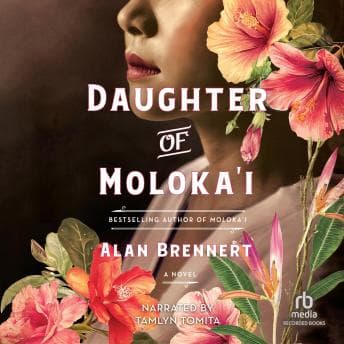
Alan Brennert's Daughter of Moloka'i picks up a thread that readers of Moloka'i have been waiting fifteen years to follow—the story of Ruth, the daughter Rachel Kalama was forced to give up at birth because of her leprosy diagnosis. And look, I'll be honest: I came to this as someone who teaches American history through literature, and I thought I knew the Japanese internment story. Manzanar. Executive Order 9066. The constitutional nightmare we'd rather forget.
I didn't know it like this.
Where Two Histories Collide
What Brennert does here is something I try to teach my students about good historical fiction—he doesn't just set a story against history, he builds history into the bones of his characters. Ruth's journey from the Kapi'olani Home for Girls in Honolulu to a strawberry farm in California to the barbed wire of Manzanar isn't just a plot. It's an education. And Tamlyn Tomita's narration carries that weight beautifully.
Her pronunciation of Hawaiian and Japanese terms is precise without being showy—something I noticed immediately because mispronounced cultural terms pull me right out of a story. (My students would say I'm being picky. They'd be right. I don't care.) When she shifts between Ruth's adopted Japanese family and the Hawaiian world she came from, there's a clarity that serves the text rather than competing with it.
The emotional moments hit. They really do. There's a warmth in Tomita's delivery that matches Brennert's prose—evocative without being overwrought. When Ruth finally receives that letter from Rachel, the woman who is her birth mother, the narration captures something I can only describe as tentative hope. Which is exactly right.
The Pacing Problem (Let's Be Honest)
Okay, so here's where I have to be the English teacher who marks up the margins. Around the 75% mark, this book starts to drag. I was grading sophomore essays while listening—my usual late-night multitask—and I noticed I was paying more attention to the papers than the audiobook. That's never a good sign.
The narrative gets repetitive. Brennert wants us to understand the depth of Ruth and Rachel's relationship, and I respect that, but some scenes feel like variations on the same emotional beat. My wife Denise, who was half-listening from the couch, actually said "Didn't we already hear this part?" We hadn't. But I understood why she thought so.
And the transitions between Ruth's Japanese American life and her Hawaiian heritage sometimes feel... constructed. Like Brennert is checking boxes rather than letting the story breathe. It's a minor complaint, but in a 14-hour audiobook, minor complaints accumulate.
Why It Still Works
Here's the thing, though. Despite the pacing issues, this is a story worth hearing. The cultural history alone—the way Brennert illuminates both Hawaiian and Japanese American experiences in the early twentieth century—makes it valuable. I get that same sense of cultural illumination from Truth About Tall Tales: American Folklore from Johnny Appleseed to Paul Bunyan, though it tackles American mythology from a completely different angle. This is the kind of book I'd assign alongside Farewell to Manzanar if I taught AP History instead of English.
Tomita's performance elevates the material. Some listeners apparently found her style distracting—I've seen those reviews—but I think they're wrong. (Yes, I'm being that guy. The one who argues about art at dinner parties. Denise has learned to live with it.) Her narration is clear and emotionally intelligent. She understands that pause is punctuation, which is something too many audiobook narrators forget.
The relationship between Ruth and Rachel, once they finally connect, is genuinely moving. Two women shaped by circumstances beyond their control, finding each other across decades of separation. If you loved Moloka'i, this is its spiritual successor—not quite as tight, maybe, but carrying the same emotional DNA.
Who This Is For (And Who Should Skip It)
Historical fiction fans, absolutely. Anyone interested in Hawaiian or Japanese American history, yes. Listeners who want something substantial during a long commute or those evening walks by the lakefront—this works. But if you need constant plot momentum or you're under eighteen with limited patience for slow burns, maybe start with something else.
Fair warning: maybe not at 1.0x speed for the whole thing. I know, I know—I'm the guy who insists on hearing every word as the author intended. But even I found myself wishing I could skip forward during some of the middle sections. You might want to save this for when you're doing something with your hands—cooking, grading, pretending to pay attention in faculty meetings.
Class Dismissed
The ending earns its emotional payoff. After fourteen hours, when Ruth finally understands the full scope of her mother's sacrifice, it lands. That's what good historical fiction does. It makes history personal.
My students would probably say this is too slow for them. They're not wrong. But they're also eighteen, and some books require patience they haven't developed yet.
This is one of those books.