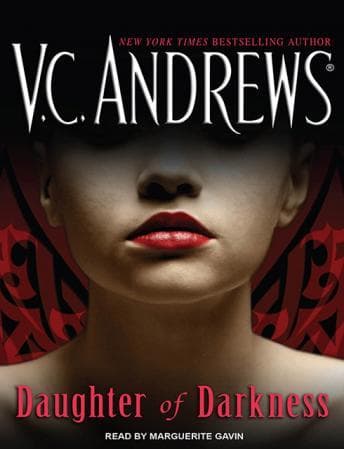

V.C. Andrews didn't write this book. Let's just get that out of the way.
The real Andrews died in 1986, and a ghostwriter named Andrew Neiderman has been cranking out novels under her name ever since. I tell my students about this when we discuss authorship and literary estates, and they're always scandalized. But here's the thing - Neiderman has been doing this so long that the V.C. Andrews brand has become its own genre. Gothic family dysfunction with a side of sexual discomfort. And Daughter of Darkness is very much that brand, dialed up with vampires.
I was grading a stack of sophomore essays on The Great Gatsby - ironic, given that this book is also about a mysterious patriarch with secrets and a carefully constructed facade - when Marguerite Gavin's voice pulled me away from yet another student claiming the green light represents money. (It does, Jaylen, but also it doesn't. We'll talk Monday.)
The Gothic Family You Can't Look Away From
Lorelei Patio is seventeen, adopted, and slowly realizing her father Sergio is a two-hundred-year-old vampire who's been grooming his "daughters" to lure men home for feeding. That premise alone is doing a lot of heavy lifting, and the book knows it. The slow reveal of what Sergio actually is - and what he expects from Lorelei - unfolds with a creeping dread that the Andrews brand does well. That methodical unspooling of horror reminded me of I Am Pilgrim, which builds its dread with similar patience. There's a scene where Lorelei has what she thinks is a dream, a moment of shocking clarity about her father's nature, and it's handled with just enough ambiguity to keep you unsettled.
But I need to be honest. The dialogue gets corny. Like, student-writing-their-first-romance-scene corny. When Lorelei meets Buddy - a boy whose name alone tells you he's not long for this world - their exchanges sometimes read like a Hallmark movie that wandered into a horror script. And the sexual content walks a strange line. It's not graphic exactly, but there are incestuous overtones woven throughout Sergio's relationship with his daughters that made me genuinely uncomfortable. Not in the "this is effective horror" way. In the "I'm not sure this is earning the discomfort it's creating" way.
This reminds me of what Hemingway said about writing - that you should be able to cut anything that doesn't serve the story. There are stretches here where the over-sexualized atmosphere doesn't serve the horror or the character development. It just... sits there. Being uncomfortable.
Gavin Carries What the Page Can't
Marguerite Gavin, though. She's a five-time Audie nominee for a reason.
Her Lorelei has this quality - calming and inviting on the surface, with something terrified swimming just underneath. She makes Lorelei's emotions feel both relatable and terrifyingly foreign, which is exactly right for a girl discovering she's been raised as bait. When Lorelei tries to maintain her normal-teenager facade around Buddy, Gavin pitches her voice slightly higher, a little breathless, like someone performing normalcy. When Lorelei interacts with Sergio, there's a careful, measured quality - the voice of a child who's learned not to make sudden movements around a predator.
The narrator understands that pause is punctuation. Gavin uses silence around Sergio's scenes the way a horror film uses the moment before the jump scare. It works.
Where the book fails her is in those corny romantic exchanges. Even Gavin can't make "Oh Buddy" sound like anything but a bad soap opera. She tries. You can hear her trying. But some material just won't cooperate.
The Ending Problem
I won't spoil it, but the last chapter lands with a thud. Not because it's shocking - it is - but because it feels like setup for a sequel rather than a conclusion. This is book one of the Kindred series, and it reads like it. You get the sense that the story just stops rather than ends, which is a particular frustration in audio where you've invested ten and a half hours of your life. My students would hate this. I... also kind of hated this. The journey earned a better destination.
Who Should Bring This Home to Daddy
If you grew up on Flowers in the Attic and want that same gothic family-secret energy with a paranormal twist, this will scratch that itch. Gavin's performance elevates material that could easily have been forgettable into something genuinely atmospheric. Listen with focused attention - this isn't a background-while-grading book despite what I was attempting.
But if incestuous overtones in fiction make you uncomfortable (and there's no shame in that), steer clear. If you need your horror to have crisp, sharp prose, this won't satisfy. And if unresolved endings infuriate you, know what you're walking into.
The Red Pen Says
Gavin's narration is an A. The atmosphere is a solid B. The prose is a C+, and the ending is an incomplete. I'd listen to Gavin read a phone book, but I wanted this story to be braver than it is - braver about its horror, more disciplined about its sexuality, more willing to give Lorelei real agency before the final pages. Worth pausing the faculty meeting for? Almost. Worth pausing Middlemarch for? Not quite.