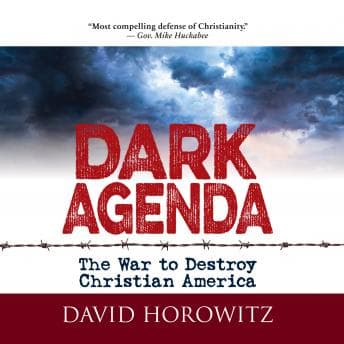

"The battle to destroy Christianity is really the battle to destroy America." That's the thesis Horowitz drops early, and if you're going to spend six hours with this book, you need to know upfront that's the hill he's planting his flag on.
Let me cut to the chase: I finished this one during a late Saturday night cleaning my Beretta at the kitchen table - Linda was asleep, Ranger was sprawled on the tile, and I had the house to myself. That's the kind of quiet where a book like this either gets under your skin or puts you to sleep. It got under my skin, though not always for the reasons Horowitz intended.
A Former Radical's Scorecard
Here's what I respect about Horowitz: the man has receipts. He was a hardcore leftist in the '60s - Ramparts magazine, Black Panthers, the whole deal - before his political conversion. So when he traces the progressive movement's hostility toward religion back to its Marxist roots, he's not guessing. He lived inside that machine. The sections connecting the Frankfurt School's influence to modern campus culture felt genuinely informed, not just talk-radio boilerplate. That insider perspective on ideological machinery - how ordinary people get drawn into participating in something monstrous - is something Christopher Browning dissects from a very different angle in Ordinary Men, and I kept thinking about both books together. His breakdown of how Madalyn Murray O'Hair's legal battles against school prayer evolved into a broader cultural offensive against religious expression in public life - that's solid historical groundwork.
But here's where it got complicated for me. Horowitz is Jewish and openly secular. He's defending Christianity not as a believer but as someone who recognizes its foundational role in American constitutional principles. That's actually a more interesting argument than a preacher making the same case, and I wish he'd leaned into that angle harder. When he sticks to the institutional history - the Supreme Court decisions, the ACLU's strategic litigation, the shift in Democratic Party platforms - the book is sharp and well-sourced.
Where the Intel Gets Thin
This is where it lost me in stretches. At six hours, this could've been tighter. Horowitz has a tendency to make sweeping connections that feel more like editorial assertions than supported arguments. Calling the entire social justice movement a rebranded communist project is a big claim. He supports parts of it well - the ideological lineage from Marx through Gramsci to modern identity politics - but other parts read like he's pattern-matching rather than proving causation. I've briefed enough commanders to know the difference between "here's what the evidence shows" and "here's what I think is happening." Horowitz blurs that line more than I'd like.
The book is strongest when it's specific: the harassment of Brendan Eich after his Proposition 8 donation, the legal battles over contraception mandates, the campus speech codes. It's weakest when it goes broad and apocalyptic. I've seen real wars. The rhetorical escalation - where every policy disagreement becomes an existential threat to civilization - wore on me after a while. Not because the concerns aren't legitimate, but because the constant high pitch makes it harder to distinguish the genuinely alarming developments from the merely annoying ones.
Phil Paonessa Behind the Mic
Paonessa reads this clean and professional. No dramatic flourishes, no Fox News anchor voice, just a straightforward delivery that lets the argument breathe. For a polemic like this, that's the right call. You don't need theatrical energy when the author's prose is already running hot. I bumped it to 1.25x within the first twenty minutes and it tracked fine at that speed - Paonessa's pacing is measured enough that the acceleration actually helps. No audio issues, no weird production artifacts. Solid, workmanlike narration that serves the material without calling attention to itself.
Who Needs This Brief
If you're already sympathetic to Horowitz's worldview, you'll find this validating and well-organized - a good primer for understanding the institutional mechanisms behind secularization in America. If you're hostile to his politics, you probably stopped reading this review two paragraphs ago. The interesting audience is the middle: people who sense something has shifted in how American culture treats religious expression but can't quite articulate what happened or when. For that group, the historical chapters alone are worth the listen.
But I'll be honest - this is a polemic, not a balanced analysis, and Horowitz would probably agree with that assessment. He's making a case, not moderating a panel. If you want the prosecution's argument, it's here and it's forceful. Just don't mistake it for the full trial transcript.
Ranger slept through most of this one, which I'm choosing to interpret as quiet agreement rather than editorial judgment.
Mission Assessment
Worth your time? Here's the debrief: it's a focused, aggressive argument from a writer who knows his enemy because he used to be one. The historical sections earn their keep. The broader claims needed more fire support. At six hours, it won't eat your whole weekend - grab it for a long drive and decide for yourself where Horowitz's analysis ends and his alarm-sounding begins. That line is different for everyone.