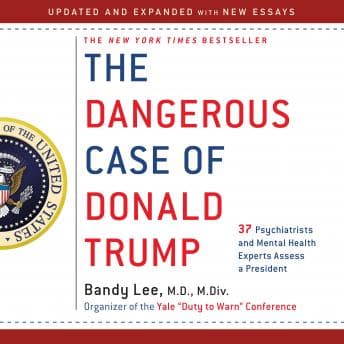

I'm going to level with you right out of the gate: seventeen and a half hours of mental health professionals telling me what I already suspected about a president is a lot of windshield time to commit. I finished this during a week of consulting gigs across Texas, and by hour twelve, Ranger was giving me looks that said "we get it, Dad."
Here's the thing that kept nagging at me through this entire listen—and I say this as someone who's sat through more military intelligence briefings than I can count—the Goldwater Rule exists for a reason. These 37 experts make a compelling case for their "duty to warn" superseding professional neutrality, but part of me kept thinking about how we'd react if 37 generals published a book diagnosing a commander-in-chief's tactical incompetence without ever being in the Situation Room with him. Some lines exist for reasons that aren't immediately obvious until someone crosses them.
When Everyone's an Expert, Nobody Is
The multi-narrator approach here is both the book's strength and its Achilles heel. You've got over twenty different voices—some professional narrators like Alex Hyde-White and William Dufris handling the heavier lifting, and then actual contributors reading their own essays. The quality variance is... noticeable. Some of the psychiatrists sound exactly like you'd expect psychiatrists to sound when reading their own academic work—measured, clinical, occasionally putting you to sleep on I-35. Others, like the professional voice actors, inject some life into material that desperately needs it.
Dr. Bandy Lee's sections come across with genuine urgency. You can hear the conviction. But when you're bouncing between twenty-plus voices across 17 hours, the experience becomes fragmented. Just when you're settling into one expert's analysis, you're yanked into another's framework, another's terminology, another's particular axe to grind.
The Intel That Actually Lands
Where this book succeeds—and I'll give credit where it's due—is in the sections analyzing observable behavior patterns rather than armchair diagnoses. The essays on "malignant narcissism" as a framework, the discussion of how certain personality types respond to pressure and criticism, the analysis of communication patterns—this is useful intelligence regardless of your politics. I've dealt with difficult personalities in command positions. Some of this framework applies to people I've served under, people I've consulted for, people I've had to work around. The strategic thinking in Art of War offers a different lens on understanding difficult leadership—less clinical diagnosis, more tactical assessment.
The updated essays covering the administration's later years add context, though by the time you're listening to this now, some of it already feels dated. That's the problem with books about current events—they're never current for long.
What genuinely interested me was the section on cult dynamics and the psychological impact on followers. As someone who's studied radicalization in other contexts—insurgent recruitment, extremist organizations—the parallels drawn here aren't crazy. Alexander Hamilton explores a different kind of political psychology—how ambition and principle collide in the founding of institutions rather than their potential unraveling. Worth considering, even if you think the overall premise is overreach.
The Credibility Question
Here's my problem, and I'm just going to say it: if you already agreed with the premise before pressing play, this book will feel like vindication. If you didn't, it'll feel like a coordinated hit job dressed up in clinical language. The book doesn't really try to persuade skeptics—it's preaching to a choir that's already singing.
I've read enough after-action reports to know the difference between objective analysis and analysis that starts with a conclusion and works backward. Some essays here feel like the former. Too many feel like the latter. The credentialing is impressive—Yale, Harvard, these aren't lightweight institutions—but credentials don't automatically equal objectivity.
The 17-hour runtime is also asking a lot. This could've been a tight 8-hour audiobook with half the contributors and twice the impact. Instead, you get repetition, overlapping arguments, and the sense that quantity was prioritized over curation.
Who Should Ruck Up (And Who Should Stand Down)
If you want a comprehensive document of professional concern about a specific presidency, this delivers. If you want balanced analysis that acknowledges counterarguments, look elsewhere. Skip it if inconsistent audio production drives you crazy—the bounce between professional narrators and academics reading their own work gets old fast.
Cooper Out
I listened at 1.25x and still found stretches that dragged. Some essays are genuinely insightful. Others feel like padding. The full-cast approach creates variety but sacrifices cohesion.
Ranger slept through most of it, which is his vote. Mine? It's a historical document now—a snapshot of professional anxiety during a particular moment. As a piece of audio entertainment or even education, it's uneven. As a primary source for future historians studying this era, it might have more value.
If you're committed to the full 17 hours, pack snacks. This is a long patrol through familiar territory.







![Steve Jobs [unabridged audiobook] audiobook cover](/_next/image?url=https%3A%2F%2Fcovers.audiobooks.com%2Fimages%2Fcovers%2Ffull%2F9788499923406.jpg&w=1920&q=75)