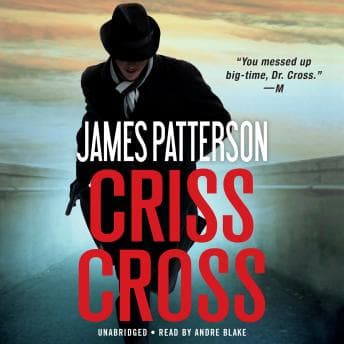

So here's the thing about James Patterson's Alex Cross series - at book 28, you either know what you're getting into or you've wandered in by accident. Criss Cross is not the entry point. It's the deep end. And honestly? I found myself fascinated not by whether the mystery would resolve (it will, it's Patterson), but by the psychological chess game 'M' plays with Cross's own past.
The premise hits a nerve that any behavioral psychologist would appreciate: a killer who doesn't just want to murder - they want to prove something. They want Cross to doubt himself. To question whether he put an innocent man on death row. That's not just a crime story. That's an identity crisis wrapped in a thriller. The protagonist exhibits classic patterns of moral injury here, and Patterson - for all his formula criticisms - understands that the deepest wound you can inflict on a man like Cross isn't physical. It's making him question his own judgment. 20th Victim plays with similar psychological pressure, though the execution there felt less personal.
When the Past Becomes the Weapon
What makes this character study compelling is the family secrets angle. 'M' isn't randomly choosing victims - they're excavating Cross's history, forcing him to confront cases he thought were closed. Psychologically, this tracks. The research actually shows that guilt over past decisions can be more destabilizing than present threats. Patterson gets this, even if he doesn't dwell on it academically (and why would he, this isn't a dissertation). Girl Before explores that same guilt-as-destabilizer dynamic, though through a completely different structural lens.
The pacing is pure Patterson - short chapters that feel like you're being propelled forward whether you want to be or not. I listened to this during morning jogs through Cambridge, and I'll admit there were moments I ran an extra block just to finish a chapter. The man knows how to structure momentum. Is it predictable in places? Sure. But predictable like a well-designed experiment - you know the hypothesis, you still want to see the data.
Andre Blake's Tightrope Walk
Okay, let's talk about Andre Blake's narration, because this is where listener opinions split dramatically. I found myself in an interesting position - I could see both sides. Blake brings genuine intensity to the proceedings. When Cross is under pressure, when the stakes ratchet up, Blake's voice carries that weight. There's a gripping quality that works for the thriller elements.
But. (And it's a meaningful but.)
With a cast this large, Blake's juggling act gets wobbly. The character differentiation isn't always crisp, and there were moments - particularly in dialogue-heavy scenes - where I had to rewind to figure out who was speaking. Some listeners found his performance genuinely annoying, and I can't entirely dismiss that. It's not a dealbreaker for me, but if you're sensitive to narration consistency, you might want to sample first.
The pacing of his delivery also varies. Some sections feel appropriately urgent. Others drag slightly, which is strange for an 8-hour thriller. It's like he's running a marathon and occasionally forgets he's racing.
The Patterson Paradox
Here's what I keep coming back to: Patterson gets criticized for being formulaic, but formulas exist because they work. The short chapters, the cliffhanger endings, the personal stakes woven into professional cases - this is a pattern that's sold millions of books for a reason. It's accessible. It's propulsive. It doesn't ask you to work hard.
Is that a criticism? Depends on what you want from a thriller audiobook. If you're looking for literary complexity or unpredictable twists that genuinely shock, this probably isn't it. But if you want something that'll make your commute disappear? That'll keep you engaged while you're cooking dinner alone? (Don't feel sorry for me, I prefer it.) This delivers.
The family secrets angle elevates it slightly above pure procedural. There's emotional weight here that Patterson doesn't always include. Cross isn't just solving a case - he's defending his legacy, his identity, his sense of himself as someone who gets it right. My therapist would have thoughts about this character's inability to separate professional validation from personal worth. But that's what makes him interesting to analyze.
Case Closed (For Now)
Probably wouldn't listen again, but that's not the point. This is a one-and-done thriller that does exactly what it promises. Blake's narration is serviceable with moments of real intensity, even if it stumbles with the ensemble cast. The mystery itself won't rewrite your understanding of the genre, but it'll keep you hooked.
Best for: series fans, commuters, anyone who needs something engaging that doesn't require full attention. Skip if: you're new to Alex Cross (start earlier) or if narrator consistency is non-negotiable for you.
Patterson knows his audience. He's been doing this for 28 books. At this point, that's not formula - that's expertise.