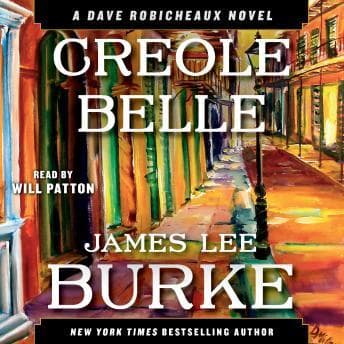

Eighteen hours. That's how long this book runs, and I'm going to tell you something that surprised even me: I didn't want it to end. I started Creole Belle on a Saturday morning walk along the lakefront with Denise, and by the time I finished it — hunched over a stack of ungraded sophomore essays at midnight the following Thursday — I'd become genuinely angry that I had to leave New Iberia and go back to grading papers about The Great Gatsby.
But let me back up. Let me complain first, because I need to get this out of my system.
Burke Writes Sentences That Make Me Want to Quit Teaching and Just Read
Here's my problem with James Lee Burke: he makes me feel inadequate. I spend my days trying to convince sixteen-year-olds that prose style matters, that word choice is everything, and then I listen to Burke describe the Louisiana bayou like he's painting with language that would make Faulkner nod approvingly — and I think, why am I even trying? The man writes about oil-slicked water and ruined marshland with the same reverence other writers reserve for cathedrals. This is set against the Deepwater Horizon disaster, and Burke doesn't let you forget that the Gulf is both a crime scene and a sacred place. The environmental devastation isn't backdrop. It's a character. It bleeds into Robicheaux's psychology the way the morphine bleeds into his hospital dreams.
And those morphine dreams — let's talk about those. The book opens with Dave Robicheaux in a New Orleans recovery unit after a shootout, and his drug-addled visions of Tee Jolie Melton, a young Cajun singer who may or may not have actually visited his bedside, set the entire novel's tone. Is she real? Is she a ghost? Is she a projection of everything Dave can't save? Burke keeps you suspended in that uncertainty for chapters, and it works because Robicheaux has always been a man haunted by things he can't quite hold onto — sobriety, peace, the people he loves.
The iPod she leaves behind, loaded with an old blues recording of "Creole Belle," becomes this perfect little engine driving the plot forward. A missing girl, a song, and a detective who can't let go. This reminds me of what Hemingway said about the iceberg theory — what's under the surface matters more than what's visible. Burke knows this instinctively. The song isn't just a clue. It's an obsession. And obsession is what Robicheaux does best.
Will Patton Doesn't Read Burke — He Inhabits Him
I need to talk about Will Patton, because this performance genuinely startled me. I've listened to plenty of Southern-set audiobooks where the narrator lays on the accent like hot sauce — too much, too performative. Patton doesn't do that. His drawl is there, Carolina-rooted but bent toward Louisiana, and it sits in his voice like something he was born with rather than something he's performing. The narrator understands that pause is punctuation. When Robicheaux is reflecting on his sobriety or staring down some oil company functionary who thinks money insulates him from consequences, Patton lets the silence do work. He trusts Burke's prose enough to slow down and let the words land.
His dialogue delivery is where things get really interesting. Clete Purcel — Robicheaux's perpetually self-destructive best friend — comes out of Patton's mouth with this loose, bourbon-soaked energy that's completely distinct from Dave's more measured cadence. You can hear the difference between a man trying to stay sober and a man who gave up trying years ago. That's not just voice acting. That's interpretation. That's a narrator who's read the character and understood what makes him tick.
I listen at 1.0x, and I'll die on this hill. Burke's sentences are built with rhythm. Speed them up and you lose the music. Patton clearly agrees, because his pacing honors the prose rather than rushing through it.
Who Should Spend Eighteen Hours in the Bayou
If you loved Cormac McCarthy's border novels or Daniel Woodrell's Winter's Bone, this is their spiritual successor — a crime novel that's really a meditation on place, addiction, violence, and whether the land itself can survive what we do to it. My students would hate this. I love it. It's long, it's dense, it's literary crime fiction that refuses to apologize for being literary. Sword Song scratched a similar itch for me — dense, place-obsessed, the kind of book that assumes you're willing to meet it halfway.
Skip this if you need a fast-moving thriller with chapters that end on cliffhangers every ten minutes. Burke meanders. He describes. He philosophizes through Robicheaux's internal monologue. Some readers find this maddening. I find it essential — the prose deserves to be savored.
If you're new to the Robicheaux series, you can start here, but you'll miss some of the emotional weight that comes from knowing Dave's history with alcohol, loss, and the particular brand of moral exhaustion that defines him. I'd suggest going back at least a few books. But if you've been walking with Robicheaux for a while? This is vintage Burke. Worth pausing the faculty meeting for.
The Assignment I'd Actually Want to Grade
Eighteen hours with Will Patton and James Lee Burke, and I came out the other side feeling like I'd spent a week in southern Louisiana — sticky, unsettled, a little heartbroken, and oddly grateful. The oil spill backdrop gives the whole thing a moral urgency that elevates it beyond standard crime fiction. Burke is asking real questions about what happens when corporate greed meets a place people actually love, and he's asking them through a protagonist who's been broken so many times he's essentially held together by stubbornness and a refusal to look away.
Denise asked me why I was so quiet on our Sunday walk. I told her I was thinking about the bayou. She said, "You've never been to the bayou." She's right. But after eighteen hours with Patton's voice in my ears, I'm not so sure anymore.