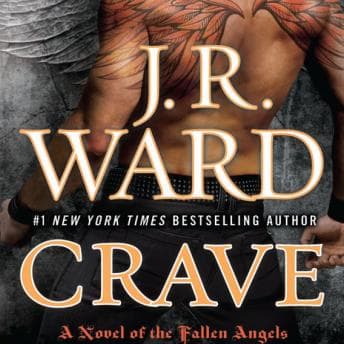

So I was up way too late debugging a procedural dungeon generator that kept spawning rooms inside other rooms - a metaphor for my thesis progress, honestly - and I needed something to keep me awake that wasn't another Sanderson reread. J.R. Ward's Crave had been sitting in my queue because a friend swore the Fallen Angels series was basically "urban fantasy D&D with a celestial alignment chart." And look, that pitch worked on me. I'm not proud. I'm not ashamed either.
Here's what I walked into: the second book in a series built around seven deadly sins, seven souls to save, and Jim Heron - a fallen angel who's basically a reluctant paladin running a campaign where the DM (God? The universe?) keeps throwing impossible encounters at him. The setup is very much "save the soul of this week's mortal" while an overarching war between angels and demons plays out in the background. Think episodic quests nested inside a bigger storyline. My D&D group would love this structure, even if the execution is... uneven.
Black Ops Meets Celestial Smackdown
Isaac Rothe is our mortal-in-peril this round. Black ops soldier, assassin on his tail, ends up behind bars and meets Grier Childe - yes, that's her actual name - his public defender. The romance between them is the engine of the book, and Ward does what Ward does: cranks the tension up with physical attraction that practically vibrates off the page (or in this case, through the earbuds). There's a scene where Isaac is basically cornered between his soldier instincts and this completely unfamiliar vulnerability Grier brings out in him, and it hit harder than I expected. Ward writes desire like it's a combat mechanic - there are stakes, there's risk, and somebody's always one bad roll away from disaster. The romantic tension here is doing real narrative work in a way that surprised me, honestly - Sundays at Tiffany's gave me that same feeling of being unexpectedly invested in two people who probably shouldn't work but somehow do.
But then there's Devina. The demon. And this is where the book gets genuinely weird in a way I wasn't prepared for. Her scenes are described by listeners as "bloodcurdling and sexually depraved," and yeah, that tracks. She's not your standard fantasy villain - she's obsessive, vain, and her attacks on the angels feel personal and grotesque in a way that actually made me uncomfortable during a late-night coding session. Which, credit to Ward, is probably the point. Devina operates like a recurring BBEG who gets scarier every session because the party keeps underestimating her.
The problem? The pacing. Ward juggles Isaac's storyline, Jim's angel-vs-demon war, and multiple side threads from returning characters, and sometimes it feels like she's running three campaigns simultaneously and none of them get enough table time. Around the middle stretch - maybe hours 5 through 8 - I kept drifting back to my code because the plot would stall out in extended internal monologues. The progression is satisfying when it moves, but it doesn't always move.
Eric G. Dove: Functional Party Member, Not the MVP
Dove's narration is... fine. And I mean that in the most measured way possible. His character differentiation is legit solid - he gives Isaac this gravel-edged military flatness that works, and Grier gets a softer, more composed register that contrasts well. His female voices avoid the dreaded falsetto trap, which alone puts him above a lot of narrators. And when Devina's on screen, he leans into something cold and predatory that genuinely adds to the creepy vibe.
But here's where I landed after 13 and a half hours: there's a stiffness to his delivery that occasionally pulls me out of emotional moments. During the romance beats especially, where Ward is writing heat and vulnerability, Dove's pacing can feel almost clinical. Like he's reading the stat block instead of rolling with advantage, if that makes sense. Some listeners called it "robotic," and while I wouldn't go that far, I get where they're coming from. Steven Pacey walked so other narrators could run, and Dove is... walking at a respectable pace. Competent. Professional. Just not electric.
Who's Rolling Initiative on This One
If you're already in Ward's world - you've done the Black Dagger Brotherhood, you liked the first Fallen Angels book - this is apparently a step up from book one, and I believe it. The angel-demon framework is interesting enough to carry a series. If you like paranormal romance with genuine darkness (content warning: violence, explicit sexual content, and Devina being Devina), this delivers.
If you're coming from epic fantasy expecting Sanderson-level world-building, pump the brakes. The magic system here is more vibes than rules, and the world-building serves the romance rather than the other way around. That's not a criticism - it's a genre expectation thing. If you don't like info-dumps, this isn't for you (but you're wrong). Except Ward's info-dumps are about emotional backstory, not cosmology, so maybe you'll survive.
I read this instead of writing my thesis, and I don't fully regret it. The Isaac-Grier dynamic carries the book even when the pacing stumbles, and Devina is memorable enough to make me want to see what happens next. But I'm not sure I'd burn a credit on it when library apps exist.
The Campaign Continues (Without My Full Commitment)
Solid second installment. Not the book that converts skeptics, but if you're already at the table, it's a decent session. Just maybe not the one you'll be talking about months later.