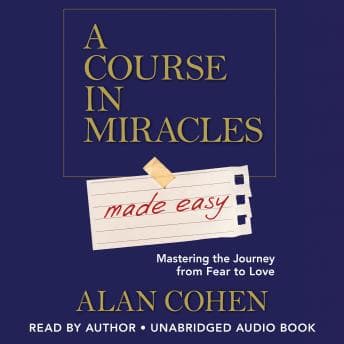

Look, I grabbed this during a particularly brutal on-call week when my brain was too fried for anything plot-heavy but I still needed something to keep me from doom-scrolling at 2AM. Spiritual self-help seemed like a safe bet. What I didn't expect was to actually... think about it? Like, days later, while debugging a particularly gnarly race condition, I caught myself applying the "choose again" principle to my own catastrophizing about the code.
Here's the thing about A Course in Miracles: I've tried reading the original text three separate times. Each time I bounced off it like a junior dev hitting their first legacy codebase—theoretically meaningful, practically impenetrable. Cohen's version is basically ACIM with better documentation.
The Pacing Problem (Or Is It?)
Cohen narrates his own work, and he speaks like he's being paid by the minute. I'm talking veeerrrry slow. My usual 1.5x felt almost normal here. At 1.75x—my standard for business books that could've been blog posts—it finally hit a comfortable conversational pace.
But here's where I'm conflicted: the slowness might actually be... intentional? The concepts here aren't meant to be consumed like a productivity hack. They're supposed to marinate. I found myself rewinding sections not because I missed something, but because I wanted to actually sit with an idea. That's rare for me. Usually I'm optimizing for throughput.
Fear vs. Love as a Binary State
The core framework is almost embarrassingly simple: every thought, every action, every reaction is either coming from fear or from love. That's it. That's the whole operating system. Cohen spends 9+ hours unpacking what this means in practice—relationships, work, self-talk, the whole thing.
As someone who thinks in systems, I appreciated how he breaks down the Course's abstract concepts into something resembling pseudocode. The "ego" isn't some Freudian construct here—it's more like a buggy subroutine that keeps running fear-based loops. The goal is to debug your own mental processes by recognizing when you're operating from that fear state.
No sound effects. No dramatic music. Just Cohen talking directly to you like a patient mentor who's seen this particular bug a thousand times and knows exactly why you keep making it.
Where It Gets Frustrating
Some listeners expected "ACIM for Dummies" and felt misled. I get it. This isn't a quick summary or a cheat sheet—it's still a serious commitment. Cohen makes the concepts accessible, but he doesn't dumb them down. If you're looking for a 2-hour overview, this ain't it.
Also, the repetition. Some ideas get circled back to multiple times from slightly different angles. For focused listening, this felt thorough. For commute listening when I'm half-asleep at 6AM? I occasionally lost track of whether we'd covered this already or if my brain was just pattern-matching.
The ROI Calculation
Here's my honest assessment: the return on this audiobook depends entirely on what you're bringing to it. If you've been ACIM-curious but intimidated by the source material, this is your on-ramp. If you're already deep into the Course, Cohen offers useful reframes and real-world applications.
If you're just looking for general self-help vibes? There are faster options. This is a 9.5-hour investment that asks you to actually engage, not just absorb.
I finished this over maybe 6 commutes at 1.75x, and I'm still thinking about some of it weeks later. That's more than I can say for most business books that promise "transformation" and deliver recycled LinkedIn posts. Rich Dad Poor Dad is one of those books that actually stuck with me too, even if the financial advice needed some debugging.
Who's This Actually For?
Queue it up if: You've got long drives ahead, you want dedicated evening listening, or you've bounced off the original ACIM but remain curious. Also surprisingly good for late-night insomnia when you want something calming but substantive.
Skip if: You need plot. You hate slow narration even at increased speed. You want quick actionable tips without the philosophical framework. You're expecting a secular approach—this is explicitly spiritual.
The Debug Report
Not a must-listen for everyone. But for the right person at the right time? This might actually stick. Cohen's 30 years with the material shows—he's not performing, he's teaching. And sometimes that's exactly what you need at 2AM when the pager hasn't gone off yet and you're trying to remember why any of this matters.