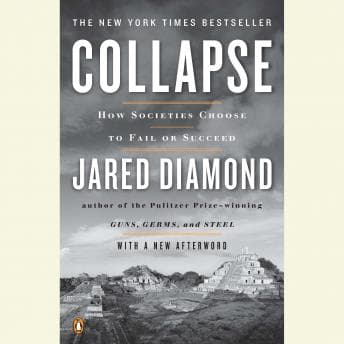

Most people talk about this book like it's the sequel to Guns, Germs, and Steel and leave it at that. Fair enough - Diamond earned that comparison. But here's the thing: Collapse is a fundamentally different animal. Where GGS asks "why did some civilizations win?" this one asks "why did some civilizations eat a bullet they loaded themselves?" That second question kept me up past midnight on a Tuesday, sitting in my home office with Ranger snoring at my feet and a bourbon going warm on the desk.
When the Vikings Starved and Nobody Learned a Damn Thing
Let me cut to the chase - the strongest section of this book is the Greenland Norse. Diamond spends serious time on how these Viking colonists literally starved to death surrounded by fish they refused to eat. They had cultural blinders so thick they couldn't adapt to survive. They watched the Inuit thriving with seal hunting and kayaks and said, basically, "We're Europeans, we don't do that." Then they died. I've seen this scenario play out in real life - not with starvation, but with organizations so married to their playbook they can't recognize when the terrain has changed. Every corporate client I've ever had who got breached had the same disease. The threat was visible. They just couldn't bring themselves to change. That particular brand of institutional blindness shows up in a different context in Never Enough: Donald Trump and the Pursuit of Success - a study in how people and organizations double down on identity even when the ground is shifting under their feet.
The Easter Island chapter is the one everyone knows about - the moai statues, the deforestation, the population crash. Diamond uses it almost like an overture, setting up the pattern he'll trace through the Anasazi, the Maya, and eventually modern examples like Rwanda and Montana. The Rwanda connection hit hard. Diamond argues the genocide wasn't purely ethnic hatred - it was also a Malthusian crisis, too many people on too little land with too few resources, and the ethnic divisions became the fault line where the pressure broke through. That's a uncomfortable argument, and he doesn't shy away from it.
But here's where it lost me, at least partially: this is the abridged version, and you can feel the cuts. Nine hours for a book that runs over 20 in its unabridged form means entire case studies got trimmed or gutted. The Montana chapter - which is supposed to be Diamond's personal connection to the material, his friends and neighbors dealing with mining pollution and water rights - feels rushed. You get the thesis but not the texture. It's like reading an after-action report when you wanted the full intelligence brief.
Murney's Voice Could Brief a General
Christopher Murney's narration is a genuine asset here. The man has this firm, raspy delivery that sounds like a seasoned professor who's also smoked a few too many cigars at faculty parties. He doesn't stumble on a single piece of Diamond's vocabulary - and there's plenty of it. Polynesian place names, archaeological terminology, environmental science jargon - Murney handles all of it clean. His pacing is comfortable, almost deliberate, which works for material this dense. I bumped it to 1.25x (because life's too short) and it felt just right - brisk but comprehensible.
What Murney doesn't do is dramatize. This isn't a performance with distinct character voices or emotional crescendos. It's a straight read, and for nonfiction of this weight, that's the correct call. You don't need theatrical flair when Diamond is describing how the last tree on Easter Island got chopped down. The facts carry their own weight.
The Abridged Problem Nobody Warns You About
Worth your time? Here's the debrief. The core argument is powerful, the historical examples are genuinely fascinating, and Diamond's five-factor framework for why societies collapse (environmental damage, climate change, hostile neighbors, loss of trading partners, and poor institutional response) is the kind of analytical structure my brain latches onto. It's how I think about threat assessments - multiple vectors converging.
But this abridged version is doing you about 60% of a favor. You're getting the highlights reel of a book that earns its length through accumulated detail. If you've never read or listened to Collapse and want the core ideas efficiently delivered, this works. If you want the full experience - the deep dives into Australia's soil salinity crisis, the extended comparison of Haiti and the Dominican Republic sharing one island with wildly different outcomes - you're going to need the unabridged version.
I'd recommend this for anyone in leadership, military or civilian, who makes decisions about long-term risk. Diamond's central insight isn't complicated: societies fail when they can't or won't recognize the consequences of their own choices. Simple to say. Apparently impossible to learn. Skip this if you need action or narrative drive - this is a lecture, a brilliant one, but a lecture. Ranger slept through most of it, but I think that says more about German Shepherds than about Jared Diamond.
Mission Assessment: Solid Intel, Incomplete File
Good book, compromised format. The abridgment costs it a full star in my book. Get this version if nine hours is all you've got. Get the unabridged if you actually want to understand why civilizations keep making the same catastrophic mistakes - and why we probably will too.