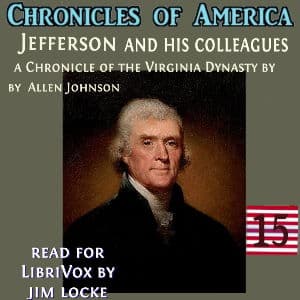

Most people would tell you a 1921 history text about Jefferson, Madison, and Monroe sounds like a guaranteed snooze. I would've agreed with them - right up until about hour two, when Allen Johnson starts walking you through the absolute constitutional pretzel Jefferson twisted himself into over the Louisiana Purchase. Here's a guy who built his entire political identity on strict constructionism, and then Napoleon dangles 828,000 square miles of territory and suddenly Jefferson's finding creative interpretations faster than a Pentagon lawyer before a congressional hearing.
Let me cut to the chase: this is a solid, compact survey of the Virginia Dynasty that punches above its weight for a book written over a century ago. It's not going to change your life, but if you want a clear-eyed walkthrough of early American power politics, foreign entanglements, and how three Virginia planters shaped the country during its most uncertain decades, Johnson delivers.
A Century-Old Book That Still Has Teeth
I was up late dealing with a proposal for a client - corporate threat assessment, the kind of thing that requires three cups of coffee and zero distractions - when I switched this on around midnight just to decompress. Ranger was already asleep on his bed. Smart dog.
What surprised me is how readable Johnson's prose still is. Yes, it's formal. Yes, you can feel the early-twentieth-century academic voice throughout. But the man knew how to structure an argument. The way he traces the Tripoli conflict - America's first real projection of naval power overseas - actually had me sitting up. I've seen this scenario play out in real life, that tension between a young nation wanting to avoid foreign commitments and the reality that pirates (or their modern equivalents) don't care about your idealism. Johnson frames it without modern editorializing, which I appreciated. He lets the facts do the talking.
The War of 1812 section is probably the strongest stretch. Johnson doesn't sugarcoat Madison's stumbles as a wartime executive. The burning of Washington, the near-disaster at Baltimore, the bizarre timing of the Battle of New Orleans happening after the peace treaty was already signed - he lays it all out with a dry matter-of-factness that actually makes the chaos more vivid than breathless dramatization would. If you've ever worked in an organization where the decision-makers were three weeks behind the situation on the ground, you'll recognize every bit of this. The dysfunction-at-the-top dynamic reminded me of what Omarosa documents in Unhinged - different century, same basic problem of leadership failing to keep pace with reality on the ground, though I found Johnson's restraint considerably easier to sit with.
Where it lost me a bit was the Monroe section. Not Johnson's fault entirely - Monroe's presidency, aside from the doctrine that bears his name, just isn't as dramatic. The Missouri Compromise gets treated almost as an epilogue, which feels like a missed opportunity given what it foreshadowed. But this was written in 1921, and the series was designed as a survey, not a deep dive. Fair enough.
Jim Locke Behind the Mic
Here's where I have to be honest: I don't have strong feelings about the narration either way. Jim Locke reads cleanly and clearly. He doesn't trip over the period language, which is no small thing when you're dealing with early-nineteenth-century syntax and a parade of historical names. But there's not much color to it. It's competent, steady, professional. Think of it like a good briefing officer - you get the information, you trust the delivery, but nobody's going to remember the briefer's name afterward.
At 6 hours and change, the pacing works fine at 1.25x. Johnson's sentences are structured enough that speeding up doesn't lose anything. If anything, it tightens the experience.
Who Gets Value From This
History buffs who want to fill gaps in their early American knowledge without committing to a 30-hour biography. People who've read about Jefferson or the War of 1812 in isolation and want to see how those events connect across three administrations. If you're the type who argues about constitutional interpretation at dinner parties (guilty), the Louisiana Purchase section alone justifies the listen.
Skip this if you want modern narrative history with characters who feel like people rather than political figures. Johnson is writing intellectual and political history, not biography in the modern sense. You won't learn what Jefferson ate for breakfast or how Madison felt about his marriage. You'll learn how they governed, and why it mattered.
Also worth noting: this is essentially a public domain text from the Chronicles of America series. The author clearly did his homework for 1921, but a century of scholarship has passed since. Some interpretations have been revised, some context is missing (Johnson's treatment of slavery is... 1921-era, let's say). Use it as a framework, not gospel.
Worth Your Time? Here's the Debrief
A lean, well-organized survey that respects your time and doesn't waste words. Not a must-own, but a perfectly good listen for a long drive or a late night when you want something substantial without the commitment of a doorstop biography. Ranger slept through the whole thing, but Ranger sleeps through everything that doesn't involve the word "walk."




![Steve Jobs [unabridged audiobook] audiobook cover](/_next/image?url=https%3A%2F%2Fcovers.audiobooks.com%2Fimages%2Fcovers%2Ffull%2F9788499923406.jpg&w=1920&q=75)