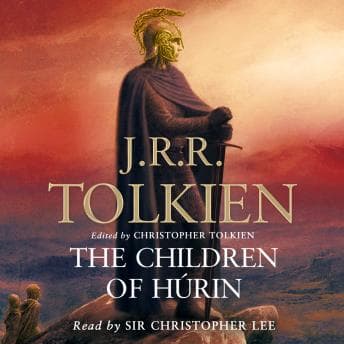

I came into this expecting to be a little bored. The Silmarillion nearly broke me in college, and Children of Húrin has that same First Age energy that can feel like reading a history textbook written by someone who really, really loves genealogies. But then Christopher Lee opens his mouth and suddenly I'm not listening to an audiobook anymore. I'm sitting in a mead hall while an old warrior tells me about the doom that fell upon the house of Húrin.
This is Tolkien at his most Greek tragedy. Like, if Sophocles had access to dragons and a deep understanding of Sindarin linguistics.
The Saruman of Narration
Here's the thing about Christopher Lee narrating Tolkien: the man was literally friends with the Professor. He met Tolkien. He read the books every year of his adult life. When he pronounces "Nargothrond" or "Dor-lómin," there's this weight to it that you just can't fake. Some listeners apparently had issues with his pronunciation choices, but honestly? I trust the guy who actually knew Tolkien over internet pedants.
Lee's voice has this weathered quality—warm but heavy, like he's carrying the weight of the story himself. The emotional moments hit different when he's delivering them. That final conversation between Túrin and Sador? I was coding at 2 AM (not working on my thesis, obviously) and had to stop because I was getting genuinely choked up. Lee draws out tragedy in a way that reading it silently never quite managed for me.
Where it gets a little shaky is the evil characters. Glaurung is supposed to be this sardonic, manipulative dragon—basically a giant reptilian gaslighter—and Lee's version is fine but not quite as menacing as I'd hoped. He's better at grief than he is at malice. Which, given the story, actually works out okay.
First Age Doom Energy
If you've only experienced Tolkien through the films or even the main trilogy, this is going to feel different. Darker. More fatalistic. The magic system here isn't Sanderson-level codified (obviously, different era of fantasy), but the curse mechanics are fascinating in their ambiguity. Morgoth basically says "your family is doomed" and then... they're just doomed. It's not flashy. It's grinding, inevitable tragedy.
Túrin is a fascinating protagonist because he's kind of a disaster. Like, objectively. That same character-driven doom shows up in Warded Man, where flawed protagonists make choices that feel inevitable even when you're screaming at them to stop. He makes terrible decisions driven by pride and rage, and you watch the curse work through his own flaws. It's not external magic forcing him to fail—it's his character being weaponized against him. My D&D group would have a field day analyzing his alignment shifts.
The world-building is dense but gorgeous. This is Middle-earth before the familiar geography, when the Elves were still fighting their doomed war against Morgoth and the Dwarves hadn't yet retreated into their mountains. At 8 hours, it's actually pretty tight for this kind of epic—no Tom Bombadil-style detours here.
The Audio Quality Asterisk
Gotta mention this because some reviews flag it: the recording quality isn't pristine. There are moments where you can tell this wasn't recorded in a modern studio with all the bells and whistles. It didn't bother me—if anything, it added to the "ancient tale being recounted" vibe—but if you're the type who notices every audio artifact, fair warning.
Who Needs This Curse (And Who Should Flee)
This is for Tolkien fans who want to go deeper. If you've read The Silmarillion and wanted more narrative meat, this delivers. If you bounced off The Silmarillion, this might actually be your way in—it's more focused, more character-driven, and Lee's narration makes the archaic language feel natural rather than stuffy.
Skip this if you're looking for cozy fantasy or anything resembling a happy ending. This is Greek tragedy with Elves. Everyone you care about will suffer, and you'll keep listening anyway because Tolkien makes you feel like you're witnessing something ancient and terrible and true.
Roll for Emotional Damage
I listened to this over a week of late-night coding sessions (still not my thesis, Dr. Patel, I'm sorry). It's become my go-to recommendation for people who say Tolkien is "just adventure stories." No. This is myth. And Christopher Lee understood that.