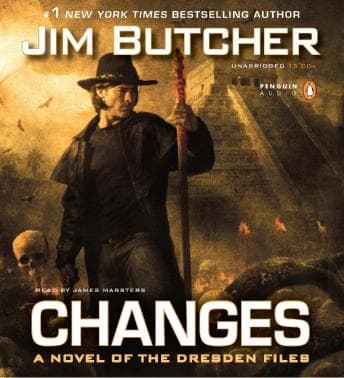

"He's fighting to save his child."
That's the hook. That's the entire premise dropped on you in the first chapter like a bomb. And honestly? After twelve books of Harry Dresden getting beaten, burned, and broken in increasingly creative ways, Jim Butcher finally found the one thing that could raise the stakes beyond anything we've seen before.
I listened to this at 2 AM. In the dark. With my cat Shirley curled up on my chest, completely unbothered by the fact that I was having a minor existential crisis about fictional characters. This is what good urban fantasy horror does—it makes you forget you're supposed to be a functional adult with a morning shift at the library.
When Marsters Becomes Dresden
Look, I've been podcasting about horror for over 200 episodes. I know what it sounds like when a narrator is just reading words versus when they're inhabiting the character. James Marsters? He IS Harry Dresden at this point. It's not even a performance anymore. It's possession.
The thing that gets me—and this is where I get nerdy about craft—is how he handles the emotional whiplash in this book. Butcher doesn't give you breathing room. You get gallows humor stacked on top of genuine grief stacked on top of rage, and Marsters shifts between them so naturally that you don't even notice the tonal gymnastics he's pulling off. One moment he's delivering a quip with that signature Dresden snark, the next his voice drops into something raw and desperate that made me stop walking my dog mid-stride.
His creature voices have always been strong (the vampires in this series genuinely unsettle me), but it's the quiet moments that hit hardest here. When Harry realizes what he might have to become to save his daughter? Marsters doesn't oversell it. He just... lets the weight sit there. That's rare. That's an actor who trusts the material.
The Horror Underneath the Urban Fantasy Label
Here's my hot take: The Dresden Files gets shelved in urban fantasy, but Changes is horror. Full stop. Not the jump-scare kind—the existential dread kind. The "what would you sacrifice to protect your child" kind. The kind that makes you examine the dark corners of your own moral framework.
Butcher has been building to this for eleven books, and he finally lets the leash off. Harry makes choices in this book that... look, I can't spoil it, but there are decisions here that made me pause the audiobook and just sit with my discomfort. That's what I want from dark fiction. Not gore for shock value—genuine moral horror.
That same kind of psychological weight shows up in Second Wife, though it trades supernatural stakes for domestic dread.
The pacing is relentless. Fifteen and a half hours flew by. I started during a weekend cleaning session and ended up sitting on my kitchen floor surrounded by half-folded laundry because I couldn't make myself stop listening. The book basically dares you to take breaks, and I failed that challenge completely.
That Gut-Punch Ending
I need to address the elephant in the room: the ending is going to make some people furious. It's a cliffhanger. Not a soft "I wonder what happens next" cliffhanger—a brutal, emotionally devastating "wait, WHAT" cliffhanger that left me immediately downloading the next book at 3 AM like an addict.
Some listeners have complained about this. I get it. But honestly? This is exactly how horror should work. You don't get neat resolution. You get consequences. You get the sick feeling in your stomach when you realize the story isn't done with you yet.
(My podcast listeners are going to love this. I'm already planning a Dresden Files deep-dive episode because this book broke something in my brain that needs processing.)
The production quality is clean—way better than the early books in the series. I've heard complaints about mouth sounds in some Marsters recordings, but I didn't notice anything distracting here. Either they've cleaned it up or I was too absorbed to care.
Who Needs This in Their Ears (And Who Should Skip)
If you scare easily or need tidy endings, this isn't your book. But if you want urban fantasy that takes the "dark" part seriously? If you've been waiting for a series to stop pulling its punches? You need this.
Fair warning: this is book twelve. You cannot start here. The emotional payoff only works because Butcher spent eleven books making you care about these characters before systematically destroying everything they love. (Yes, I said that with admiration. Shirley Jackson walked so Jim Butcher could run.)
I listened in the dark. Mistake? Maybe. Worth it? Absolutely.