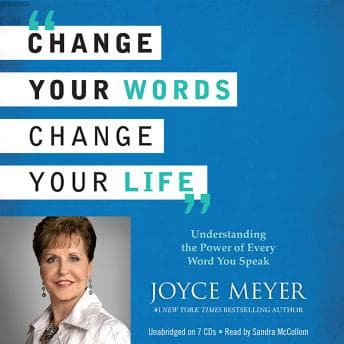

I was reorganizing my home office at 10 PM on a Tuesday - Jenny calls this "stress tidying," I call it productivity - when I decided to queue up Joyce Meyer's Change Your Words, Change Your Life. Eight hours on the power of words. At 2.0x speed, that's four hours of my life. Fair enough. Let's see if the ROI checks out.
Bottom line: If you're already in the Joyce Meyer ecosystem, this is a solid companion piece to Battlefield of the Mind and Power Thoughts. If you're coming from the secular business/self-help world expecting something like Crucial Conversations or Never Split the Difference, recalibrate your expectations. This is faith-based personal development, heavy on scripture, light on frameworks. And that's not a criticism - it's just the label on the tin.
My Parents Already Knew This (Without the Book Deal)
Here's what hit me: Meyer's core argument - that your words shape your reality, that complaining corrodes your life, that keeping your word matters more than people think - is basically everything I watched my parents live out in their dry cleaning shop in Koreatown. My mom never read a self-help book in her life, but she understood that how you talk to customers, to yourself, to your kids at the end of a 14-hour day... it compounds. Meyer puts theological scaffolding around this idea, anchoring it in Proverbs and James and dozens of other passages. The chapter on "The Corrosion of Complaints" landed hardest for me. I've sat in enough boardrooms to know that chronic complainers don't just drain energy - they actually reshape how teams make decisions. Meyer frames this spiritually, but the principle is universal.
The section on knowing when to talk and when to shut up? That's worth the listen by itself. I've seen startups implode because a founder couldn't stop giving their opinion in every meeting. Meyer's take is gentler than mine (she'd say "let God handle it," I'd say "read the room"), but the destination is the same.
The Padding Problem - 8 Hours Is 3 Hours Too Many
This is where my consultant brain starts twitching. The key takeaway is worth the listen. The other 7 hours? Not so much. Meyer has maybe 90 minutes of genuinely sharp insight here, stretched across eight hours with a lot of repetition, anecdotal stories that circle the same point, and scripture readings that - while meaningful to her audience - slow the pacing considerably. By hour five (hour 2.5 at my speed), I was filing papers and only half-listening because she was restating the same principle with a different Bible verse attached.
The "Dictionary of God's Word" section at the end is actually a smart resource if you're a person of faith who wants quick-reference scripture for specific situations. But as an audiobook experience, listening to someone read a dictionary-style appendix is... not great. That section belongs in print.
Sandra McCollom - Turn Down the Volume
Look, I respect Sandra McCollom's commitment. She clearly believes in this material, and there's an earnestness to her delivery that fits Meyer's straightforward style. But - and I'm not the only one saying this - her volume and intensity run hot. For a book about words and their power, the narration could use more dynamic range. When every sentence hits at the same energy level, nothing stands out. It's like a PowerPoint where every bullet point is bolded and underlined. After a while, the emphasis loses meaning.
Jenny would say I'm being harsh. Jenny is right. But when you're listening at 2x speed and the narrator is already at a 9 out of 10 on the intensity dial, it's... a lot. I had to turn my volume down twice. For bedtime or commute listening, this could genuinely be fatiguing.
Who Gets ROI Here
If you're a Joyce Meyer reader who's already bought into her worldview and wants another angle on the Power Thoughts framework, this delivers. If you're a Christian looking for practical, scripture-grounded guidance on how your speech habits affect your spiritual life, there's real value. If you're a secular self-help person or a business reader hoping for data-driven insights on communication - skip this. You want Talk Like TED or Nonviolent Communication instead. I ran into a similar audience-fit problem with True North — solid material, but the framing assumes you've already bought the premise, and if you haven't, you're spending the whole time arguing with the book instead of learning from it.
The Consulting Memo
Joyce Meyer is basically your mom's best friend who also happens to have a theology degree and a TV show. She's not trying to be Malcolm Gladwell. She's trying to help people stop tearing themselves down with their own words. Noble goal. Decent book. About three hours too long. And the audiobook narrator needs a gain knob adjustment. I've seen worse uses of a credit, but I've also seen better. My 2.0x speed couldn't save this one from feeling padded, but the core chapters on complaints and silence are genuinely useful - faith or no faith.