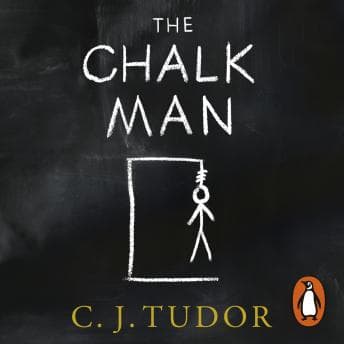

Everyone kept telling me this was "the next Stephen King" — King himself blurbed it, which, let's be honest, the man blurbs a lot of things. So I went in skeptical. I was chopping onions for a lamb rogan josh on a Saturday afternoon, half-expecting to be bored by chapter three. I was not bored.
But I also wasn't entirely convinced.
Two Eddies, Two Accents, One Problem
Here's the structural conceit: Eddie Adams at twelve years old in 1986, and Eddie Adams at forty-two in 2016, narrating alternating chapters about a mystery involving chalk stick figures, a dismembered body in the woods, and the slow-motion disintegration of a friend group over thirty years. C.J. Tudor splits the narration between Asa Butterfield (young Eddie) and Andrew Scott (adult Eddie), which is a genuinely smart production choice for a dual-timeline story. Butterfield gives you this bright, cut-glass English kid — direct, a little naive, processing terrible things with that particular child logic where everything is both more and less frightening than it should be. Scott's adult Eddie is quieter, more guarded, speaking in a measured Irish-inflected register that communicates decades of accumulated guilt.
The issue? These are supposed to be the same person. And the accent jump — Butterfield's crisp English to Scott's Irish lilt — creates a dissonance that my brain kept flagging. Psychologically, this doesn't track. Voice is one of the most deeply embedded markers of identity continuity; when young Eddie and old Eddie sound like they grew up in different countries, something in the listener's pattern recognition rebels. I found myself asking: why does adult Eddie sound like he relocated to Dublin at some point? It's a minor thing for some listeners. For me, it was a persistent itch.
Also — and I need to say this — Andrew Scott sometimes drops into this conspiratorial whisper during crucial revelations, and I genuinely could not make out what he was saying while my pressure cooker was going. I had to rewind at least three times during the body-in-the-woods sequence. If your narrator is going to go breathy for dramatic effect, the words still need to be, you know, audible.
The Psychology of Chalk Men (Where Tudor Gets It Right)
What makes this book work as a psychological study is Tudor's understanding of childhood group dynamics. The friend group — Eddie, Fat Gav, Metal Mickey, Hoppo, Nicky — operates exactly the way developmental psychology predicts: shifting alliances, loyalty tests, the desperate need to belong that makes twelve-year-olds capable of both extraordinary cruelty and extraordinary courage. The chalk men function as a kind of shared symbolic language, a secret code that binds the group together. And when those chalk figures start appearing without anyone claiming to have drawn them, the violation isn't just creepy — it's an invasion of the group's private meaning-making system. This is a fascinating case study in how shared symbols can become instruments of control. I tracked something similar in Crevice, where a group's private rituals curdle into something far more sinister once an outsider gets hold of their meaning.
The fairground accident scene is genuinely harrowing. Tudor doesn't flinch from the physical reality of it, and Butterfield's narration captures that particular childhood horror where you're seeing something your brain doesn't have the framework to process yet. The protagonist exhibits classic dissociative response — that flat, observational tone kids adopt when reality overwhelms their coping mechanisms.
Where Tudor loses me is the ending. I won't spoil it, but the final twist requires you to accept a character motivation that — I'm sorry — psychologically, this doesn't track. The research actually shows that the kind of long-game deception the ending requires would demand a specific personality profile, and the character in question has been written with contradictory traits throughout. It felt like Tudor chose the most shocking reveal over the most psychologically coherent one. My therapist would have thoughts about this character. Specifically: "That's not how any of this works."
Who Gets the Chalk and Who Gets the Eraser
If you love dual-timeline mysteries and you're willing to forgive an ending that prioritizes twist over truth, this is a solid eight-and-a-half-hour listen. The atmosphere is thick — small English town, 1980s nostalgia without the saccharine coating, real menace underneath the ordinary. Tudor understands that the scariest thing about childhood isn't monsters; it's the moment you realize the adults around you are capable of monstrous things.
If you're an accent purist or you listen in noisy environments, Scott's whispering will drive you up the wall. Consider headphones. And maybe bump the volume up.
If implausible character motivations in the final act ruin an otherwise well-constructed mystery for you — well, you're me, and I'm still a little annoyed about it.
Case File: Closed, With Reservations
Tudor's debut is strong on atmosphere, smart about childhood psychology, and genuinely unsettling in its best moments. The dual-narrator format mostly works — Butterfield is the standout for me, capturing something true about how kids narrate their own lives. Scott is magnetic when he's at full volume and frustrating when he's not. The story earns its dread for about seven hours, then spends the last stretch cashing a check the character development can't quite cover.
I finished it standing over a pot of perfectly cooked rogan josh, staring at my kitchen wall, thinking: you were so close, Tudor. So close.