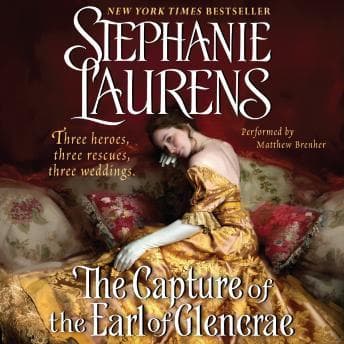

I was walking the lakefront with Denise last Saturday — one of those late April mornings where Chicago pretends it's already spring and you just go with it — when I realized I was fifteen hours deep into a Regency romance about a Scottish earl kidnapping a Cynster bride. And I was invested. This is not a sentence I expected to write. My grad school self would be appalled. My current self, the one who's listened to more audiobooks than he can count while pretending to review sophomore essays, is entirely at peace with it.
Let me explain how I got here.
A Romance Novelist Who Studied Her Austen
Stephanie Laurens is a former scientist, which tracks, because The Capture of the Earl of Glencrae is engineered with precision. This is the conclusion of her Cynster Brides trilogy, and Laurens knows exactly what she's doing with the architecture. Angelica Cynster spots her destined match across a ballroom — standard Regency setup — and then gets kidnapped by him within the first hour of audio. From there, it's a coach ride to the Scottish Highlands, a crumbling castle, a scheming mother-in-law figure, and a marriage plot that doubles as a heist plot. Laurens layers the romance with an actual scheme — Dominic, the Earl of Glencrae, needs Angelica's help to recover a stolen goblet and save his family's legacy. It's not just attraction driving the plot forward; there's genuine stakes-based storytelling underneath the bodice-ripping.
And yes, there is bodice-ripping. Quite a bit of it. Laurens writes her love scenes with the kind of thoroughness that suggests she's done her research. If you loved Georgette Heyer but wished she'd turned the heat up to about a seven, this is the spiritual successor you've been looking for. My students would hate this. I love it. (Well — I wouldn't assign it. But I love it.)
What surprised me is how much time Laurens spends on the Highland setting. There's real attention to place here — the description of Glencrae's castle, the surrounding terrain, the social dynamics between Angelica and the local staff. It reminded me, oddly, of what Scott did in Waverley — using the journey north as a kind of cultural crossing. Laurens isn't Walter Scott, obviously, but she understands that romance needs geography. The relationship changes because the setting changes. That's smart writing, even if the prose sometimes runs long. And at fifteen and a half hours, it does run long. There are stretches in the middle — particularly around the repeated strategy sessions about the goblet retrieval — where I felt Laurens circling the same ground. The pacing sags when the characters stop moving and start planning.
Matthew Brenher and the Problem of Angelica's Voice
Here's where things get complicated. Matthew Brenher has a lovely voice for Dominic and the male characters. His Scottish inflections for the Highland scenes feel grounded, not cartoonish. When he's doing Dominic's internal conflict — the guilt, the duty, the growing desire — the narrator understands that pause is punctuation. He lets the silence do work. I appreciated that.
But Angelica is the co-lead of this book, and Brenher's female register is... a problem. His voice for Angelica and her female relatives sits in this strained, slightly pinched upper range that makes it genuinely hard to tell the women apart. During scenes where Angelica is speaking with multiple female characters — and there are several, especially in the castle sequences — I found myself rewinding to figure out who was talking. It's not that Brenher is bad. He's a skilled reader. But the female characterization flattens out, and in a romance novel where the heroine's perspective is at least half the story, that's a significant limitation.
Some listeners swear by him — I've seen the "favorite male narrator" praise, and I get it if you're listening primarily for the male POV. But for a book where Angelica's determination and cleverness are supposed to be the engine? The audio doesn't quite serve her. It's like watching a play where one of the two leads is slightly out of focus.
Who Gets Swept Off to the Highlands
If you're already a Cynster reader, you know whether you want this. It's the payoff book. Laurens delivers the expected conclusion with enough warmth and heat to satisfy the faithful. If you're new to the series — honestly, you could start here, but you'd miss some of the family dynamics that give the early chapters their weight.
This is a good listen for long walks, road trips, or — and I say this from experience — faculty meetings where the budget presentation has gone forty minutes past its useful life. (Principal Martinez, I remain deeply engaged with your fiscal projections. Always.) It's comfort reading in audio form. Not demanding, occasionally predictable, but genuinely enjoyable when Laurens is firing on all cylinders.
The narration issue is real, though. If male narrators doing female voices is a dealbreaker for you, this audiobook will test your patience. If you can ride with it, Brenher's handling of Dominic and the Scottish atmosphere is worth the compromise. I was curious to hear Brenher in a different genre, so I picked up Alone on the Ice—his narration of the Antarctic expedition is equally immersive.
The Annotation in the Margin
I walked six miles that Saturday morning without noticing. Denise had to physically tap my shoulder to tell me we'd passed our turnaround point. That's the thing about a well-constructed romance — it's not high literature, and it doesn't need to be. It's engineered to pull you forward, and Laurens knows her craft. The prose deserves to be savored, even when the narrator can't quite keep up with every character it serves. I'd have liked sharper female voice work, and I'd have liked about two fewer hours of goblet strategy. But I'd listen to the next Laurens on a lakefront morning without hesitation.