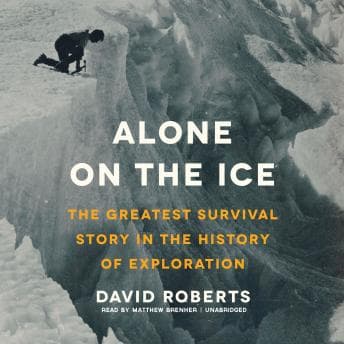

Look, I'm going to complain about something first because it's been bothering me for three days: David Roberts spends what feels like geological epochs setting up this story. I'm grading sophomore essays on The Great Gatsby at 11 PM, desperately needing something to keep me awake, and Roberts is giving me detailed meteorological histories of Antarctica. The man wrote a book with "Greatest Survival Story" in the title and then makes you wait nearly four hours before Mawson is actually alone on the ice.
But here's the thing about patience—and I say this as someone who teaches Faulkner to teenagers who'd rather watch paint dry—the payoff matters. And good Lord, does this one deliver.
When the Soles of His Feet Just... Detached
I need you to understand what Roberts is describing here. Douglas Mawson, one hundred miles from camp, discovers that the bottoms of his feet have separated from the flesh underneath. He bandages them back on. He keeps walking. This isn't hyperbole or Victorian melodrama—this is a man literally holding himself together with gauze and willpower while crossing a frozen wasteland that's actively trying to kill him.
The moment that wrecked me—and I was walking the lakefront with Denise when this happened, had to stop and just stare at Lake Michigan like an idiot—is when Mawson falls through a snow bridge and dangles over an abyss, held only by his sledge harness. A line of poetry gives him the strength to haul himself back up. Roberts doesn't tell us which poem. (This drove me absolutely crazy. I spent twenty minutes after that chapter ended trying to figure it out. My students would recognize this obsessive behavior.)
And then there's his return to base camp, skeletal and unrecognizable, when his own teammate asks "Which one are you?" That's not dramatic license. That's what actually happened. Roberts dramatizes these death-defying moments without sensationalizing them, which is harder than it sounds.
Matthew Brenher's Formal British Approach (That Actually Works)
Here's where I need to be honest: Brenher reads this with a formal British voice that doesn't differentiate between characters. No Australian accent for Mawson, no vocal distinction between the expedition members who die and the ones who survive. Some listeners found this frustrating.
I didn't. This isn't a novel. This is historical scholarship about men who died over a century ago, and Brenher's formal, almost documentary approach feels appropriate. He's not performing a story; he's bearing witness to one. The narration matches the descriptive, scholarly content Roberts wrote. It's clear, it's measured, and when Mawson is crawling across the ice with his feet bandaged together, Brenher's restraint makes the horror land harder.
That said, some listeners found the pacing slow, especially in those early chapters. I can't entirely disagree. At 1.0x speed (yes, I'm that person), parts of this felt like a comprehensive history of Antarctic exploration when I just wanted to get to the survival story. If you're less patient than I am—and most people are—1.25x might save your sanity during the setup.
What Roberts Gets Wrong (And Why It Annoyed Me)
One thing that genuinely bothered me: Roberts takes shots at other polar explorers throughout the book. There's a competitive edge to his advocacy for Mawson that feels unnecessary. We get it—Shackleton's more famous, Scott's more tragic, and you think Mawson deserves better. But disparaging other explorers to elevate your subject is the literary equivalent of tearing down other students to make yourself look good. I don't allow it in my classroom, and I didn't love it here.
Also—and this is minor but real—there are some editing issues in the audiobook edition. Nothing catastrophic, but noticeable enough that other listeners mentioned it.
Who Should Freeze With Mawson (And Who Should Stay Home)
If you loved Endurance and want something equally harrowing but less famous, this is your book. That same appreciation for meticulous historical detail is what makes Great Influenza: The Epic Story of the Deadliest Plague in History so compelling—another story of humans pushed to their absolute limits, just with microscopic enemies instead of ice. If you're the kind of person who appreciates historical context and doesn't mind earning your payoff, Roberts rewards your patience. If you loved Into Thin Air, this is its frozen spiritual successor.
But if you want immediate action, if you hate when authors take their time, if detailed expedition planning makes your eyes glaze over—maybe borrow this from the library first. The core survival story is genuinely one of the most unbelievable things I've ever heard, but you have to get through a lot of Antarctic history to reach it.
Worth Pausing the Faculty Meeting For
This is why we still read—and listen to—stories about people pushed beyond human limits. Mawson's survival isn't just improbable; it's philosophically confounding. What makes a person keep walking when their feet are literally falling apart? What line of poetry has that kind of power?
I'm still thinking about it. Principal Martinez definitely noticed I wasn't paying attention during yesterday's budget presentation. Worth it.








![Steve Jobs [unabridged audiobook] audiobook cover](/_next/image?url=https%3A%2F%2Fcovers.audiobooks.com%2Fimages%2Fcovers%2Ffull%2F9788499923406.jpg&w=1920&q=75)