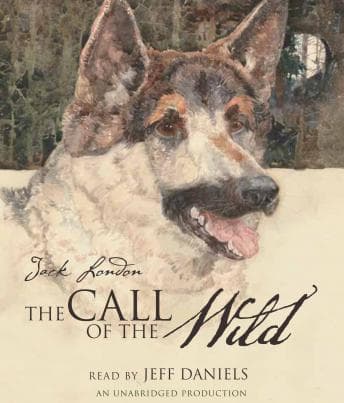

Three hours and ten minutes. That's it. That's the whole book.
I listened to Call of the Wild on a Thursday night when I should've been debugging my procedural terrain generator for Dr. Patel. My headphones were in, my IDE was open, and I told myself I'd just listen to the first chapter while I worked. Reader, I did not work. I sat there in my dim apartment, surrounded by my Gloomhaven box and a stack of Abercrombie paperbacks, completely locked into the story of a dog getting kidnapped and dragged to the Yukon.
And look - I know what you're thinking. "Tom, you listen to 40-hour Sanderson epics with hard magic systems and interlude chapters. Why are you reviewing a 3-hour novella about a dog from 1903?" Fair question. But here's the thing: Jack London wrote one of the best progression fantasies ever, and he did it with a St. Bernard-Scotch Collie mix instead of a LitRPG stat block.
Buck's Build Is Actually Cracked
I'm serious. Buck starts as a pampered estate dog in Santa Clara - basically a level 1 character with high base stats but zero XP. Then London throws him into the harshest environment imaginable and we watch him level up. He learns to fight. He learns to steal food (a survival skill, not a moral failing). He learns the hierarchy of the sled team. And the progression is satisfying in the same way watching a character in Cradle go from nothing to world-breaker is satisfying, except London does it in under 200 pages.
The whole central tension is this pull between domestication and something ancient and wild that Buck can feel waking up inside him. London calls it the "call" obviously, but it's more like... imagine your Ranger character suddenly remembering they're actually a polymorphed wolf deity. That ancestral memory stuff, where Buck dreams of primitive humans crouching by fires - that hit different at midnight with my apartment lights off.
The Spitz rivalry is genuinely tense. Buck doesn't just fight the lead dog once and win. It's this slow, political campaign where Buck systematically undermines Spitz's authority with the other dogs before the final confrontation. My D&D group would love this - it's basically intra-party conflict done right. Honestly, the political maneuvering Buck pulls off reminded me of the faction dynamics in We Hunt the Flame, where survival politics are just as brutal as any direct confrontation.
Jeff Daniels - Yes, THAT Jeff Daniels
So when I saw "narrated by Jeff Daniels" I immediately thought of Dumb and Dumber and had zero expectations. That was wrong of me. Daniels reads this with a warmth and steadiness that fits the material perfectly. He's not doing what Steven Pacey does (Steven Pacey walked so other narrators could run, as always), but this book doesn't need eight distinct character voices. It's mostly Buck's internal experience filtered through London's prose, and Daniels has this friendly, almost fireside quality that makes the narration feel like your cool uncle telling you a story.
When dialogue does show up - John Thornton's gentle commands, or the cruel Hal and Charles bickering over their overloaded sled - Daniels captures the tone without going full voice-actor mode. It works. The emotional beats land, especially the Thornton chapters. I won't spoil it but there's a section near the end where Buck's loyalty gets tested in the most devastating way possible, and Daniels' delivery had me staring at my ceiling for a solid minute afterward.
The production is clean and straightforward. No music, no sound effects, no gimmicks. Just a good reader and good prose. For a three-hour listen, that's exactly right.
The 1903 of It All
Fair warning: this was written in 1903 and it reads like it. London's prose is muscular and declarative in a way that modern fiction isn't. If you don't like info-dumps, this isn't for you (but you're wrong) - there are passages where London straight up explains sled dog logistics and Yukon trail conditions like he's writing a D&D sourcebook for the setting. I loved it. Some people won't.
There's also violence. Dog fights, human cruelty, the brutality of survival. London doesn't shy away from any of it. Buck gets beaten with a club early on and it's not glossed over. This is technically shelved under Kids & Family, and yeah, I read it as a kid, but know what you're getting into with younger listeners.
Who This Is For (And My Thesis Can Wait)
If you want a quick, powerful listen between longer series - the audiobook equivalent of a one-shot between campaigns - this is perfect. If you've never read it, Daniels' narration is a great way in. If you have read it, three hours is nothing and it's worth revisiting.
Is it Sanderson-level world-building? No. But London built the Yukon so vividly in so few words that I could feel the cold in my 74-degree apartment. I read this instead of writing my thesis, and for three hours, that felt like exactly the right call.