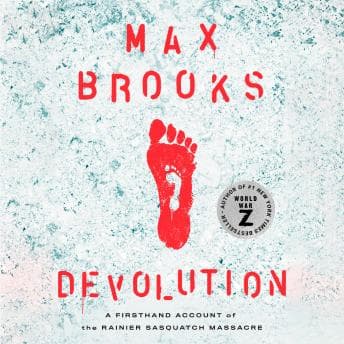

I honestly thought this was going to be my "palate cleanser" book. You know, something silly about big hairy monsters to laugh at after stitching up a drunk guy's forehead at 2 AM. Bigfoot? Really? I expected a SyFy channel original movie in audio form.
I was wrong. Dead wrong.
Instead of a campy creature feature, I got a survival stress test that felt way too much like a trauma intake report. Max Brooks—who wrote World War Z, which I also loved—apparently doesn't do "silly." He treats Sasquatch like an invasive species, not a ghost story. And listening to this on a dark stretch of the I-10 at 3 AM? Bad idea. (Or the best idea, depending on your adrenaline tolerance.)
When "Wellness" Meets Reality
The setup is basically a bunch of tech-bros and yoga moms trapped in a high-end eco-village called Greenloop when Mt. Rainier blows its top. No delivery drones. No wifi. Just expensive glass houses and zero survival skills.
As someone who deals with people in crisis for a living, watching these characters unravel before the creatures even show up was... weirdly satisfying? (Don't judge me). It's like watching a Code Blue where nobody knows CPR and everyone is just checking their heart rate monitors. Brooks nails that specific type of modern helplessness. The social satire is sharp—sharp enough to cut.
But then the rocks start flying. And the mood shifts from "look at these idiots" to "oh god, nobody is getting out of this." The shift is brutal. Not a slow burn; a sudden drop.
Judy Greer Almost Made Me Quit (Then Wrecked Me)
Let's talk about Judy Greer, who plays the main diarist, Kate Holland.
I'll be honest—the first hour, I almost returned the audiobook. Her voice was driving me nuts. Too bubbly. Too anxious. Too "let me speak to your manager." I was yelling at my dashboard, "GET IT TOGETHER, KATE."
But here's the thing—I think that's the point. As the situation goes from bad to bloody, Greer's performance morphs. She captures that specific sound of someone trying to hold it together while their brain is breaking. The hyperventilation? The shaky breaths? I've heard that sound in the ER waiting room. By the end, she wasn't annoying me anymore; she was terrifying me.
The rest of the cast is stacked—Nathan Fillion, Jeff Daniels—but it's really Greer's show. It plays out like a found-footage horror movie for your ears. Or a really, really dark NPR segment. (Kai Ryssdal playing himself is a stroke of genius, by the way.)
Clinical Horror vs. Movie Monsters
What gets me is the biology of it.
Most thriller authors treat monsters like magic—they roar, they kill, they vanish. Brooks treats them like apex predators. The injuries described in this book? Blunt force trauma. Avulsions. Crushing injuries. It's anatomical.
There's a scene involving a "rock throw" that made me physically wince. And I've seen bone sticking out of skin in real life. That level of visceral, unflinching detail reminded me of Dark Tower II: The Drawing of the Three—Stephen King doesn't shy away from the body horror either, and the audiobook narrator makes every injury feel uncomfortably real. The sound design during the attacks isn't over-the-top with cheesy music; it's grounded, which makes it worse.
If you liked World War Z, this is different. That was global; this is claustrophobic. It feels more like The Martian if the planet was trying to eat you, or maybe Lord of the Flies with 800-pound gorillas.
Clocking Out
I pulled into my driveway and sat there for ten minutes because I didn't want to walk to the front door in the dark. My husband Carlos asked if the shift was bad because I looked pale. I just told him, "Bigfoot."
He thinks I've finally lost it.
Who should listen: Anyone who wants horror that feels like a disaster report, not a monster movie. Fans of Brooks, survival fiction, or full-cast productions will eat this up. Who should skip: If you need polished, poetic prose or can't handle graphic injury descriptions, this isn't your book. Just maybe keep the lights on.