
What happens when civilization is just a thin veneer we've painted over something older and wilder?
I was grading sophomore essays on symbolism at 11 PM—the usual parade of "the green light means hope" observations—when I realized I'd stopped reading their papers entirely. Buck had just been beaten with a club for the first time, learning what London calls "the law of club and fang," and I was sitting there with a red pen frozen in my hand, completely transported to the Yukon.
This is why we still read the classics.
The Prose Deserves to Be Savored at 1.0x
At three hours and twenty-one minutes, this is practically a novella by audiobook standards. My students would call it "short king energy." I call it economical brilliance. London doesn't waste a single sentence. Every description of Buck's transformation—from pampered California estate dog to apex predator of the frozen North—lands with purpose.
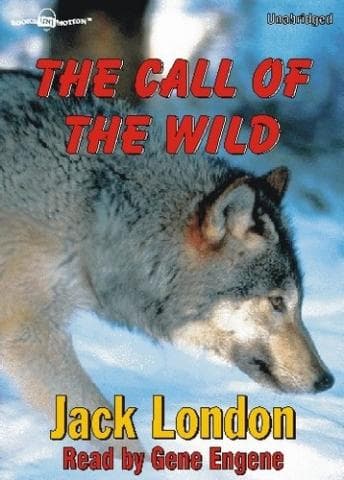
Gene Engene's narration is... serviceable. I wish I had more to say here, but the research turned up surprisingly little about his specific approach to this text. What I can tell you is that he doesn't get in the way, which for London's prose is actually a compliment. The writing itself is so muscular, so deliberately paced, that a narrator's job is mostly to step aside and let the language work. Engene does that. He reads clearly, maintains appropriate gravity for the violence (and there is violence—Buck's world is not gentle), and doesn't try to turn this into something it isn't.
But I found myself wishing for more. A narrator who understood that pause is punctuation could have made certain moments devastating. When Buck finally answers the call—that primal howl scene near the end—it needed a performance that matched London's intensity. What I got was competent. Not bad. Just... competent.
This Is Really About Us, Isn't It?
Here's what I tell my students when we read excerpts: London isn't writing a dog story. He's writing about the thin membrane between who we pretend to be and who we actually are. Buck doesn't become wild—he remembers he always was. The civilization was the costume.
Listening to this while surrounded by stacks of papers about Gatsby and the American Dream, I kept thinking about how London and Fitzgerald are asking the same question from opposite directions. Gatsby believes you can reinvent yourself upward into something refined. Buck proves you can only strip away the refinement to find something more honest underneath.
My students would hate this take. They want their classics to stay in separate boxes. But that's exactly what makes teaching literature worth the eye strain and the 11 PM grading sessions—these books talk to each other across decades.
The Violence Question
Fair warning: this book doesn't flinch. Dogs die. Dogs kill. Buck himself becomes capable of things that would horrify his former self. London was writing in 1903 and he wasn't interested in sanitizing nature. If you're coming to this expecting a heartwarming boy-and-his-dog story, you're going to have a rough time.
But—and this is important—the violence serves the theme. It's not gratuitous. Every brutal moment strips away another layer of Buck's domestication. By the time he's running with wolves, you understand exactly how he got there. The journey earns its destination.
Who Should Answer the Call (And Who Should Stay by the Fire)
This one's for readers who want their classics lean and unsparing—anyone drawn to questions about civilization versus instinct, or who appreciates prose that hits like a sled dog pulling through snow. Skip it if animal violence bothers you, or if you need a narrator who delivers more than competent.
Worth Pausing the Faculty Meeting For?
Almost. At three hours, this is perfect for a long walk along the lakefront or a particularly tedious professional development day. (Principal Martinez, I was definitely paying attention to that equity training. I was not listening to a dog become a wolf. Absolutely not.)
The brevity works in its favor—you can finish this in two or three sessions, and the momentum never flags. London understood pacing before pacing was a buzzword. Each chapter escalates Buck's transformation, and you feel the wildness growing in him like a fever.
Gene Engene's narration won't blow you away, but it won't distract you either. For a public domain classic with dozens of available versions, this is a solid choice if you want something straightforward and unadorned.
If you loved White Fang, this is its spiritual predecessor—same world, same themes, but Buck's journey from civilization to wilderness is the inverse of White Fang's path. That tension between our civilized masks and primal instincts shows up differently in Edge, though in a much more contemporary setting. Read them back to back and you've got London's complete thesis on what we are versus what we've trained ourselves to become.
The Lake, the Dog, and the Teacher Who Thinks Too Much
Denise asked me why I was so quiet during our walk last Sunday. I told her I was thinking about a dog. She knows me well enough to know that meant I was actually thinking about Nietzsche and the will to power and whether high school English teachers are just domesticated academics who've forgotten how to howl.
She told me to stop being dramatic and enjoy the lake.
She's usually right.