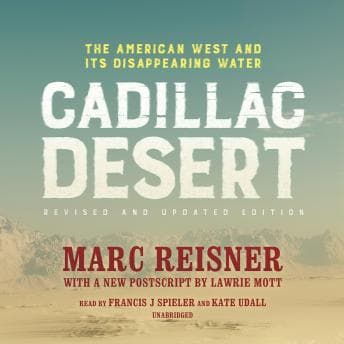

So here's the thing about 2AM insomnia after a week of on-call rotations: your brain won't shut off, but it also won't do anything useful. I was lying in bed, Kevin snoring next to me, scrolling through my audiobook queue looking for something that would either knock me out or at least make the sleeplessness productive. I landed on Cadillac Desert. Twenty-eight hours about water policy in the American West. That should do it, right?
It did not knock me out. I was up until 4:30.
The West's Entire Water Supply Is Basically Technical Debt
TL;DR: Worth your commute — but only if you're in focus mode.
Marc Reisner basically wrote a 28-hour postmortem on how the American West built itself on infrastructure promises it could never keep. And if you've ever worked on a system where someone made an architectural decision in 1905 that you're still paying for today, this book will feel uncomfortably familiar. The Bureau of Reclamation and the Army Corps of Engineers are two competing engineering teams who kept building dams and aqueducts not because the projects made sense, but because each agency needed to justify its own existence and budget. It's empire building. Literal empire building, except the empires are made of concrete and diverted rivers.
The LA water grab section is the centerpiece — you know, the stuff Chinatown was loosely based on. Reisner lays out how William Mulholland and the city's power brokers essentially stole the Owens Valley's water through deception, backroom deals, and legal maneuvering that makes modern tech acquisitions look quaint. But what got me was the stuff I didn't know: the insane rivalry between the Bureau and the Corps, each racing to propose bigger, more expensive, more ecologically catastrophic projects just to one-up the other. There's a section where Reisner describes how the Bureau wanted to literally reverse the flow of rivers in the Pacific Northwest to send water south to California. The scale of hubris is — I kept pausing to text Kevin about it and he eventually muted me.
The science actually holds up, mostly. Reisner's hydrology and geology explanations are solid, though the book was originally published in 1986 and even this "revised" edition has gaps. Climate change barely registers, and the Colorado River crisis has gotten dramatically worse since publication. You're getting a brilliant historical autopsy, but the patient has deteriorated significantly since the last exam.
Three Narrators Walk Into a Desert
Spieler, Udall, and Mott split duties across 28 hours, and it's an interesting setup. Spieler handles the bulk of the historical narrative with this steady, almost documentary-style authority — think Ken Burns but audio-only. Udall comes in for the ecological devastation sections and her delivery is noticeably softer, more measured, which works when she's describing the death of rivers and the salination of farmland. The contrast between their tones actually creates a useful signal: when Udall's voice kicks in, your brain goes "okay, something's about to get environmentally tragic."
But — and this is the but — 28 hours is a LOT of dense nonfiction narration, and neither narrator has the kind of magnetic pull that keeps you locked in during low-attention moments. Spieler is competent but not captivating. He's the narrator equivalent of a well-organized Wikipedia article: informative, clear, zero charisma. This is not a Ray Porter situation. (Ray Porter narrates this. Need I say more? — is what I WISH I could say, but I cannot, because he does not, and we are all poorer for it.)
The third narrator, Lawrie Mott, appears to handle updated material, which is a clever structural choice — you can hear when the book is in "revision" mode vs. original text.
Commute-Worthiness: It's Complicated
Here's my honest assessment: I tried this on my 6AM Caltrain and it did not survive the packed-train-zombie-brain test. This is not a 1.5x-speed-while-half-asleep book. The information density is high, the narrative jumps between decades and geographic regions constantly, and if you zone out for five minutes you'll miss an entire dam project and its political fallout. I ended up switching it to evening focus sessions — lying on the couch with headphones, no distractions.
At 1.25x it flows well. I wouldn't go faster. The ROI on this audiobook is high if you care about environmental policy, Western US history, or understanding why cities like Phoenix and Las Vegas exist in places where cities probably shouldn't exist. But the time investment is real: 28 hours is basically Project Hail Mary plus Bobiverse Book 1 combined.
Perfect for: dedicated listening, road trips through the actual West (seriously, driving past Hoover Dam after this hits different). Skip for: background, gym, sleepy commutes.
Who Runs Your Water
If you're the kind of person who reads infrastructure postmortems for fun — and given that you're on this site, you might be — this is essential. If you live anywhere in the American West and pay a water bill, it's borderline required reading. If you need a fast-paced narrative with a charismatic narrator to stay engaged, this will test your patience around the 15-hour mark when Reisner is deep in congressional appropriations fights.
I finished it across about 10 days of evening sessions. I now have opinions about the Central Arizona Project that I will inflict on Kevin at dinner. My George Washington phase last winter had a similar effect on him — apparently there is a limit to how many dinner conversations can be about 18th-century land speculation before someone stops asking how your day was. He regrets introducing me to audiobooks.