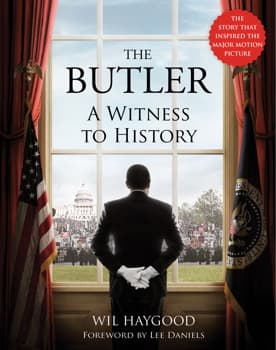

I was up at 2 AM finishing a logo revision for a client who keeps saying "make it pop" (if you know, you know), and I put this on thinking a two-and-a-half-hour listen would carry me through the last stretch of work. I did not finish that logo. I sat there with my stylus hovering over my tablet, completely still, because this book felt like sitting in my abuela's living room while she told me about the world she grew up in - the one where you kept your head down, did your work with dignity, and watched history happen to you whether you were ready or not.
Eugene Allen served eight presidents. Thirty-four years in the White House. And the thing that wrecked me wasn't the big moments - the Civil Rights legislation, the conversations about apartheid under Reagan - it was the smallness of his position next to the enormity of what he witnessed. He's pouring tea while decisions that would reshape Black America are being made in the next room. Haygood understands that tension, and he doesn't let you look away from it.
Four Voices Carrying One Man's Silence
So here's the thing about having David Oyelowo, Forest Whitaker, Lee Daniels, and Oprah Winfrey narrate a two-and-a-half-hour book: it's ambitious as hell for something this short. And honestly? The transitions between narrators can feel a little abrupt - you're settling into one voice's rhythm and suddenly you're adjusting to another. It's not always smooth. But Oyelowo carries the emotional weight of the historical sections with this quiet gravity that just... sits in your chest. There's a steadiness in his delivery that mirrors Allen himself - measured, careful, observant. Whitaker brings something warmer, more intimate. Lee Daniels contextualizes the Hollywood angle (the book spends time on the history of African Americans in film, which I wasn't expecting but really appreciated). And Oprah - look, say what you will, but the woman knows how to land a line.
The format works best when you think of it less as a traditional audiobook and more as a documentary you're listening to. Multiple perspectives on one story. It's not the warm-hug narration I usually crave, but it fits. This isn't a warm-hug kind of story.
The Jim Crow of It All
What gutted me - and I mean genuinely had me pressing pause to breathe - is how Haygood draws the line between Allen's professional life and his personal one. Inside the White House, he's witnessing LBJ push Civil Rights forward. Outside those gates, his family, his neighbors, his community are still living under Jim Crow. That duality. That split screen of American life. It's not new information if you know your history, but hearing it framed through one man's daily existence makes it hit different.
I kept thinking about my abuela cleaning houses in San Antonio in the '60s. Different specifics, same architecture of invisibility - being inside powerful spaces while being rendered invisible by them. She would've had opinions about this book. Loud ones. Probably would've paused it every five minutes to tell me about someone she knew who had a similar story. Abuela would have loved this one.
Too Short to Be the Whole Story
Here's my honest frustration: at 2 hours and 32 minutes, this is a companion piece to the film, and it feels like one. There are moments where Haygood is clearly setting up context that the movie will pay off, and sections that feel more like extended liner notes than a fully fleshed narrative. The Hollywood history chapter is interesting but pulls focus from Allen's personal story right when I wanted to go deeper. I wanted more of Allen's wife, Helene. I wanted more about what it felt like to come home from the White House to a segregated neighborhood. The book gestures at these things but doesn't always linger.
And the audio quality - I noticed a couple of spots where the production felt slightly uneven between narrator segments, like they were recorded in different sessions (which, obviously, they were) without quite matching the levels. Minor, but noticeable at 1.0x when you're really listening.
Who This Is For (and Who Should Wait)
If you loved the film and want historical grounding, this is exactly right. If you're coming to Eugene Allen's story fresh and want the full emotional experience, I'd actually say read Isabel Wilkerson's The Warmth of Other Suns first for the broader context, then come back to this. It'll hit harder. On a completely different end of the emotional spectrum, Catching the Wolf of Wall Street is another memoir-adjacent listen where the narrator's voice does a lot of heavy lifting - though the silence at the center of that story is a very different kind.
This is for a quiet night. Not background listening. Not a commute book. You need to be still for this one.
Diego Knocked My Headphones Off the Nightstand and I Took It as a Sign to Stop Crying
This book felt like holding a photograph of someone you never met but somehow recognize. Eugene Allen's story is American history told through pressed uniforms and silver trays and a silence that says more than speeches ever could. The multi-narrator format is imperfect but ambitious, and at under three hours, it asks very little of your time while giving you a lot to sit with. I didn't ugly-cry - this one was more of a slow, quiet ache that stayed with me through the next morning. Sometimes those are the ones that matter most.








![Steve Jobs [unabridged audiobook] audiobook cover](/_next/image?url=https%3A%2F%2Fcovers.audiobooks.com%2Fimages%2Fcovers%2Ffull%2F9788499923406.jpg&w=1920&q=75)