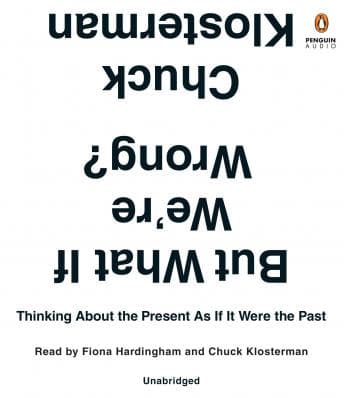

Chuck Klosterman wrote a book about epistemological humility, and I listened to it while making chana masala at midnight because my brain wouldn't stop running through a draft paragraph about cognitive dissonance in fictional antiheroes. Perfect headspace for a book that basically asks: what if everything you think you know is wrong?
Here's the thing. As someone who studies how people construct meaning — how we build identity out of narratives we tell ourselves — this book is a fascinating case study in applied uncertainty. Klosterman takes the intellectual exercise of imagining the present from the future's vantage point and runs with it across gravity, rock music, democracy, dreams, television, sports. The breadth is wild. And he's not just being contrarian for the fun of it (though he's clearly having fun). He's genuinely trying to destabilize the assumptions we treat as permanent. The research actually shows that humans are spectacularly bad at recognizing which of their beliefs are culturally contingent versus which are empirically durable — and Klosterman gets this, even if he's working more from instinct and cultural criticism than from peer-reviewed journals.
I found myself asking: why does Klosterman keep circling back to the idea that the most important cultural figure of our era might be someone we currently dismiss or don't know? Because it's not really about predicting the future. It's about the psychology of consensus. We retroactively assign importance based on patterns we can only see after the fact, and we're wildly overconfident about our ability to identify significance in real time. That's not just a cultural studies observation — that's a cognitive bias problem. Hindsight bias, availability heuristic, anchoring. Klosterman doesn't use these terms, but the architecture of his arguments maps onto them almost perfectly.
The British Accent Problem (And Why It Matters More Than You'd Think)
Okay, let's talk about the elephant in the room. Fiona Hardingham narrates the bulk of this audiobook, and she has a British accent. Reading a book that is relentlessly, unapologetically about American cultural identity — rock music canons, NFL extinction scenarios, American democracy, American television. And look, Hardingham is a skilled narrator. She balances the whimsical passages and the more serious philosophical stretches with real control. But there's a disconnect I couldn't shake. When she's reading Klosterman's passages about, say, whether Chuck Berry or Bob Dylan will represent rock music in 500 years, the British delivery creates this strange anthropological distance — like she's narrating a documentary about American culture rather than channeling someone who lives inside it. Psychologically, this doesn't track with the intimacy Klosterman's writing demands. His prose reads like a guy at a bar making you question everything over cheap beer. The accent turns it into a lecture hall.
And then Klosterman himself shows up for the introduction and afterword, with his manic, rapid-fire American delivery, and suddenly you hear what this book is supposed to sound like. The energy shifts. You hear the restlessness in his thinking. And then he's gone, and you're back with Hardingham's composed professionalism. It's not bad narration — it's mismatched narration. Which might actually be worse, because you can hear exactly what you're missing. The mismatch between narrator and material is something I keep returning to in my case files — I had a similar reaction reviewing Bone Crossed, where the audiobook delivery either deepens or fractures your relationship with the protagonist's interiority depending on how well the voice matches the character's psychology.
A Book That's Smarter Than It Pretends To Be
What makes this book compelling is that Klosterman disguises genuinely difficult philosophical problems as pop culture riffs. He interviews Neil deGrasse Tyson about gravity and Brian Greene about the nature of reality, and then pivots to whether the Simpsons or Seinfeld will be remembered as the defining TV show of the '90s. The tonal whiplash is the point. He's arguing that we apply the same flawed cognitive machinery to physics as we do to sitcom rankings — and he's probably right.
But here's where it falters: the book occasionally mistakes breadth for depth. Some chapters feel like they're warming up to a profound point and then — chapter over, new topic. The dreams chapter in particular felt like it ended right when it was getting psychologically interesting. My therapist would have thoughts about a guy who raises the question of whether dreams contain real information and then just... moves on.
At 10 hours, this is not a casual background listen. The ideas require focused attention, and at normal speed the pacing drags in spots. Bumping it to 1.25x or 1.5x helped considerably — it actually mimicked the pace of Klosterman's own delivery in the intro sections, which felt right.
Who This Is For (And Who Should Probably Skip)
If you love the feeling of having your assumptions interrogated — not attacked, just gently destabilized — this is your book. If you've ever stood in the shower wondering whether future historians will think we were all idiots, Klosterman is your people. Skip it if you need arguments to resolve into clear conclusions. This book raises questions and then sits with them, which is either intellectually honest or deeply frustrating depending on your tolerance for ambiguity.
The Case File Closes (Sort Of)
The protagonist of this book — and yes, the protagonist is Klosterman's own restless mind — exhibits classic intellectual anxiety: the compulsive need to question not just what we know, but whether knowing is even the right framework. I respect that. I just wish he'd narrated the whole thing himself. The ideas deserve his voice. Literally.