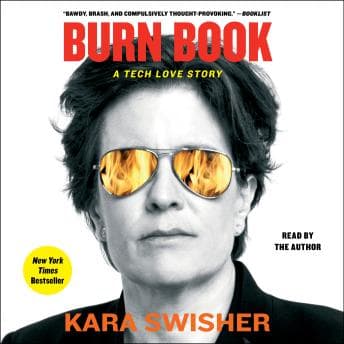

So there I was, 11:30 PM, still wired from a postmortem on a cascading failure in our message queue system, scrolling through my audiobook backlog looking for something that wouldn't require me to track seventeen character names. Kara Swisher's Burn Book had been sitting in my queue for weeks. A tech industry tell-all narrated by the author herself, under 8 hours? Perfect decompression material. I started it that night and finished it by the end of my Friday commute.
The Podcast Episode That Ate a Book Deal
TL;DR: Worth your commute — but barely, and with caveats.
Let me be real: this audiobook is basically Kara Swisher's podcast but stretched to 7 hours 40 minutes and given a hardcover. If you've listened to Pivot or Sway, you already know the cadence — rapid-fire delivery, confident to the point of combative, zero patience for anyone she considers a fool. The woman calls Rupert Murdoch "Uncle Satan" and refers to half the tech industry's leadership class as "man-boys," and she does it with the energy of someone who's been holding these zingers in a notes app for thirty years.
The thing is, some of those zingers actually land. Her account of making Zuckerberg visibly sweat during interviews is entertaining because you can hear the satisfaction in her voice when she recounts it. She was there for the AOL-Time Warner disaster, the rise and stumble of Yahoo, the early Google days when Page and Brin were still weird grad students instead of weird billionaires. As someone who grew up watching the tech industry from Seattle and then moved straight into it, I appreciated the institutional memory. She connects dots between decisions made in 1995 and consequences we're debugging in 2024.
But here's the problem: for every genuinely insightful observation about how Silicon Valley's libertarian streak metastasized into something uglier, there are two or three paragraphs where Swisher is essentially telling you how prescient she was. She warned them about privacy! She told Zuckerberg about misinformation! She saw it all coming! It's like pair programming with someone who keeps reminding you they flagged that bug three sprints ago.
Author-Narrated: Feature or Bug?
This is where it gets complicated. Swisher narrating her own book is both the biggest selling point and the biggest liability. On the plus side: authenticity. You're getting the real Kara — the inflections, the timing, the barely contained eye-rolls you can somehow hear. When she talks about her personal life, her struggles as a queer woman in tech journalism in the '90s, her health scares — those moments hit harder because it's her voice cracking slightly, not some narrator performing vulnerability.
On the minus side: she's not a narrator. The pacing is uneven. Some sections feel rushed, like she's speed-running through a decade of tech history to get to the next name-drop. Other sections drag because she's lingering on personal anecdotes that don't earn their runtime. There's no character differentiation when she's quoting other people — it's all Kara's voice with Kara's energy, which means a Steve Jobs quote and a Jeff Bezos quote sound identical. Ray Porter would've given them each distinct cadences, but I digress. (I always digress when it comes to Ray Porter.)
I bumped this to 1.5x almost immediately and honestly? It improved the experience. Her natural speaking pace has that podcast tendency to linger, and the speed-up tightened everything nicely.
The ROI Calculation
The ROI on this audiobook is decent if you're already in tech and want a breezy refresher on how we got here, sprinkled with insider gossip. If you're looking for rigorous analysis of platform economics or regulatory failure — this isn't it. Could large chunks have been a blog post? A blog series, maybe. There's a 4-hour book hiding inside this 7.5-hour one.
What saves it from "could've been a blog post" territory is the memoir component. Swisher's career arc is genuinely interesting — Washington Post to Wall Street Journal to building her own media properties. That particular flavor of memoir — someone building something from nothing while moving through institutions that weren't designed for them — reminded me of the Autobiography of Benjamin Franklin, which does the same self-mythologizing but with enough historical distance that the bragging somehow reads as charming rather than grating. The sections about co-founding D: All Things Digital with Walt Mossberg have real warmth. You can tell she actually misses the earlier, scrappier era of tech journalism before everything became content.
Perfect for: train, gym. Skip for: deep work or bedtime (her energy level will keep you awake).
Who Gets a Ticket to This Burn
If you work in tech and follow the industry even casually, you'll enjoy the gossip and recognize the patterns she describes. If you already find Swisher grating on podcasts, this will not change your mind — it's seven hours of concentrated Swisher energy. If you're completely outside tech, you might feel like you showed up to an inside-jokes-only party.
Kevin asked me what I was listening to and I said "a journalist roasting every CEO I've ever been affected by" and he said "so therapy?" He's not wrong.
Commit With Reservations
I finished this in 3 commutes and don't regret the time. But I also don't think I'll re-listen. It's a snapshot — entertaining, occasionally sharp, frequently self-congratulatory. Like a well-written Slack thread from someone who's been in the industry long enough to have earned their opinions, even when those opinions come with a side of "I told you so" that gets old by hour five.









