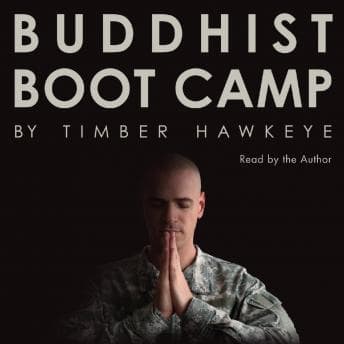

This book is basically what happens when someone takes Buddhism, strips out the incense and the intimidating Sanskrit terminology, and hands you a field manual instead.
I was making dal makhani at 10 PM—one of those elaborate cooking projects I do when I need to process something—and figured I'd put on something short. Two hours and thirty-nine minutes later, I had perfectly simmered lentils and a head full of surprisingly practical wisdom. The research actually shows that micro-interventions work better for behavior change than massive overhauls, and Timber Hawkeye seems to understand this intuitively. Each chapter is bite-sized. No commitment required. Just... here's a thought. Sit with it or don't.
The Author-as-Narrator Psychology
There's something fascinating about hearing an author read their own work, especially in the self-help space. You get the intended emphasis, the pauses that matter, the emotional weight they placed on specific phrases. Hawkeye's delivery is clear—almost deliberately simple. No dramatic flourishes. No attempt to sound like a Wise Spiritual Teacher™. He sounds like a guy who figured some things out and wants to share them without making it weird.
The autobiographical bits, like his story about confronting a fear of spiders, aren't just illustrative. They're vulnerability in action. My therapist would have thoughts about how he uses personal narrative to disarm listener defenses. It works.
What This Is (And Isn't)
Here's where I have to be honest with you. If you're looking for deep Buddhist scholarship—the kind with historical context, debates between schools of thought, nuanced philosophical arguments—this isn't it. One listener complaint I found particularly telling: "Some of the ideas Buddhist thought he presents is incorrect." And yeah, probably. This is Buddhism-adjacent. Buddhism as life hack. Buddhism for people who want the practical applications without the religious framework.
Which is either a feature or a bug depending on what you want.
For me? I appreciated the accessibility. The Dalai Lama quote in the description—"use it to be a better whatever-you-already-are"—captures the whole approach. Hawkeye isn't trying to convert anyone. He's offering tools. Take what works, leave what doesn't.
Why does this non-sectarian approach feel so refreshing? Probably because most spiritual content comes with an agenda attached. This feels like someone sharing notes from their own practice rather than recruiting for a team.
The Short-Form Advantage
The structure is genuinely clever. Short chapters. No required order. You can dip in, get a concept, and return to your life. It's a fascinating case study in how to package wisdom for modern attention spans without dumbing it down. Each section is a complete thought—inspirational quote, teaching, story—rather than a fragment of some larger argument you need to follow.
Is this a limitation? Maybe. The book can feel like a collection of fortune cookies at times. But fortune cookies written by someone who's actually thought about suffering and how to reduce it. Not nothing.
The 2-hour-39-minute runtime is perfect for this format. Long enough to feel substantial. Short enough that you can actually finish it and re-listen (apparently some people have done this a dozen times, which tracks—it's the kind of content that hits different depending on where you are in your life).
The Psychological Mechanics
What makes this content compelling is how it bypasses intellectual resistance. Hawkeye doesn't argue. He doesn't try to prove Buddhism is correct. He just... offers. Here's a perspective. Here's a practice. Here's why it might help.
Psychologically, this tracks. We resist being told what to do. We're more receptive to gentle suggestions from someone who seems to have found something that works for them. The author understands human nature well enough to know that preaching creates pushback.
The "boot camp" framing is interesting too. It suggests rigor without religiosity. Discipline without dogma. For people who are allergic to anything that smells like organized spirituality, this rebranding makes the medicine go down easier.
Who Should (And Shouldn't) Enlist
This is for you if: you're curious about mindfulness but don't want to commit to a meditation retreat or read dense philosophical texts. If you want practical, applicable wisdom in small doses. If you're already stressed and need something calming that doesn't require much cognitive effort to absorb.
Skip it if: you want rigorous Buddhist scholarship. If you're already well-versed in contemplative traditions and would find this too basic. If you're looking for depth over breadth.
The Prescription
I've read enough self-help to be deeply skeptical of the genre. Most of it is recycled obvious advice dressed up in new metaphors. This is... not that. Kybalion tried for profound and landed on cryptic—this book actually achieves clarity. It's simple, yes. Basic, even. But there's a difference between simple and simplistic. Hawkeye lands on the right side of that line.
Would I assign this to my students? No—it's not academic enough. Would I recommend it to a friend going through a rough patch who needs something gentle and practical? Absolutely. Sometimes the most useful interventions are the least complicated ones.