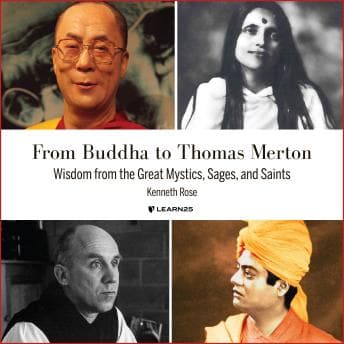

What happens when you put Buddha, Thomas Aquinas, and the Dalai Lama in the same room - or in this case, the same lecture series - and ask them what they agree on?
I was grading a stack of sophomore essays on The Great Gatsby at 11 PM (Denise had already gone to bed, God bless her patience with me) and I needed something in my earbuds that wasn't another teenager's interpretation of the green light as "money or whatever." So I put on Kenneth Rose's lecture course, expecting background-level academic filler. Instead, I found myself putting the red pen down by lecture three.
The Professor You Wish You'd Had at 8 AM
Let me be honest about what this is: it's a lecture course, not a traditional audiobook. Rose is author-narrated here, which means you're getting the man who spent his career at Harvard studying comparative religion delivering his own material. And that distinction matters. When Rose talks about Rumi's ecstatic poetry or Meister Eckhart's dangerous flirtations with heresy, there's a quality of lived engagement that a hired narrator simply couldn't replicate. He's not reading someone else's enthusiasm - he's channeling his own.
The pace is measured. Deliberate. Rose speaks like a man who believes in the weight of each sentence, which - and my students would roll their eyes at this - I deeply respect. The narrator understands that pause is punctuation. He doesn't rush through the Dalai Lama's teachings to get to the next chapter. He lets ideas breathe. At 4 hours and 45 minutes, this isn't asking for a massive time commitment, but it asks for your attention.
Now. Is Rose a professional voice actor? No. And you'll feel that. His delivery is academic - warm and clear, but academic. If you're coming from a Sebastian York or Bahni Turpin performance, the energy level will feel different. This is a classroom, not a stage. But it's a good classroom. The kind where you actually learn something.
Eleven Saints Walk Into a Lecture Hall
Here's what Rose does that I genuinely admire: he takes eleven spiritual figures spanning centuries and continents - Buddha, Aquinas, Rumi, Hildegard of Bingen, the Dalai Lama, Thomas Merton, among others - and instead of flattening their differences into some vague "we're all saying the same thing" universalism, he maps the specific contours of each tradition while showing where the rivers converge.
The sections on lesser-known figures are where Rose really earns his keep. I teach canonical Western literature for a living, so Aquinas and Merton are familiar territory. But Rose's treatment of figures outside the usual Western spiritual syllabus - the ones whose thought was, as he puts it, ahead of their time - gave me something I wasn't expecting: new reading for my own annotated life.
This reminds me of what Hemingway said about the iceberg theory. Rose gives you the visible tenth of each figure's biography and theology, but you can feel the depth underneath. He's not dumbing anything down. He's compressing decades of scholarship into accessible lectures, which is a different skill entirely.
That said - and this is the honest part - not every mystic gets equal treatment, and not every profile lands with the same force. One listener I came across nailed it: some of Rose's chosen figures simply generate more electricity than others. I found myself drifting during a couple of the middle lectures, reaching for that red pen again out of habit. The structure is consistent (historical context, biography, core teachings, legacy), which is helpful for learning but occasionally predictable as a listening experience.
Who Should Hit Play (And Who Should Keep Walking)
If you loved Karen Armstrong's work on comparative religion, this is its spiritual successor - condensed, personal, and genuinely erudite. If you're the kind of listener who wants narrative drive, characters with dramatic arcs, and rising action, this will feel like sitting in on a really good university course. Which is exactly what it is.
This is for focused listening. I tried it on my lakefront walk with Denise one Saturday and kept stopping to replay sections, which she found either endearing or annoying (she wouldn't specify). It rewards attention. It punishes multitasking.
My students would hate this. I love it. Though I'll admit, the last time I felt this cleanly divided from my students' tastes was when I reviewed New Kind of Zeal — they wanted plot velocity, I wanted the slow burn.
But here's my caveat for the audiobook-as-investment crowd: at under five hours, this is a survey course, not a deep dive. You're getting introductions to eleven traditions, not mastery of any single one. If you already have a shelf of comparative religion books, Rose might be covering ground you've walked. If you're newer to interfaith study, though? This is a remarkably efficient and respectful entry point.
Worth Pausing the Faculty Meeting For
Kenneth Rose made me put down my grading pen. For a man who's been marking papers for twenty years, that's not nothing. The prose deserves to be savored - or in this case, the lectures do. It's not flashy. It's not dramatic. But it's the kind of quiet, substantive work that reminds you why people have been chasing wisdom across every culture and century. The kind of thing that makes you want to go read Merton afterward. Or Rumi. Or both.
And honestly? At my age, any audiobook that sends me toward more books instead of away from them has done its job.