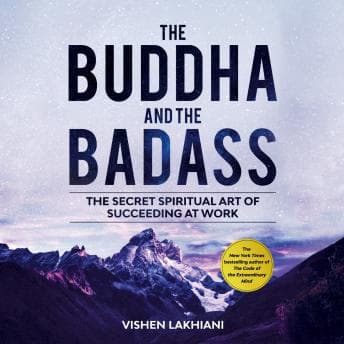

Vishen Lakhiani wants you to meditate AND disrupt industries, and honestly? I have feelings about that.
I was halfway through prepping a lamb rogan josh — hands covered in garam masala, timer going, the whole production — when Lakhiani started describing how he runs Mindvalley team meetings with gratitude exercises and visualization. And I found myself asking: why does this actually work for him when it would get you laughed out of most American boardrooms? That question kept me listening for the next nine hours.
The CEO as His Own Lab Rat
Here's what I'll give Lakhiani credit for: he doesn't just theorize. He built a company, used it as a testing ground for spiritual-meets-business principles, and is reporting back. That's basically applied psychology with a sample size of one organization, which — look, as a researcher, I have thoughts about that methodology. But it's more than most self-help authors offer, which is usually just vibes and a TED talk.
The core framework is this dual archetype thing: the Buddha (inner peace, presence, flow) and the Badass (external impact, building things, challenging norms). Lakhiani argues you need both. Not revolutionary if you've read any contemplative leadership literature, but he packages it with enough personal anecdotes from running Mindvalley — hiring practices based on values alignment, his "unfuckwithable" concept, specific meditation protocols he uses before investor meetings — that it feels grounded rather than abstract.
The protagonist here (and yes, in self-help, the author IS the protagonist) exhibits classic entrepreneurial narcissism tempered by genuine spiritual curiosity. It's a fascinating case study in someone trying to reconcile ambition with mindfulness, and not always succeeding. There are moments where Lakhiani's self-awareness is sharp — he talks about his own failures, his divorce, periods where the company culture he'd built started cracking. And then there are moments where the self-mythologizing kicks in and I wanted to throw my phone into the pot of simmering tomatoes.
Where the Psychology Tracks (and Where It Doesn't)
Some of this is genuinely backed by research. The stuff about flow states, intrinsic vs. extrinsic motivation, the importance of meaning-making in work — the research actually shows these matter. That same psychology of pushing through mental barriers shows up in How Bad Do You Want It?, though applied to athletes rather than entrepreneurs. Lakhiani isn't wrong that most workplaces are soul-crushing by design. His concept of "soulprint" — identifying your unique contribution beyond just job function — maps onto self-determination theory pretty well, even if he never calls it that.
But psychologically, this doesn't track in places. The book sometimes implies that if you just align your inner Buddha with your outer Badass, success follows naturally. That's a dangerous oversimplification. It ignores structural barriers, privilege (and Lakhiani has plenty of it), and the fact that not everyone can afford to "forget hustling" when they're two paychecks from eviction. My therapist would have thoughts about this character — specifically about how easily spiritual language can become a shield against examining one's own advantages.
Also, the exercises. There are guided visualizations and journaling prompts scattered throughout that work better on paper than in audio. You can't exactly do a written values assessment while driving. This is a book that probably benefits from having the physical copy alongside the audiobook, which feels like a design flaw for the format.
Vikas Adam Keeps It Clean
Vikas Adam narrates with steady, clear delivery — no dramatic vocal fireworks, which suits the material. He reads like a smart friend explaining something over coffee rather than a motivational speaker working a stadium. For a book that could easily tip into guru-worship territory, Adam's measured tone actually keeps it grounded. He doesn't oversell the spiritual moments or undersell the business strategy sections. It's professional, it's competent, it's... fine. Not the kind of narration that makes you forget you're listening to an audiobook, but never once did I get pulled out by a weird inflection or misplaced emphasis.
At 9 hours 43 minutes, the pacing is reasonable. It doesn't drag, but there are sections in the middle — particularly around company culture frameworks — that feel like they could've been tightened by an hour.
Who This Is Actually For
If you're a founder, manager, or anyone with actual decision-making power over how a team operates, there are actionable ideas here. Lakhiani's hiring philosophy, his approach to company rituals, his framework for identifying personal mission — these are specific enough to implement. If you're an employee with no organizational authority who's just looking for "how to be happy at work," this book will inspire you for about 48 hours before reality reasserts itself. And if you're allergic to any sentence containing the word "vibration" used non-scientifically, you should know that happens.
My Professional Assessment, Delivered While Cleaning Cumin Off My Counter
It's a 3.5. Lakhiani is smarter than most people in his genre, more honest about his failures than you'd expect, and occasionally genuinely insightful about the intersection of inner work and outer impact. But the blind spots around privilege are real, the audio format fights against the interactive exercises, and some of this is repackaged positive psychology without proper attribution. Worth your time if you're in a position to actually change your work environment. Less useful as pure personal development unless you pair it with something more structurally aware.