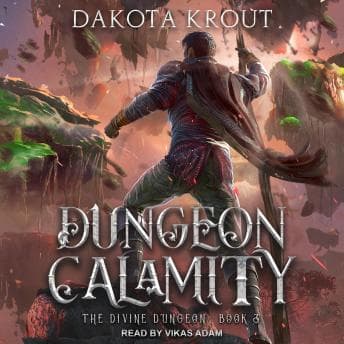

Quick Verdict: Worth your commute. This is basically what happens when a dungeon AI has a mental breakdown and it's way more entertaining than it has any right to be.
Look, I've been putting off this series for months because "sentient dungeon" sounded like a gimmick that would get old fast. I was wrong. I finished Dungeon Calamity in exactly 6 commutes (yes, I counted), and I'm already queuing up the next one.
When Your Dungeon Has a Breakdown
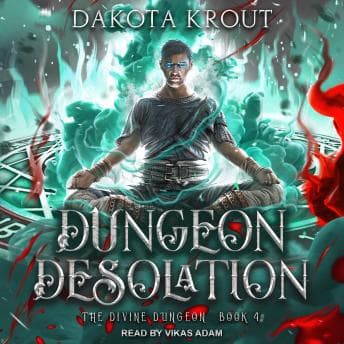
So here's the setup: Cal, our dungeon protagonist, loses his Wisp companion and starts going full unhinged. We're talking traps that would make Jigsaw uncomfortable, monsters that cross ethical lines even by dungeon standards. And honestly? The psychological spiral is what hooked me. Dakota Krout doesn't just tell you Cal's losing it—you feel the logic getting twisted, the moral compass spinning. It's like watching a distributed system slowly corrupt its own state. (Yes, I'm making that comparison. No, I won't apologize.)
Meanwhile, Dale's storyline is the classic "I thought I was strong until I left my bubble" arc, which—okay, been there. Not in a fantasy combat sense, but definitely in a "presented my code at a conference and got destroyed" sense. The parallel narratives work surprisingly well, even if Dale's sections occasionally feel like they're interrupting the good stuff. Iron Gold had a similar multi-POV structure that sometimes worked against itself, though at least here the dungeon perspective stays consistently engaging.
Vikas Adam Gets the Assignment
Vikas Adam is doing some serious heavy lifting here. Cal's voice has this detached, slightly unhinged quality that perfectly captures "AI having an existential crisis." But the real win is how he differentiates the massive cast. Every character sounds distinct—not just accent-different, but personality-different. The necromancers sound appropriately menacing without going full cartoon villain. The supporting characters have enough texture that I could actually track who was who during complex scenes.
The pacing? Perfect for 6 AM zombie brain. Adam knows when to punch dialogue and when to let descriptions breathe. I never had to rewind because I zoned out during a critical moment. That's the real test.
The humor lands too. There's this specific brand of litRPG comedy—kind of meta, kind of absurdist—and Adam leans into it without overselling. When Cal makes a particularly dark decision and there's this beat of "well, that happened," it hits right.
About That Body Count
Fair warning: there's a LOT of killing in this book. Like, a lot a lot. Necromancers gonna necromance, dungeons gonna dungeon. If you're sensitive to fantasy violence, maybe not this one. But if you've read any progression fantasy, you know what you're signing up for. The body count is high but it serves the story—this is a war, and Krout doesn't pretend otherwise.
The dark themes around necromancy actually add weight to what could've been a fluffy dungeon-building romp. Cal's struggle to maintain his morality while literally designed to kill intruders? That's genuinely interesting philosophical territory for a litRPG.
Best Use Cases (and When to Skip)
This is ideal commute material. Complex enough to keep you engaged, not so intricate that you'll lose the plot if someone bumps into you on a crowded Caltrain. The 13-hour runtime is substantial but doesn't drag. I hit 1.5x for most of it, dropped to 1.25x during the bigger action sequences just to catch all the details.
Listen if: You want progression fantasy with actual psychological depth, or you've ever wondered what happens when a dungeon-core AI goes off the rails. Skip if: Fantasy violence isn't your thing, or you need something for deep work. And maybe don't start this one right before bed unless you want to stay up way too late. I made that mistake once. The cliffhangers are real.
The ROI Breakdown
Probably not a full relisten for me, but I could see revisiting specific sections. The dungeon-building mechanics are satisfying in that spreadsheet-brain way, and some of Cal's trap designs are genuinely clever. If you're into litRPG at all, this series is basically required reading—or required listening, in this case.
The ROI on this audiobook is solid. 13 hours of entertainment, zero moments where I wanted to skip ahead, and a narrator who clearly understands the assignment. Vikas Adam doesn't have Ray Porter's gravitas, but he brings exactly the right energy for this material. Lighter, more playful, with just enough edge when things get dark.
Kevin's already stolen my Audible login to start the series from book one. I'm choosing to take that as a compliment to my taste.