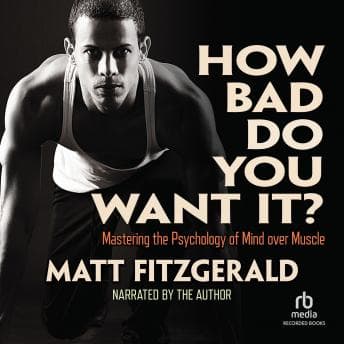

Look, I picked this up because I've been thinking a lot about why some people push through pain and others don't. It's a question that haunts my research on motivation and self-regulation. And Matt Fitzgerald's book? It's basically a case study collection for the psychologically curious athlete. Or in my case, the psychologically curious person who jogs and pretends she's training for something.
Here's the thing about How Bad Do You Want It? - it's not really a how-to book. If you're expecting a step-by-step mental training program with exercises and worksheets, you're going to be disappointed. What Fitzgerald does instead is something I find way more interesting: he takes pivotal moments from elite athletes' careers and dissects the psychology behind them. It's narrative psychology applied to sports, and honestly? I was here for it.
The Case Studies That Actually Stuck
Fitzgerald structures each chapter around a specific race or competition, then extracts a psychological principle from it. The research he cites aligns with what we know about perception of effort and the psychobiological model of endurance - basically, that your brain decides when you're "done" long before your body actually is. This isn't revolutionary if you've read the literature, but Fitzgerald makes it accessible in a way that academic papers never do.
What I found compelling was how he demonstrates that mental toughness isn't some mystical trait you either have or don't. It's a set of cognitive strategies that can be learned. The chapter on "bracing yourself" for pain - essentially, accepting that suffering is coming and choosing to meet it - reminded me of research on anticipatory coping. Athletes who mentally rehearse the hard parts perform better than those who hope it won't be that bad. (My therapist would have thoughts about the life applications here.)
The protagonist of each chapter exhibits classic patterns of either adaptive or maladaptive response to stress. Some crack under pressure - Fitzgerald calls it a form of self-consciousness, which tracks with what we know about choking. Others find a way to reframe the pain, to make it meaningful. The difference isn't physical. It's entirely mental.
When the Author Becomes the Narrator
So here's where I have mixed feelings. Fitzgerald narrates his own book, which I generally love because you get the intended emphasis, the pauses where they matter. And there's an authenticity to hearing an author read their own work that a professional narrator can't replicate.
But. He talks fast. Like, really fast at first. I caught myself rewinding because I'd zoned out during a key point and realized I'd missed three sentences. Once I adjusted (took maybe 30 minutes), it was fine. His delivery is journalistic - clear, competent, not dramatic. If you want someone who's going to perform the agony of a marathon finish with theatrical intensity, this isn't it. Fitzgerald reads like a sports journalist telling you about the race, not like he's reliving it in real-time.
Is that a problem? Depends on what you want. I found the restraint appropriate for the content. This is a book about science and psychology dressed in athletic narrative, not a memoir about suffering. The emotional flatness some listeners complain about didn't bother me because I was there for the ideas, not the feels.
What's Missing (And Why It Matters)
Here's my honest critique: Fitzgerald is better at describing what mental toughness looks like than teaching you how to build it. Each chapter ends with a principle, sure, but the application is vague. "Believe in your training." "Accept the pain." Okay, but how? The research actually shows that implementation intentions - specific if-then plans - are what make psychological strategies work. Fitzgerald gestures at this but doesn't go deep.
For endurance athletes who already have a practice and just need inspiration and framework, this is probably enough. For someone looking to fundamentally change their relationship with effort and discomfort? You might need to supplement with more structured mental training resources.
I also noticed the book leans heavily on running, cycling, and triathlon. If you're not into endurance sports, some chapters will feel less relevant. The principles are universal, but the examples assume you care about split times and race strategy.
Would I Listen Again?
Probably not cover to cover, but I've already gone back to specific chapters when I needed a mental reset before a hard workout. (Yes, I'm that person now. Don't tell my colleagues.) The book works as a reference library of psychological case studies, each one illustrating a different facet of how perception shapes performance.
What makes this book worth your time is that Fitzgerald understands something fundamental about human nature: we don't perform to our physical limits, we perform to our perceived limits. And those limits are negotiable. That's not just a sports insight. That's a life insight.
The same principle applies to creative work, which is why I found myself thinking about Big Magic: Creative Living Beyond Fear while listening to this—both books are really about negotiating with your own resistance.
Who Should Listen (And Who Should Skip)
Endurance athletes, sports psychology enthusiasts, or anyone who's ever wondered why they quit before their body actually needed to - this is worth your time. Skip it if you want a structured training manual with exercises; this is inspiration and framework, not a workbook. And maybe slow down the playback speed for the first hour.