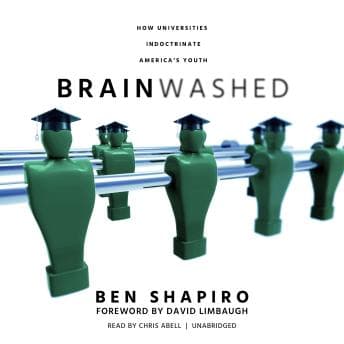

How many of us who served came home and used our GI Bill benefits without once questioning what was actually being sold in those lecture halls?
I finished this one on a late Tuesday night, sitting on the back porch with Ranger sprawled across my feet and a bourbon I probably didn't need. Linda had gone to bed. The neighborhood was dead quiet - which was the right setting, because this book got my blood pressure up enough without distractions.
A Young Man Brought a Knife to a Gunfight (And Knew It)
Let me cut to the chase: Shapiro wrote this as a 20-year-old UCLA grad, and you can feel that energy throughout - raw, angry, swinging at everything that moves. There's a fearlessness to it that I respect. In the military, we had a saying about lieutenants who were bold but green: "High speed, low drag, no map." That's this book in a nutshell.
The strongest sections are when Shapiro pulls from his own campus experience - specific professors, specific policies, specific instances of ideological gatekeeping. He's not just theorizing from a think tank. He was there, in the trenches (and yes, I'm using that metaphor loosely - nobody was shooting at him, which he'd be the first to admit). The section near the end about tuition dollars funding groups like MEChA - student organizations with genuinely radical charters - is the kind of concrete, follow-the-money reporting I wish there was more of. That's intelligence work. Show me the money trail, show me the org chart, and I'll believe your threat assessment.
But here's where it lost me: the book swings between sharp institutional critique and what sometimes feels like a greatest-hits compilation of campus outrages without enough connective tissue. After 25 years in the Army, I know the difference between a thorough intelligence briefing and a target list. This leans toward the latter too often. You get example after example - professor said this, textbook claims that - but the analytical framework holding it together can feel thin. He was 20. I get it. I wrote some pretty confident after-action reports as a second lieutenant that make me wince now.
The Last Chapter Does the Heavy Lifting
The final chapter on solutions - including his discussion of places like Hillsdale College that operate outside the federal funding apparatus - is actually the most valuable part of the whole listen. It's the "so what" that every good brief needs. I've sat through a thousand PowerPoint presentations where junior officers could identify every problem in the battlespace but couldn't articulate a single course of action. Piece of Cake: A Memoir had that same frustrating quality in its early sections — all diagnosis, no prescription — though it earned its ending in a way this book only partially does. Shapiro at least attempts the COA slide, and his point about funding mechanisms as leverage is genuinely worth considering.
At 7 hours and 20 minutes, it's a reasonable commitment. Doesn't overstay its welcome. The book knows what it wants to say and says it - no 400-page academic padding.
Chris Abell Gets the Job Done
Abell's narration is clean, professional, and appropriately energetic without going full cable-news-pundit. He reads Shapiro's more sardonic passages with the right amount of edge without turning it into a performance piece. At 1.25x, the pacing felt natural - Abell's default tempo is measured enough that the speed bump keeps things moving like a proper briefing.
No audio issues, no weird production artifacts. Straight clean read. Not flashy, but competent. Like a good staff officer - you don't notice them until they're gone.
Know What You're Getting Into
Worth your time? Here's the debrief: If you're already in Shapiro's camp, this will arm you with specific examples and some structural arguments about how university systems perpetuate ideological conformity. If you're looking for a balanced, both-sides examination of higher education's political leanings, this isn't that mission. Shapiro isn't pretending to be a neutral observer, and honestly, I'd rather someone be upfront about their position than fake objectivity. I've seen this scenario play out in real life - I've hired analysts from top universities who couldn't think outside the framework they were handed. The problem Shapiro identifies is real, even if his 20-year-old self didn't always prosecute the argument with the discipline it deserved.
The book is dated now - written in the mid-2000s - and campus culture has shifted significantly since then, which is both a weakness (some examples feel like ancient history) and ironically a strength (many of his predictions about where things were heading turned out to be pretty accurate).
Parents sending kids to college will find some genuinely useful food for thought here. Academics looking for a rigorous critique of university culture should look elsewhere - try Jonathan Haidt's work instead. People who want to hate-listen will get exactly what they came for.
Mission Debrief
Solid reconnaissance report from a young operative, not a finished intelligence product. Ranger slept through most of it, which tells me the explosions were ideological rather than literal. Linda would've turned it off in ten minutes. I listened to the whole thing and I'm glad I did - but I'm not going back for a second pass.







![Steve Jobs [unabridged audiobook] audiobook cover](/_next/image?url=https%3A%2F%2Fcovers.audiobooks.com%2Fimages%2Fcovers%2Ffull%2F9788499923406.jpg&w=1920&q=75)