
I've been debugging my own brain for years—therapy, medication adjustments, the whole stack. So when I heard about a Harvard psychiatrist claiming mental illness is basically a metabolic bug, my skeptic alarm went off hard. Another "one weird trick" book? Another oversimplification that could've been a TED talk?
Turns out I was wrong. Mostly.
The Thesis That Actually Compiles
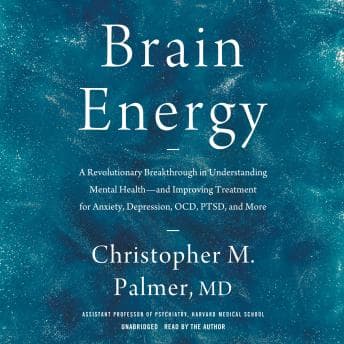
Dr. Palmer's core argument is elegantly simple: mental disorders aren't separate conditions with separate causes—they're all symptoms of mitochondrial dysfunction. Your brain cells aren't getting enough energy, and everything downstream breaks. Depression, anxiety, schizophrenia, ADHD—different manifestations of the same underlying metabolic failure.
And here's the thing that got me: the science actually holds up. He walks through decades of research connecting metabolic disorders (diabetes, obesity, heart disease) to mental illness. The correlation data is genuinely striking—people with bipolar disorder have significantly higher rates of metabolic syndrome, and it's not just from the meds. He explains how the ketogenic diet, originally developed for epilepsy, has shown promise for treatment-resistant schizophrenia. Real case studies, real patients, real outcomes.
I finished this in about 6 commutes, and by commute 3, I was texting Kevin excerpts about mitochondrial dysfunction. He told me I needed to stop treating our relationship like a debugging session. Fair.
Author-Narrated: Clear But Flat
Dr. Palmer narrates his own book. He's a psychiatrist, not a voice actor, and it shows. The delivery is clear and authoritative—you can tell he knows this material cold. But there's a flatness to it that makes 12+ hours feel longer than it should. No dynamic range, no emphasis that helps you track what's critical versus what's supporting detail.
I bumped it to 1.5x around hour 4 and never looked back. At normal speed, the pacing drags through the more technical sections. At 1.5x, it feels like a really detailed podcast—which is probably the right comparison. Some listeners have said they preferred his podcast appearances to the audiobook, and I get that. The content deserves a narrator who can make mitochondria sound exciting. Ray Porter, if you're reading this, please.
The ROI Problem
Here's where my engineer brain got frustrated: the actionable advice ratio is... not great. Palmer spends maybe 80% of the book building his theoretical framework and 20% on "so what do I actually do about this." The interventions he does mention—ketogenic diet, fasting, exercise, sleep optimization—aren't exactly revolutionary. They're solid, evidence-based suggestions, but if you've spent any time in the biohacking space, you've heard most of this before.
The patient stories are genuinely moving. There's one about a man with treatment-resistant schizophrenia who achieved remission through dietary changes—and Palmer is careful to note this isn't typical, that results vary, that this is early research. I appreciated the intellectual honesty. But I found myself wanting more specifics. What exactly did these patients eat? What was the timeline? How do you actually implement this if you're currently struggling to get out of bed?
This is basically "Why We Sleep" but for metabolism and mental health. If you're looking for something more immediately actionable on the self-improvement front, Millionaire Next Door delivers way more concrete takeaways per hour of listening. Big theory, compelling evidence, somewhat thin on the practical implementation.
Save It for Focus Mode, Not the 6AM Train
This is NOT a commute book. I made that mistake the first morning and realized I'd zoned out through an entire section on cellular respiration. The science is dense enough that you need actual attention. Save it for a weekend deep-dive or a long solo drive where you can actually engage.
Who should listen: Anyone frustrated with the current mental health treatment paradigm. People who've tried multiple medications with limited success. Biohackers who want the scientific backing for why their keto experiment might be helping their mood. Clinicians looking for a new framework.
Who should skip: If you want a step-by-step protocol, this isn't it. If you find cellular biology boring, the middle section will lose you. If you need engaging narration to stay focused, wait for a professional narrator version (if one ever happens).
Worth the Debug Time?
The core thesis is genuinely paradigm-shifting, and Palmer presents it with appropriate scientific rigor. The narration is functional but uninspiring. The practical takeaways are thinner than I'd like. But I came away with a fundamentally different mental model for thinking about mental health—and that's worth something.
I've already recommended it to three friends dealing with treatment-resistant depression. With the caveat that they should probably read the print version instead.