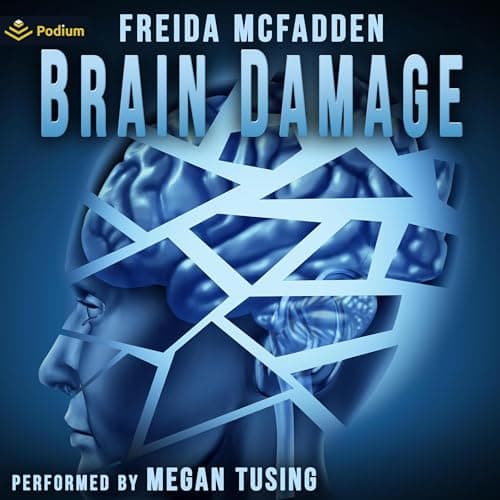

Freida McFadden is a practicing brain injury physician who wrote a novel about brain injury recovery. Let that sink in for a second.
I was shelving returns at the library on a Thursday evening — the branch was empty, that particular kind of quiet where the fluorescent lights seem louder than they should be — and I had this playing through my earbuds. Chapter after chapter of Charly McKenna relearning how to use the left side of her body, struggling to form words, fighting through therapy sessions that feel more like humiliation rituals. And I kept thinking: this is the real horror. Not the bullet. Not the mystery of who pulled the trigger. The horror is waking up and your own body has become a stranger.
The Slow Rot of Recovery
Look, I need to be upfront. This isn't horror in the traditional sense. It's shelved as a thriller, and the mystery architecture is there — someone shot Charly, the answer is locked in the damaged right hemisphere of her brain, she has to piece it together before the shooter comes back. Classic setup. But McFadden spends an almost uncomfortable amount of time in the recovery itself. The therapy sessions where Charly can't grip a fork. The flashbacks that blur with present-day confusion. The way her internal monologue shifts between sharp pre-injury Charly and the post-injury version who's fighting through cognitive fog.
This is where the book either works for you or doesn't. If you're here for a sprint, you'll be frustrated. Listeners who bounced early weren't wrong — things genuinely don't pick up thriller-pace until deep into the second half. But I'd argue that slow burn is the point. McFadden knows brain injury from the inside out. She's not approximating. She's documenting. And that clinical precision creates a dread that most thriller writers can't touch because they don't have the expertise to earn it.
The unexpected humor helps, too. Charly's voice — even damaged, even struggling — has this dry, self-aware edge. She knows her situation is absurd. She knows the dermatologist-to-disabled pipeline is a cruel joke. McFadden lets her be funny about it without undercutting the gravity, which is a tightrope I've seen plenty of authors fall off of.
Megan Tusing Understands the Assignment
The narrator commits. That's rare. Tusing handles the split between pre-injury and post-injury Charly with real control — the pre-injury flashbacks are crisp, confident, a little performatively polished (which fits, because pre-injury Charly was performatively polished). Post-injury Charly is slower, more halting, and Tusing doesn't overplay it. She doesn't make it a caricature of disability. She makes it sound like someone genuinely working to get the words out.
Her male voices are the weak spot, and yeah, it's the typical issue with a solo female narrator trying to pitch down for husbands and doctors and detectives. It's not terrible — you always know who's speaking — but the husband in particular sounds a bit like she's doing an impression of "generic male" rather than a specific person. In a book where the husband is actually important to the mystery, that's a missed opportunity.
But the emotional register? Tusing nails it. The therapy scenes carry real weight. There's a rawness in how she voices Charly's frustration — not screaming, not melodramatic, just this grinding exhaustion that made me stop shelving books and stand there in the 616 section (that's Dewey for diseases of the nervous system, and yes, the irony was not lost on me).
The Twist Problem
Okay. Here's where I have to be honest, and my podcast listeners know I don't pull punches. The mystery resolution is... exactly who I thought it was. By about the midpoint, the jigsaw Charly is assembling has pretty obvious edges, and when the full picture snaps into place, it's less "oh god" and more "yeah, that tracks." Anti-climactic is a strong word, but the landing doesn't match the buildup.
And that's frustrating because the buildup is genuinely excellent. McFadden constructs this paranoid atmosphere where Charly can't trust her own perception — damaged brain, unreliable memories, a body that betrays her — and that uncertainty is the engine of the whole book. When the answer turns out to be the most straightforward version of events, it deflates some of that carefully built tension.
Compared to Never Lie, which has a tighter structure and a twist that actually earns its reveal, Brain Damage trades surprise for authenticity. Whether that trade works for you depends entirely on what you came for.
Who Should Listen (And Who Should Skip)
If you scare easily, this isn't that kind of book. But if the idea of losing yourself — your competence, your independence, your ability to trust your own mind — gets under your skin the way it gets under mine, this is potent stuff. It's closer to psychological horror than pure thriller, and I mean that as a compliment. Skip it if you need a fast-burning whodunit with a knockout twist; this one's more about the wound than the weapon. If you've got a medical background or you're drawn to stories about the body failing its owner, though, you'll find something here that most thrillers don't even attempt.
The 9-hour runtime feels right for the story, though I'd say 1.25x speed smooths out some of the pacing drag in the first third without losing Tusing's careful emotional work.
Shirley (my cat) was unimpressed. I was genuinely unsettled — not by the whodunit, but by the what-if-this-happened-to-me of it all. McFadden's medical background turns what could've been a standard domestic thriller into something that understands the body as a horror landscape. And that? That I respect. The body-as-threat territory actually made me think of Into the Drowning Deep, which weaponizes biological horror in a completely different setting but lands that same gut-level dread of flesh turning against you.
Shelving This One in the Right Section
Not the strongest McFadden thriller, but maybe her most felt one. The mystery disappoints. The humanity doesn't. Worth the listen for the recovery portrayal alone — just go in knowing the destination matters less than the brutal, funny, heartbreaking road to getting there.