
"There is danger in your future." I was standing over a pot of dal at 9:40 p.m., tempering cumin in too much ghee like my mother taught me not to, when Greta said that line and I actually turned the stove down just to listen harder. Which is rude, frankly. I had dinner plans with myself.
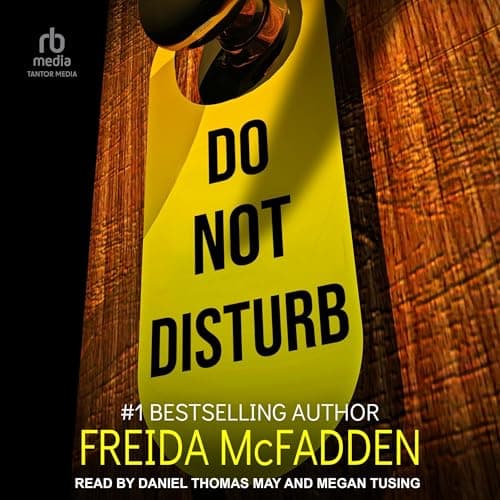
Freida McFadden's Do Not Disturb knows exactly how to weaponize a familiar thriller setup: a woman on the run, a snowstorm, a motel that should come with tetanus shots and a prayer, and a man who seems a little too helpful for anyone's good. Quinn Alexander has done something bad enough that prison is on the table, and her plan is simple - get to the border, disappear, survive. Then weather and terrible luck push her into the Baxter Motel, where Nick Baxter offers shelter, the place has a nasty history, and his sick wife's silhouette keeps appearing in the house across the way. At the window. Watching. Excellent. My therapist would have thoughts about why I keep listening to books like this right before bed.
What makes this book work is not originality of premise. It's velocity plus paranoia. McFadden is very good at building the kind of forward momentum where every new detail feels like either a clue or a trap, and you don't know which until much later.
Why Quinn's bad decisions still work
A lot of listener complaints circle Quinn being unlikable or dumb. I get it. She makes choices that will have experienced thriller readers muttering, babe, no. The same dynamic shows up in Dog on It, where a protagonist's flawed judgment reads less like bad writing and more like a case study in motivated reasoning under pressure. But the protagonist exhibits classic panic cognition: narrowed thinking, short-term survival over long-term logic, and that very human belief that one more bad decision might somehow rescue the last five. Psychologically, this tracks more than people want to admit.
Quinn is not here to be admired. She's here to be cornered.
That distinction matters, because Do Not Disturb gets much of its tension from Quinn being morally compromised before she even checks in. The book doesn't ask, "Will this innocent woman survive?" It asks a more interesting question: what does a guilty person recognize in other guilty people? That's why the motel material lands. Nick's kindness feels calibrated. The motel's decay feels less atmospheric than accusatory. And the image of the ailing wife in the window is exactly the kind of visual this subgenre thrives on - melodramatic, yes, but also weirdly primal. Someone sees you. Someone knows.
Then there's the mid-book shift to Quinn's older sister, Claudia. I liked that choice more than I expected to. Just when the story risks becoming a closed-room panic spiral, McFadden widens the lens. Claudia's arrival adds context and reframes Quinn without sanding down her rough edges. It also changes the emotional geometry of the book. Suddenly this isn't just about escape. It's about family narratives, who gets cast as the reckless one, who cleans up the mess, who is believed. As someone who studies how identity gets built through story, I perked up there.
Not every twist hit with the same force, though. If you've inhaled a lot of psychological thrillers, you may see some of the machinery before the curtain drops. And the ending - while undeniably energetic - does flirt with the contrived. I didn't hate it. But I did have that very specific thriller-reader reaction of laughing once and then thinking, okay, that's a lot.
The motel voices in your head
This re-recording lives or dies on performance, and Megan Tusing does the heavy lifting well. Quinn's voice has the right brittle urgency - she sounds like someone who is trying to stay functional by sheer force of adrenaline. Tusing doesn't overplay the fear, which helps. Too much trembling and the character becomes exhausting. Here, she stays sharp enough to keep the suspense moving even when Quinn herself is making me question her frontal lobe.
And apparently I'm joining the chorus on Greta's voice, because yes, it's excellent. Creepy without slipping into caricature. That matters. A line like "There is danger in your future" can sound ridiculous if the actor leans too hard. Instead, it lands as eerie and oddly matter-of-fact, which is much more unsettling.
Daniel Thomas May has less runway, but he gives the secondary material a useful tonal shift. Since the book plays with perspective, having two narrators helps orient the listener when the story pivots. No music, no sound effects, no production gimmicks - just clean audio and strong enough performances to keep the motel atmosphere intact. For a book like this, that's the right call. You don't need fake thunderclaps when the text already has a woman trapped in a snowstorm staring at a silhouette in a window.
I did notice the middle sag a bit. Not enough to lose me, but enough that I bumped the speed to 1.25x while out on a gray morning run along the Charles. That tightened the repetition and made the suspicious glances, withheld information, and Quinn's internal spiraling feel brisk instead of stalled.
Who should listen (and who should walk past the front desk)
Pick this up if you like your thrillers built on bad choices, locked-in settings, and escalating dread rather than pristine realism. You also need to be okay with a protagonist who is stressful on purpose. If you require your main character to make consistently sensible decisions, you will be annoyed by hour two. Maybe earlier. Skip it if you're burned out on the "isolated location + mysterious host" formula - this one plays the hits well, but they're still the hits.
Compared with some of McFadden's other books, this one has a slightly stranger structure, and the Claudia shift gives it more shape than a straight motel-survival plot would've had. I don't think it's her most elegant ending. But it is one of her more addictive setups, and in audio that counts for a lot.
My last note, poured out like the last inch of wine: this is a very good binge listen, not a profound one. It wants your nerves, not your soul. Sometimes that's exactly the assignment.
And yes, I did check my own windows before sleeping. Embarrassing. But earned.