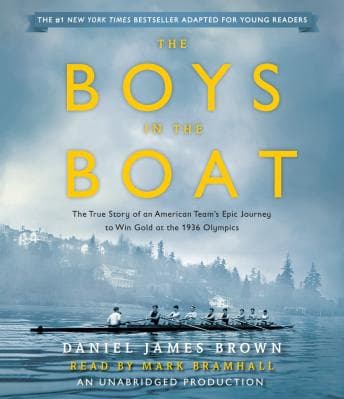

So I'm sitting in my apartment at like 1 AM, ostensibly debugging a procedural terrain generation algorithm that's been producing maps that look like melted cheese, and I throw this on because I figured a five-and-a-half-hour listen about rowing would be the perfect background noise to keep me company while I fixed my Perlin noise implementation. Reader, I did not fix the Perlin noise. I stopped coding about twenty minutes in and just... listened.
Here's the thing. I'm a fantasy guy. Dragons, magic systems, 40-hour epics where the glossary is longer than most novels. So when I tell you that a young readers adaptation about Depression-era college rowers had me white-knuckling my desk chair, you should understand the weight of that statement.
Nine Kids With No Stats, All Heart
Let me frame this in terms my D&D group would understand: Joe Rantz is basically a level-1 character with no gold, no party, and the worst backstory your DM could write — abandoned by his family, literally sleeping in the woods, scrounging to survive. No magic items, no patron, nothing. And the campaign he's been dropped into? Row for the University of Washington against Ivy League crews who've basically been min-maxing since birth, then go to Berlin and beat the boat Hitler personally endorsed.
The progression is satisfying. Brown does something clever with the young readers adaptation — he strips the adult version down to its emotional skeleton without losing the structural tension. You get the rivalry between the West Coast boys and the East Coast establishment. You get the boat builder George Pocock, who talks about wooden shells the way Sanderson writes about Allomantic metals — with this reverence that makes you believe the craft itself is almost alive. And you get Al Ulbrickson, the stoic coach who's basically running a campaign where his players keep almost getting cut.
What I didn't expect was how much the team dynamics would hit me. There's this idea in rowing — "swing" — where eight individuals somehow synchronize into one organism. Brown keeps circling back to it, and by the time the crew actually achieves it, you feel it. My D&D group has been chasing that kind of synergy for years and we still can't coordinate a flanking maneuver, so maybe I'm projecting, but still.
Bramhall Rows Steady
Mark Bramhall's narration is the audiobook equivalent of a reliable coxswain — he's not doing wild vocal gymnastics (this isn't Steven Pacey territory, and it doesn't need to be), but his pacing is precise. Where a flashier narrator might ham up the Olympic race sequences, Bramhall trusts the material. His read is measured during the Depression-era hardship sections, letting the weight of Joe's circumstances just sit there without melodrama. And then during the racing scenes — particularly the final Olympic race in Berlin — he tightens his cadence in a way that mirrors the stroke rate increasing. It's subtle. I noticed it on the second race sequence and then couldn't un-notice it.
He doesn't do wildly distinct character voices, which honestly makes sense for nonfiction. The transitions between narrative sections and quoted dialogue are smooth enough that you never lose track of who's speaking. It's a clean, professional performance from an Audie Award winner, and it serves the story exactly the way it should.
Compared to, say, Tim Gerard Reynolds narrating an epic fantasy, it's a completely different skill set — Reynolds is building a cast of dozens; Bramhall is building a mood. And the mood here is quiet determination slowly building to a roar.
The Young Readers Question (And Why It Doesn't Matter)
Okay, yes, this is a young readers adaptation. At 5 hours 36 minutes, it's significantly shorter than the full adult version. And look — if you're a hardcore history nerd who wants every technical detail about hull design and interwar politics, the adult version exists and it's excellent. But here's what this adaptation does better: it moves. There's no fat on this thing. Brown trimmed it to its emotional core — Joe's journey, the team's bond, the race — and the result is something that works for a 12-year-old AND for a 27-year-old CS grad student procrastinating his thesis at 2 AM. Every Day pulled a similar trick on me — a premise that sounds like YA fluff but somehow has enough emotional architecture to keep an adult genuinely invested to the end.
I read this instead of writing my thesis. (Well, listened. Same energy.) And I'd do it again.
Who Needs to Hear This
If you've got kids who need something that isn't another dystopian YA novel — put this in their ears. If you loved Unbroken or Seabiscuit and want that same "underdogs vs. history" rush in a tight package, this delivers. If you're a fantasy listener like me who thinks nonfiction can't generate real tension — buddy, the 1936 Olympic final will change your mind.
Skip it if you specifically want the deep-dive version with full historical context. That's a different audiobook and a different experience.
Roll for Inspiration (You Won't Need It)
Nine working-class kids from the Pacific Northwest rowing against fascism. It sounds like the pitch for the most insane one-shot campaign ever, except it actually happened. Bramhall tells it straight, Brown tells it lean, and by the final strokes in Berlin you're holding your breath even though you know how it ends. That's the mark of a story that works — when history itself has the tension of fiction.
Now if you'll excuse me, I have a thesis to not write and a terrain generator that still looks like melted cheese.