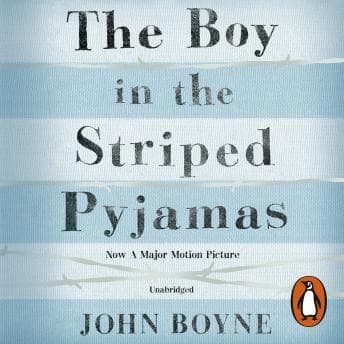

"We don't have the luxury of unhappiness." That's not from the book. That's something my mom said to me when I was nine, roughly Bruno's age, when I asked why we couldn't go to Disneyland like my friends. I thought about her a lot during these five hours.
I picked this up on a red-eye to Austin - client meeting at 7 AM, couldn't sleep, figured a sub-five-hour listen tagged "Kids & Family" would be light enough to drift off to. I did not drift off. I sat in seat 14C with my noise-canceling headphones on, staring at the seat back in front of me, feeling like I'd been hit by a truck.
A Nine-Year-Old's Ignorance as Strategy
Here's the thing about this book that'll frustrate some people: Bruno is aggressively naive. He calls Auschwitz "Out-With." The Führer becomes "the Fury." At first I thought Boyne was being cute, and my consulting brain immediately flagged it - are we dumbing down the Holocaust for palatability? But somewhere around the second hour, when Bruno keeps describing the people on the other side of the fence in their "striped pyjamas" without any comprehension of what he's seeing, it clicked. The ignorance isn't the point. The comfort of that ignorance is the point. Bruno's father is a Nazi commandant, and this kid has been so insulated by privilege that genocide is just... the weird thing happening behind the house.
I've sat in boardrooms where executives couldn't tell you what happened on their own factory floors. Different scale, obviously. But the architecture of willful not-knowing? That's universal.
The friendship between Bruno and Shmuel - the boy on the other side of the fence - is drawn with this devastating simplicity. Two kids sitting on opposite sides of a wire barrier, sharing stories. Shmuel is hungry. Bruno sneaks him food sometimes. They talk about their lives like any two kids would, except one of them is starving in a concentration camp and the other one thinks his own situation (moving from Berlin to the countryside) is the real tragedy. Boyne never editorializes. He just lets that gap sit there, and it does more work than any lecture could.
Michael Maloney Does Enough - Barely
Maloney's narration is... fine. I'll give him credit for Bruno's voice - he captures that specific frequency of a nine-year-old who's simultaneously curious and self-absorbed, the way Bruno shifts from excited chatter to indignant anger when things don't go his way. It's believable. You buy this kid.
But here's where I'll be the consultant nobody asked for: a stronger narrator would have differentiated the supporting cast more. Bruno's father, his mother, the soldiers - they all live in this same calm, slightly modulated register. For a book where the adults are complicit in horror while maintaining domestic normalcy, you'd want to hear that dissonance. The dinner table conversations should sound different from the fence conversations. They don't, really. Maloney keeps everything at the same emotional temperature, and while that works for the fable-like quality Boyne is going for, it also means the moments that should gut-punch you sometimes just... arrive quietly.
Some people have argued they should've cast a child actor. I get it. I don't fully agree - a kid narrator for five hours is a gamble - but I get it.
Jenny would say I'm being harsh. Jenny is right. The narration doesn't hurt the book. It just doesn't elevate it the way the material deserves.
What My Parents' Generation Would Say About This Book
My parents' generation - Korean War survivors, immigrants, people who knew what it meant to lose everything - they didn't need fables to understand what happens when ordinary people look away. My dad never read a book about it. He lived adjacent to it. So when I hear Bruno's mother slowly unraveling as she realizes what her husband's "important work" actually involves, when she starts drinking more and fighting more and eventually demanding they leave - I don't think "what a well-constructed character arc." I think about every spouse I've watched in consulting who figured out too late what the company was actually doing.
The ending. I won't spoil it, but I will say this: at 2.0x speed, it still hit like a freight train. Five minutes of audio that reframes everything you just heard. I sat on that plane and didn't move for a full minute after it ended. The flight attendant asked if I was okay.
I was not okay.
Who Gets the Most Out of This
If you want a business book, this isn't it. But if you want to understand complicity - how systems make monsters out of bureaucrats, how proximity to evil gets normalized one small compromise at a time - this five-hour listen teaches that lesson better than any leadership ethics seminar I've ever sat through. And I've sat through dozens.
Parents: this is a gut-wrenching way to introduce kids to the Holocaust, but an effective one. Listen together. You'll want to talk after.
Skip if: you need historical accuracy above all else (Boyne has caught criticism from historians, and some of it is fair), or if you're looking for a comprehensive account of the Holocaust. This is a fable. It operates on fable logic.
The Invoice
Bottom line: Under five hours. No padding. A story that uses a child's ignorance to indict an entire system of adult complicity. The narration is serviceable, not spectacular, and the book has legitimate historical critiques worth reading about separately. The Christie Affair scratched a similar itch for me - another novel that uses an unconventional narrative frame to smuggle in something genuinely devastating. But the emotional ROI on this one is off the charts. Sometimes the most efficient use of your time is letting something break your heart a little.
Finally, a book that respects your time. Even if it doesn't respect your emotional stability.