Look, I need to rant for a second. Lord Dunsany — the man who basically invented modern fantasy, the writer Lovecraft called the greatest prose stylist of his age, the author whose weird dreamscapes gave Tolkien permission to build Middle-earth — deserves better than this. I'm not saying that to be cruel. I'm saying it because these stories are some of the most gorgeous, hallucinatory prose in the English language, and the audiobook format should be where they absolutely sing.
They don't sing here. They hum. Politely. In monotone.
The Prose That Built a Genre (and the Voice That Couldn't Carry It)
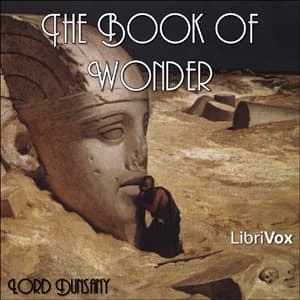
I was shelving returned books at the library — late shift, fluorescent lights buzzing overhead, the kind of quiet that makes you hyper-aware of every sound in your earbuds — when I started Book of Wonder. And for the first few minutes, the text itself did its job. Dunsany's opening preface is basically an incantation: "Come with me, ladies and gentlemen who are in any wise weary of London." That line alone should make a narrator lean in, drop their register, seduce you into another world.
Greg Elmensdorp reads it like he's reading a weather report for a particularly mild Tuesday.
Here's the thing — and I've said this on the podcast probably a hundred times — audiobook narrators are actors. Especially in fantasy. Especially in this kind of fantasy, where Dunsany is writing these compressed, jewel-box stories about thieves stealing idols from terrible gods, about cities at the edge of the world, about the disturbance in Dorozhand. The language is incantatory. It's meant to cast a spell. When the narrator doesn't commit to that — when the delivery is dry and the pacing doesn't linger on those rolling, comma-heavy sentences Dunsany loved — you lose the spell entirely. And without the spell, what are you left with? Pretty words read aloud.
I will say this: Elmensdorp clearly loves these stories. You can hear a kind of reverence in how carefully he enunciates. But reverence isn't performance. There's almost no character differentiation between the thieves and the gods, the dreamers and the merchants. Everyone sounds like the same well-meaning guy reading at a library event. (And I work at a library. I've been to those events. I know what that sounds like.)
Dunsany Deserves an Actor, Not a Reader
The stories themselves? Absolute bangers. At two and a half hours, this is a tight collection — fourteen tales, most clocking in under fifteen minutes. They're weird, ancient-feeling, and deeply strange in a way that modern fantasy has largely forgotten how to be. I keep chasing that specific flavor of strangeness in other audio — most recently in Narrow Road Between Desires, which gets closer than most to that ancient, myth-soaked weirdness, though it's working in a completely different register. "The Hoard of the Gibbelins" is this perfect little horror fable about greed and a very bad plan. "Chu-Bu and Sheemish" is darkly funny in a way that feels centuries old and completely timeless. Shirley Jackson walked so a lot of authors could run, sure, but Dunsany was sprinting before Jackson was born.
But here's my frustration: these stories are compact. They don't have room for slow character development or plot twists. They live and die by atmosphere. And atmosphere in audio is almost entirely the narrator's job. When Dunsany writes about the doomed expedition to steal from the Dorozhand, I want to hear dread in the narrator's voice. I want the pacing to slow when the city appears on the horizon. I want the silence between sentences to feel dangerous. Instead, I got a consistent, pleasant, slightly academic delivery that treats a tale of cosmic horror with the same energy as a tale of comic misunderstanding.
This is a LibriVox recording, which means it's free, which means my expectations need a calibration. Volunteer narrators are doing a service. I respect that deeply. But when the text is this good, the gap between what the prose demands and what the performance delivers becomes painful.
Who This Is For (and Who Should Wait)
If you've never read Dunsany and you want a free entry point? Fine, this works as an introduction. The stories are short enough that even a flat delivery can't completely kill them. If you're a Dunsany devotee who wants to hear these stories performed? You're going to be disappointed. You'll spend the whole time mentally recasting the narrator.
If you scare easily — well, this version probably won't scare you. But Dunsany's actual prose? Read "The Hoard of the Gibbelins" with the lights off and tell me that ending doesn't land like a punch. The text understands that horror isn't about gore — it's about dread. The narration just doesn't carry that understanding through.
My Podcast Listeners Are Going to Have Opinions
I'm going to talk about this on the show, but mostly to argue that Dunsany needs a proper audiobook treatment — a narrator who treats these stories like the dark fairy tales they are. Someone who can shift between Dunsany's wry humor and his cosmic terror without changing gears, because Dunsany never does. He just glides from funny to horrifying mid-sentence, and you need a performer who can match that.
This version is free. It exists. The stories inside it are foundational to everything I love about weird fiction and dark fantasy. But the performance sits at a level where I kept catching myself reading along on my phone instead of just listening, which kind of defeats the purpose.
Shirley (my cat) was unimpressed. For once, I agreed with her.