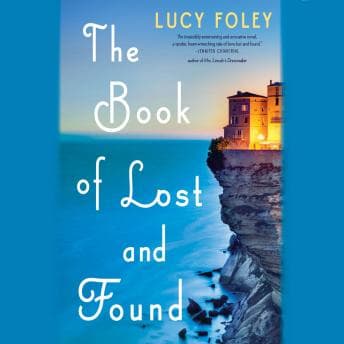

Everyone knows Lucy Foley as the queen of locked-room thrillers — The Guest List, The Paris Apartment, that whole vibe. So when I started Book of Lost and Found, her earlier historical fiction, I expected... honestly, I'm not sure what I expected. Something sharper-edged, maybe. What I got instead was a dual-timeline love story wrapped in a family mystery, and I found myself genuinely torn about how to feel about it.
I was making chana masala — the real kind, the kind that takes forever because you're toasting whole spices and your apartment smells incredible for three days afterward — and I had this playing through my kitchen speaker. And here's the thing: the first hour almost lost me. Kate Darling (yes, that's really her surname, and yes, Foley leans into it) discovers a mysterious portrait after her ballerina mother dies and her grandmother falls ill. The protagonist exhibits classic grief-avoidance behavior — throwing herself into a puzzle instead of sitting with loss. Psychologically? That tracks perfectly. The setup is sound.
But then chapters started doing this thing where they'd wander. Kate's present-day investigation alternates with 1920s voices — a love story born in Corsica, disrupted by war, tangled up in art and secrets. And some of those past-timeline chapters rambled with period detail that felt more like atmosphere-padding than character revelation. I caught myself stirring the chana and thinking, wait, what was the point of that section? When you're losing your listener between cumin and coriander, you've got a pacing problem.
The Psychology of Kate Darling (and Why She Almost Works)
I found myself asking: why does Kate really chase this mystery? The obvious answer is grief displacement — classic. But Foley does something interesting with Kate's identity formation. Kate has built her entire sense of self around her mother's fame, her mother's beauty, her mother's mystery. The portrait isn't just a clue; it's a mirror. Kate is looking for herself in the faces of dead women.
This is a fascinating case study in intergenerational identity — the way daughters of extraordinary mothers sometimes can't locate their own edges. The research actually shows that children of celebrities or public figures often struggle with individuation, and Foley seems to intuit this even if she doesn't name it. Kahneman gets at something adjacent in Thinking, Fast and Slow — the way our intuitive System 1 thinking shapes identity narratives we never consciously chose, which is exactly the trap Kate is stuck in. Kate's journey across London, Corsica, and Paris isn't really geographic. It's psychological. She's trying to figure out where her mother ends and she begins.
Where it falters — and psychologically, this doesn't quite track — is the romance that sparks for Kate in the present day. It arrives with a convenience that feels more like genre obligation than organic character development. The 1920s love story carries genuine emotional weight; you feel the desperation, the war hanging over everything, the impossibility of it. Kate's modern romance, by comparison, felt like someone checking a box. My therapist would have thoughts about a woman immediately falling for someone while actively unraveling a decades-old family trauma. Just saying.
Fiona Hardingham Earns Her Keep
Here's where the audiobook format genuinely elevates the material. Fiona Hardingham — AudioFile Earphones Award winner, for the record — does something crucial with this dual-timeline structure: she makes you feel the century between the two stories. Her voice shifts register between Kate's modern, slightly searching tone and the period voices in a way that anchors you temporally without being showy about it. The emotional beats in the final stretch hit harder in audio than I suspect they would on the page. Several listeners apparently wept at the ending, and while I didn't cry (I save that for particularly devastating case studies and the end of Devdas), I understood why.
The narration carried me through passages where the writing meandered. That's not nothing. At 11 and a half hours, this book asks for a real commitment, and Hardingham's careful pacing kept me present during stretches that might've lost me in print.
Who This Is For (and Who Should Keep Walking)
If you loved Foley's thrillers and want the same adrenaline — skip this one. Different animal entirely. But if you're drawn to generational family secrets, dual timelines where the past is more vivid than the present, and you don't mind a slow burn that occasionally burns a little too slow — this will work for you. Fans of Kate Morton will feel right at home.
If you need airtight character motivations and can't tolerate a convenient romance subplot, you'll be mildly annoyed in the same places I was. But the core mystery — the portrait, the identity, the question of who we become when we stop performing our parents' stories — that part lingered with me. I was still thinking about it the next morning on my jog through Cambridge, which is my personal benchmark for whether a book actually got under my skin.
Not Foley's best. But not a waste of time either. Just know what you're walking into: a slow, romantic, occasionally frustrating puzzle box with a narrator good enough to hold the whole thing together when the seams show.