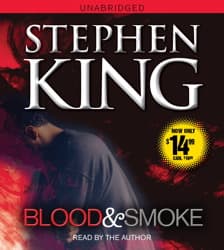

I was grading a stack of junior essays on "The Cask of Amontillado" at 11:30 PM — the kind of grading session where you start questioning every career decision you've ever made — when I put on Blood and Smoke. Stephen King reading his own horror stories seemed like the right energy for a night where I was already losing my mind. And for the most part? It was. But let me be honest with you about the whole experience.
The Author Behind the Mic Is Not the Author on the Page
Here's the thing about authors reading their own work: you're getting the definitive interpretation. When King reads the scene in "1408" where the hotel manager Olin tries desperately to talk Mike Enslin out of staying in that room — practically begging him, laying out the death toll like a man confessing sins — you hear exactly how King heard it in his head. That conversation is the best stretch in this entire collection. King gives Olin this weary, almost paternal urgency, and Enslin this arrogant dismissiveness that makes you want to shake him. The prose deserves to be savored, and King savors it right there.
But then there are long stretches where King reads like a man sitting in a comfortable chair telling you a story at his own pace, with very little variation in pitch or intensity. "In the Deathroom" — a story about a journalist being interrogated in a South American torture chamber — should have my pulse up. It didn't always get there. King's delivery flattens some of the tension that lives on the page. He's not a bad narrator, but he's not a performer. There's a difference, and twenty years of listening to audiobooks has taught me to hear it.
Compare this to, say, Frank Muller reading King's work. Muller was a narrator who could make you forget you were listening to someone read. I ran into a similar awareness problem with Affair at the Victory Ball, where the narrator's choices kept pulling me out of the story at exactly the wrong moments. King makes you very aware that a writer is reading to you. Whether that's a feature or a bug depends on what you want from the experience.
That Saxophone, Though
Let's talk about the production choices, because they're impossible to ignore. Blood and Smoke is an audio original — it was designed specifically for this format, not adapted from a print collection. So they layered in music and sound effects, including a saxophone that weaves through the stories like an uninvited guest at a dinner party who won't stop playing jazz.
Sometimes it works. It creates this smoky, noir atmosphere that fits the collection's obsession with cigarettes, addiction, and self-destruction. "Lunch at the Gotham Café" — where a recently separated man meets his estranged wife at a restaurant and things go violently, spectacularly wrong — benefits from the atmospheric tension the production builds.
But other times the sax is just too loud. I caught myself rewinding because the music was competing with King's already understated delivery. At four hours total, this isn't a huge time commitment, but I shouldn't be straining to hear the narrator over his own production team. It's the audio equivalent of a student turning in an essay with decorative fonts — the presentation is fighting the content.
Three Stories, One Smoking Break
The thematic thread here is addiction — specifically smoking, but really the broader human habit of doing things we know are killing us. "1408" is the standout, and it's not close. King's version of the haunted hotel room isn't about ghosts or monsters. It's about a room that simply doesn't want you in it, and the way it dismantles your sanity one small impossibility at a time. My students would hate this. I love it. The horror is patient and psychological, not jump-scare cheap.
"Lunch at the Gotham Café" is the wildest of the three — a maître d' named Guy who snaps in a way I won't spoil, but let's just say it involves a steak knife and the word "eeeeee" repeated in a way that's genuinely unnerving even in King's flat delivery. "In the Deathroom" is the thinnest, a pulp thriller that reads like King wrote it in an afternoon. (He might have. The man is prolific enough.)
At four hours, this is a quick listen. A long walk along the lakefront covers most of it. But I'd recommend focused attention — the layered audio and King's quiet delivery both punish distracted listening.
Who Gets an A, Who Gets Sent to the Principal
If you're a King completist who wants to hear the man himself interpret his own stories, this is a treat. Flawed, occasionally frustrating, but a treat. If you've seen the 1408 movie with John Cusack and want the source material, the short story is sharper and stranger than what Hollywood made of it.
But if you need dynamic narration to stay engaged, or if you're sensitive to production audio competing with the narrator, this will test your patience. And — genuinely — if you recently quit smoking, maybe skip this one. King writes about cigarettes the way Hemingway wrote about drinking: with a specificity that makes the thing sound irresistible.
Worth Pausing the Faculty Meeting For — But Barely
Blood and Smoke is a fascinating artifact: an author-narrated audio original from a master of the genre, hampered by uneven production and a narrator who's better at writing terror than performing it. The stories themselves — especially "1408" — are vintage King. The listening experience is a B-minus. I've had students argue their way from a B-minus to a B. King almost gets there too.